Support WBUR
The Weekender: Boston's Saturday Morning Newsletter
5 turkey facts to pass around the table this Thanksgiving
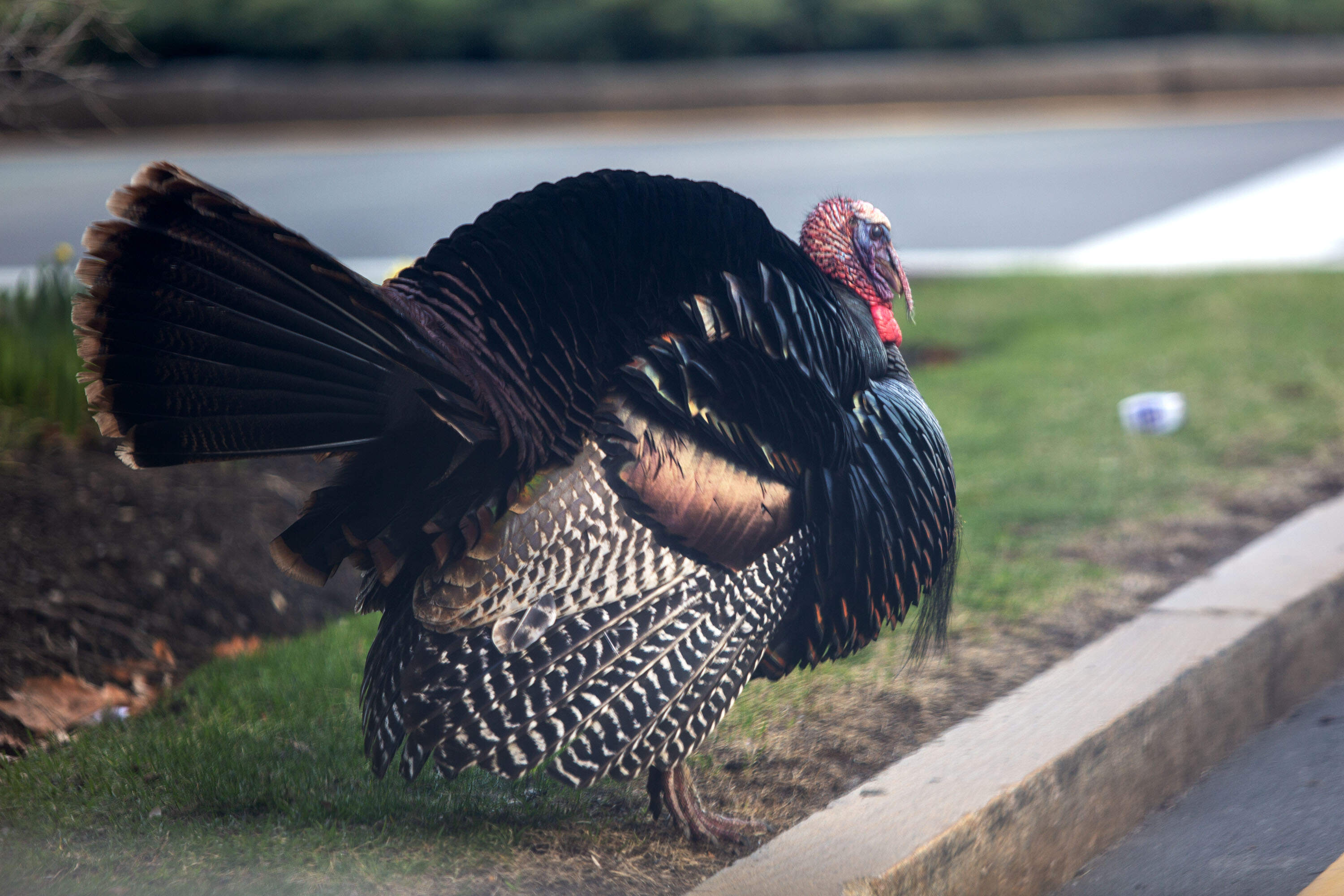
Editor's Note: This is an excerpt from WBUR's Saturday morning newsletter, The Weekender. If you like what you read and want it in your inbox, sign up here.
Had you asked me what I knew about turkeys last week, I would have only been able to share what little I’ve gleaned through observation: The birds are a central part of Thanksgiving dinner for many. They rule the streets of Brookline. And, of course, they gobble.
That was before I spoke with Tia Pinney.
Pinney has worked for Mass Audubon for over 25 years — and has a wealth of knowledge about our local birds, including turkeys. Turkeys have a colorful history in Massachusetts, and according to Pinney, their (abundant) presence in the commonwealth today isn’t by accident.
Here are five tidbits about turkeys to pass around the table this Thanksgiving:
1. Turkeys were nearly wiped out in Massachusetts
Wild turkeys are native to our state. But when European colonists arrived, they began clearing out the woods the turkeys inhabited to build cities and towns. “With that, and the fact that turkeys were such a good food source, there were no native turkeys left in the commonwealth by 1851,” Pinney told me.
The state made nine unsuccessful attempts at reintroducing the birds in the region between 1911 and 1967. Then in the 1970s, 37 wild turkeys were placed by MassWildlife in the Berkshires. “Their population absolutely exploded,” said Pinney. “Now they’re everywhere. There’s like 30,000 in Massachusetts!” (Fact check: true!)
2. Turkeys do communicate
Turkeys aren’t the loudest birds, but they do communicate with one another. What about, you ask?
“They communicate with each other to establish hierarchy,” said Pinney. The birds are not territorial, but hierarchical, meaning they’ve got a literal “pecking order,” just like chickens, Pinney said. In other words, each bird is dominant over — or “pecks on” — birds of lesser social status. (This is also the part of the reason turkeys sometimes try to attack humans and cars, according to MassWildlife.)
“If you’ve got a flock of 15 turkeys, they know who’s who,” said Pinney. “And it’s important for number one to maintain number one status.”
3. Turkeys can identify their relatives
For male turkeys, maintaining that “number one” status also means eliminating any other males in your flock, who could end up being romantic competition. But there are some exceptions.
“Tom turkeys will only tolerate other toms — or jakes, which are young male turkeys — in their flock if they are genetically related,” said Pinney. “They will tolerate their brothers, cousins, uncles and grandfathers, but no one else.”
This fact still mystifies Pinney. “Our gene pool for our turkeys are pretty small,” she said. “How do they know that this individual is genetically related to them? How do they know that?”
4. Turkeys vibe with urban and suburban living
By 1978, the original 37 wild turkeys MassWildlife placed in the Berkshires had spawned a flock of over 1,000 birds. Volunteers and biologists then began trapping and releasing the birds in different counties. As the populations spread further across the state, it became apparent that turkeys tend to prefer the city life.
“Turkeys are now becoming human-habituated in a way that MassWildlife would have never predicted,” said Pinney. “We’ve created a habitat that’s perfect for turkeys. There are insects, acorns, and plenty of things to eat here. There’s some areas with [tree] cover and brush. And in the eastern part of the state, there is no room to hunt them,” said Pinney. (Sound familiar?)
To curb the number of turkeys near your home, clear out your bird feeder and refrain from feeding turkeys in the area.
5. To avoid turkey attacks, 'be the bigger turkey'
With so many turkeys in the Boston area, you can expect to run into one (or a flock!) at some point. But if they seem aggressive, don’t fret — Pinney has a few tips to de-escalate the situation.
The turkey attacking you is usually a tom. “He needs to establish that he’s the number one turkey,” said Pinney. “So he’s not attacking you in particular; he’s just attacking a bigger turkey. Turkeys are not antagonistic towards humans. They just want to establish their place.”
Why does that matter? Well, it means you should “never, ever” let the turkey intimidate you, Pinney said.
“You need to be in charge. Never turn around and run away. Be big, be loud, and maintain that status. Carry a broom and wave it around if you have to. Be the bigger turkey.”
P.S.— Let’s be real. Sometimes Thanksgiving conversations go beyond just turkey talk. That’s why NPR has compiled a few tips for navigating the heavier discussions that may arise at the holidays.