Support WBUR
Review
A collection of illustrator Edward Gorey's works shared in new book
From his infamous “The Gashlycrumb Tinies” to the much-admired animated introduction to GBH’s long-running “Mystery!” anthology series, Edward “Ted” Gorey’s intricately detailed, ersatz-Victorian illustrations have for more than a half-century captivated audiences with their eccentric aesthetics and macabre sense of humor. This February marks the centennial of the famed illustrator's birth, and to celebrate the occasion New York Review Books is issuing a unique collection of Gorey’s private works that’s sure to be of interest to his many ardent fans.
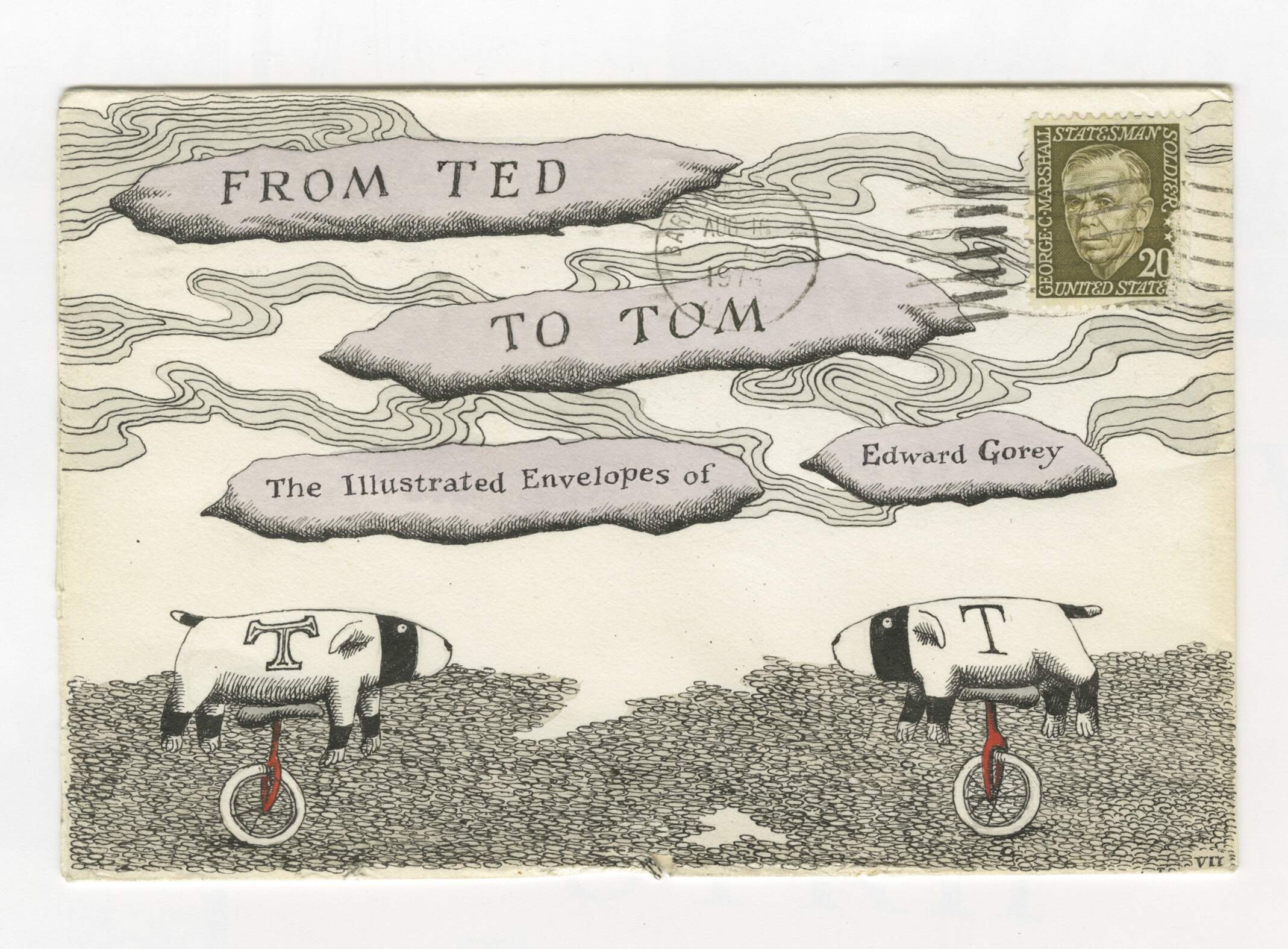
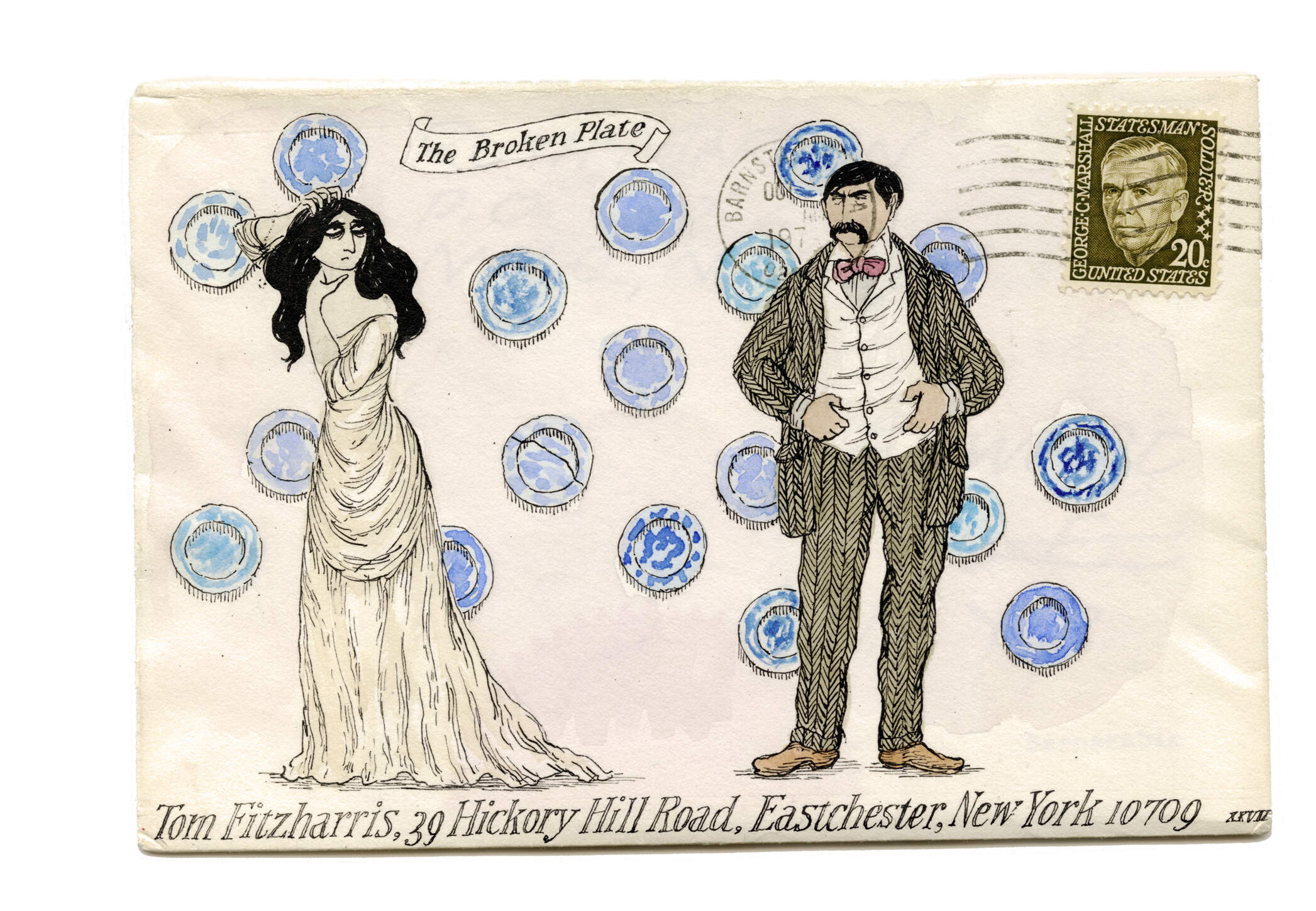
“From Ted to Tom: The Illustrated Envelopes of Edward Gorey” brings together 50 illustrations that Gorey sent to his friend, Tom Fitzharris, at the height of their friendship in 1974 and 1975. Not content to simply drop his typewritten letters in the post, Gorey took the time to meticulously adorn each envelope with a one-of-a-kind artwork. It’s a testament to the rapport that existed between the two men, who met by chance one day in midtown Manhattan, bonding over work of 19th-century French humorist Alphonse Allais.
“The subjects drawn on them came from all corners of our friendship,” writes Fitzharris. “Details from our conversations, trips we’d taken together, things Ted had seen in junk shops, and often from somewhere within his impossibly wide imagination.”
Fitzharris has also included excerpts from some of the letters, providing a window into Gorey’s summers spent on Cape Cod (to which he ultimately moved permanently) as well as his professional and intellectual pursuits during this period. Though Fitzharris does not provide his side of the correspondence, he has helpfully written a key to the references and inside jokes strewn throughout Gorey’s letters, included as an appendix.
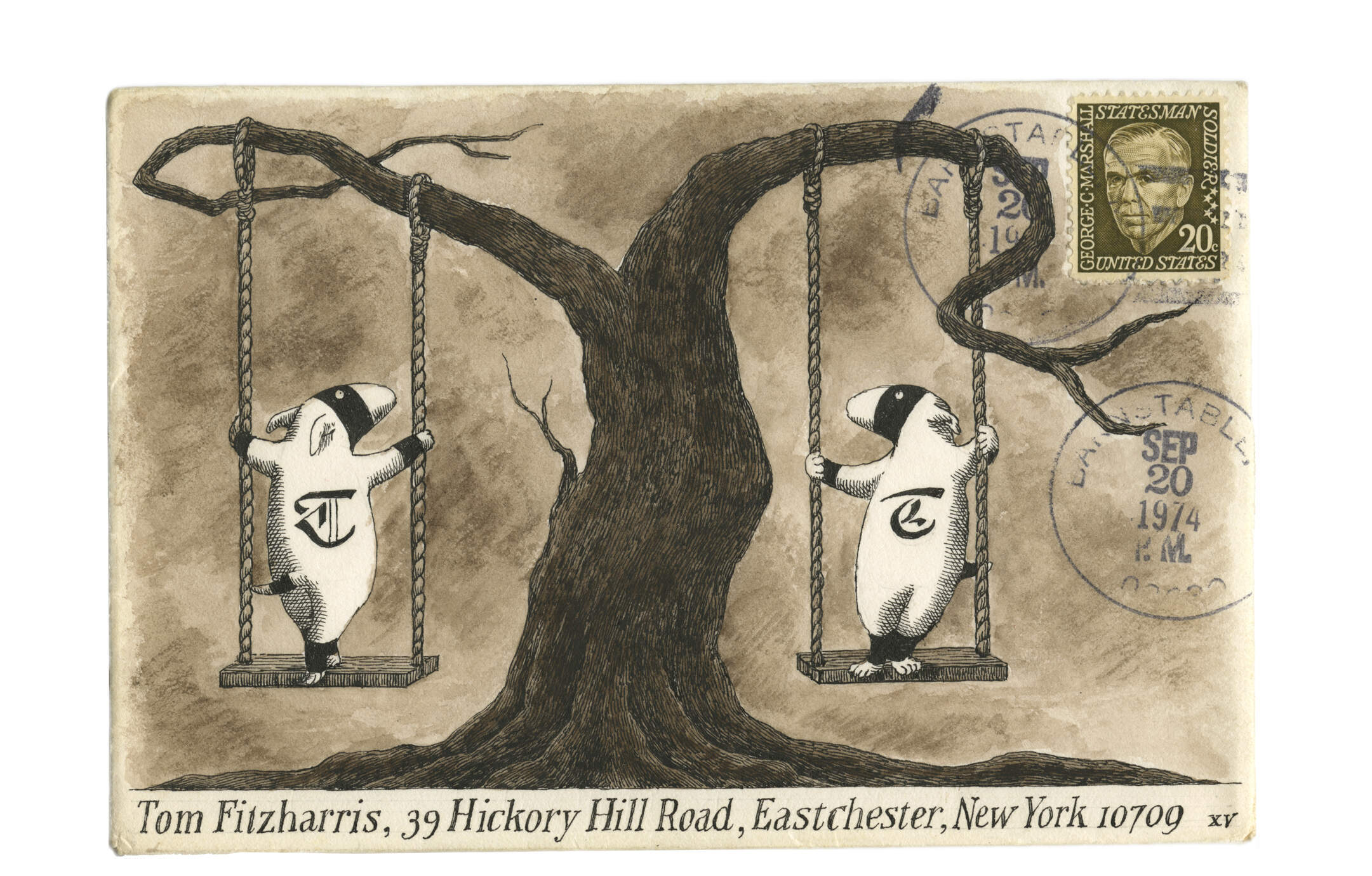
The drawings begin simply enough with an envelope dated July 8, 1974. It depicts a chubby little dog bearing an ornately decorated “T” on its side, gazing at Tom Fitzharris’ address — which Gorey has etched out in his unique script — from a windowsill. The dog is soon joined by a similar-looking compatriot on the next envelope, distinguished only by the lettering of its own “T.” By the fourth envelope, the first that Gorey numbers, it’s clear the artist is committed to making this a series. From there, Gorey lets his imagination run wild. Tom’s address is borne by increasingly elaborate banners and ribbons; the dogs ride unicycles, wrestle with exotic-looking flowers, and share cocktails or eat ice cream amid a deep blue dusk. On envelope 15, they ride swings that hang from a tree that looks more suited for serving as a gallows.
One can see the amount of thought and effort Gorey is pouring into these miniature masterpieces expanding as time goes on. Looking at the elaborately designed envelopes, you have to wonder what the humble clerk at the Barnstable post office must’ve thought when processing them, forced by law to spoil them with a postmark. (“As to the postmarks, look at it this way,” Gorey wrote to Fitzharris, “they add a Proustian dimension of time.”) On occasion, the project seemed to weigh on Gorey. “I still haven’t done the envelope,” he typed on Aug. 26, 1974. “Time is passing. None of us is/are getting any younger. What does it all mean? We are temporarily out of Oreos. Oh God.”
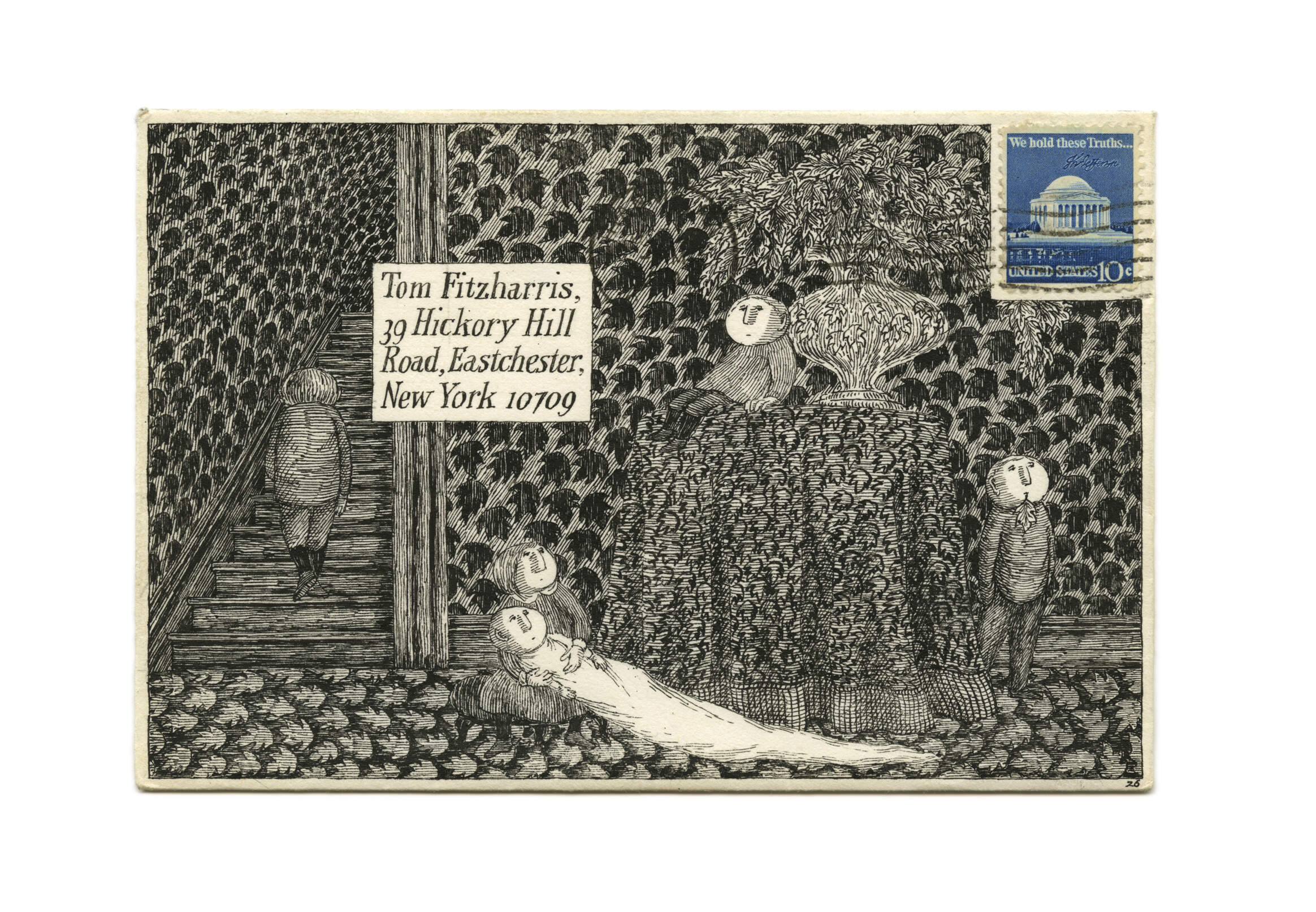
Past the halfway point, the scope broadens and more traditionally Gorey figures begin to appear — characters from his works in progress, picture book “Les Passementeries Horribles” and “The Worsted Monster,” a cut-out “toy theater” that appeared in a 1975 issue of The National Lampoon. A little more context for these might have been nice — perhaps instead of including the photos of the blank backsides of a few of the envelopes.
Gorey was renowned for his erudition. A voracious reader, cinephile, and lover of culture both high and low, his letters to Fitzharris are peppered with droll recommendations (“Johann Christian Bach’s Six Symphonies for Wind are to die”) and intriguing epigraphs, which he hand-lettered on note cards included with his typewritten messages. These pearls of wisdom from Gauguin, John Cage and Rumi, to name a few, help us understand Gorey’s point of view a little bit better. “Life’s all right,” says one card, taken from Edmund Wilson’s “The Twenties” — “if you can stand it.” One could do worse than to spend their time tracking down the works of the artists, writers and musicians he name-checks throughout his letters to Tom.
As many of Gorey’s letters were sent from his summer home in Yarmouth (now a Gorey museum open between April and December), they often feature charming bits of local color that provide an insight into quotidian quirks of the artist’s life. It’s fun to imagine Gorey enjoying “supper at the Friendly’s in Hyannis” or antiquing in Sandwich. Of a trip to Provincetown, he notes grimly that the town “was packed with lots of unattractive people, and the marine surplus store, which is usually filled with all sorts of amusing things to buy, was this time definitely not.”
It’s amusing to read these letters with contemporary complaints that texting and social media have supplanted a once-rich culture of in-depth letter writing. Gorey was firing off short, unstructured missives to Fitzharris almost daily, often about the same kind of minutiae you might see on X or Instagram. “The cats are behaving abominably to each other,” he once typed, without further elaboration.
In time, Gorey and Fitzharris fell out of touch. One day, after a long period of silence, Tom received an unsigned letter, declaring that “one can’t predict when things will end, or how they’ll run their course.” It was obviously from Gorey, though a far cry from the laboriously personalized missives of ‘74 and ‘75. It’s a bittersweet denouement to this once-intense friendship. But Fitzharris looks back at his time with Gorey warmly, noting that despite his gloomy artistic oeuvre and grim public persona, Gorey was a warm, playful companion and a delight to be around.
“When I think back on that time with Ted,” Fitzharris writes wistfully, “I remember him laughing.”