Support WBUR
A key Atlantic Ocean current might be more stable than we thought, new study finds
A system of Atlantic Ocean currents crucial for regulating the world's weather and ecosystems might be more resilient against climate change than previously thought, a new study found.
Researchers concluded that the current hasn't slowed down in the past 60 years, which might mean there's time to address climate change before they weaken or collapse.
" If we continue to perturb our climate system, like we have in the past, it's most likely that (the currents) will decline," said Nick Foukal, a researcher at University of Georgia's Skidaway Institute of Oceanography and co-author on the study. " This gives us some hope that there is some time to act before that happens."
Scientists from Woods Hole Oceanographic Institution took part in the study, which was published in Nature Communications last month.
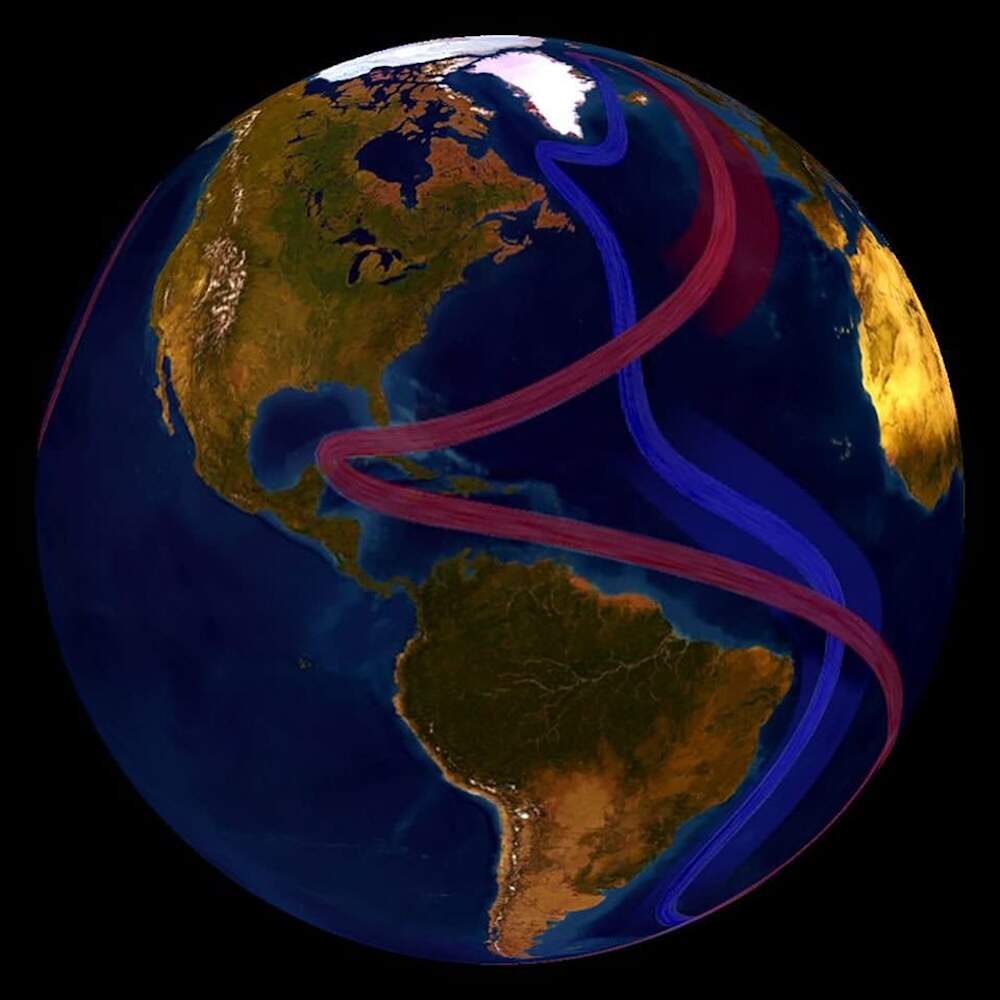
The massive current system, known as the "Atlantic meridional overturning circulation," balances the world's climate. Like a conveyer belt, the current transports heat, moisture and nutrients around the world. It affects everything from the amount of rainfall on the African continent, temperatures in Northern Europe and marine life throughout the Atlantic.
Climate change might weaken the system, but there's debate in the scientific community about when that will occur and whether it's already started. In October, more than 40 scientists worldwide signed a letter to international leaders warning them that the current is on the "brink of collapse." A 2018 study suggested that the current has been slowing for the last century.
" I think the uncertainties are large and they remain large," said Jens Terhaar, a researcher at the University of Bern and co-author on the study.
Part of that uncertainty has to do with the variables scientists use to gauge the stability of the currents.
" It's just a highly complex system. And to simulate such a complex system with models that are not extremely, highly resolved, it just always makes it difficult," Terhaar said.
Some studies rely on records of sea surface temperatures, which go back to the late 19th century and are still recorded annually.
But this study's team and other researchers have argued that sea surface temperatures aren't the best tool. Records come from just one area of a massive system, annual data doesn't reflect long-term trends, and surface temperatures can be sensitive to storms or hurricanes, Foukal said.
In the new study, the authors measured the transfer of heat from the ocean to the atmosphere, which they said could become a new "fingerprint" for the current's stability. They used climate models and direct observational data to reconstruct the current for the past 60 years, finding that it didn't decline in this time period.
The study has drawn some skepticism. Heat transfer isn't as direct of a measurement as sea surface temperatures, said Peter Ditlevsen, a researcher at University of Copenhagen's Niels Bohr Institute who was not involved with the new study.
A 2023 paper he co-authored suggested that we can expect to see more fluctuations in the current's activity, which could be a tipping point for collapse in the future.
Ditlevsen questioned the new study's time scale, since direct data on sea surface temperatures dates back over 150 years and this study only looks at 60 years.
Still, the idea of using heat transfer is "insightful" and perhaps a combination of all these fingerprints will lead to less uncertainty in future studies, Ditlevsen said.
But what's certain among researchers is that the stakes are higher than ever to slow climate change.
If this oceanic conveyer belt weakens, there will be less heat moving throughout the Atlantic. That can lead to drought in some areas, flooding in others, disrupt marine ecosystems, and even degrade ocean's ability to store carbon.
" It's really, really uncertain, but it's definitely not going to be a small decline and consequences will be grave and extreme and around the North Atlantic," Terhaar said.