Support WBUR
Judge extends temporary block to huge cuts in National Institutes of Health medical research funding
A federal judge in Boston on Friday continued, for now, the pause on a Trump administration policy to slash billions of dollars in funding from the National Institutes of Health. Scientists and public officials fear the planned cuts would devastate critical scientific research.
Twenty-two states, led by Massachusetts, along with groups representing academic research centers, are suing to stop the funding reductions. U.S. District Court Judge Angel Kelley extended her temporary restraining order, and said she would “quickly” decide whether to grant a more lasting freeze while the lawsuits progress.
The legal dispute centers on a Feb. 7 memo from the National Institutes of Health that seeks a 15% cap on what are known as the “indirect” costs of research. These can include expenses such as computers and equipment, lab maintenance and other administrative costs.
Trump administration officials say the policy would bring NIH funding in line with private grants and allow the federal government to more carefully steward taxpayer dollars.
The guidance came as a shock; NIH is the biggest funder of scientific research in the United States, with an annual budget near $48 billion. More than 300,000 researchers rely on the agency to back projects aimed at developing treatments and cures for cancer, heart disease, Alzheimer’s and numerous other diseases.
"Pretty much every scientist in the country is terrified at the moment."
Gina Turrigiano, a neuroscience professor at Brandeis University
At a court hearing Friday, attorneys suing the administration argued the sudden change in funding skirted federal law and was made without considering the consequences for public health. They said the administration gave no rationale for suddenly slashing spending.
An attorney for the Trump administration argued the executive branch has broad power to restructure NIH funding, and that changing the formula would not cause irreparable harm.
But many disagree. Heather Pierce, senior director for science policy at the Association of American Medical Colleges — one of the groups suing the administration — said the $4 billion in proposed NIH cuts would force essential projects to come to a halt.
“The impact to cutting federal funding for research is felt immediately by not just researchers — but by patients, by families, by anyone who's waiting for medical progress. That's all of us,” she told reporters after attending the court hearing.
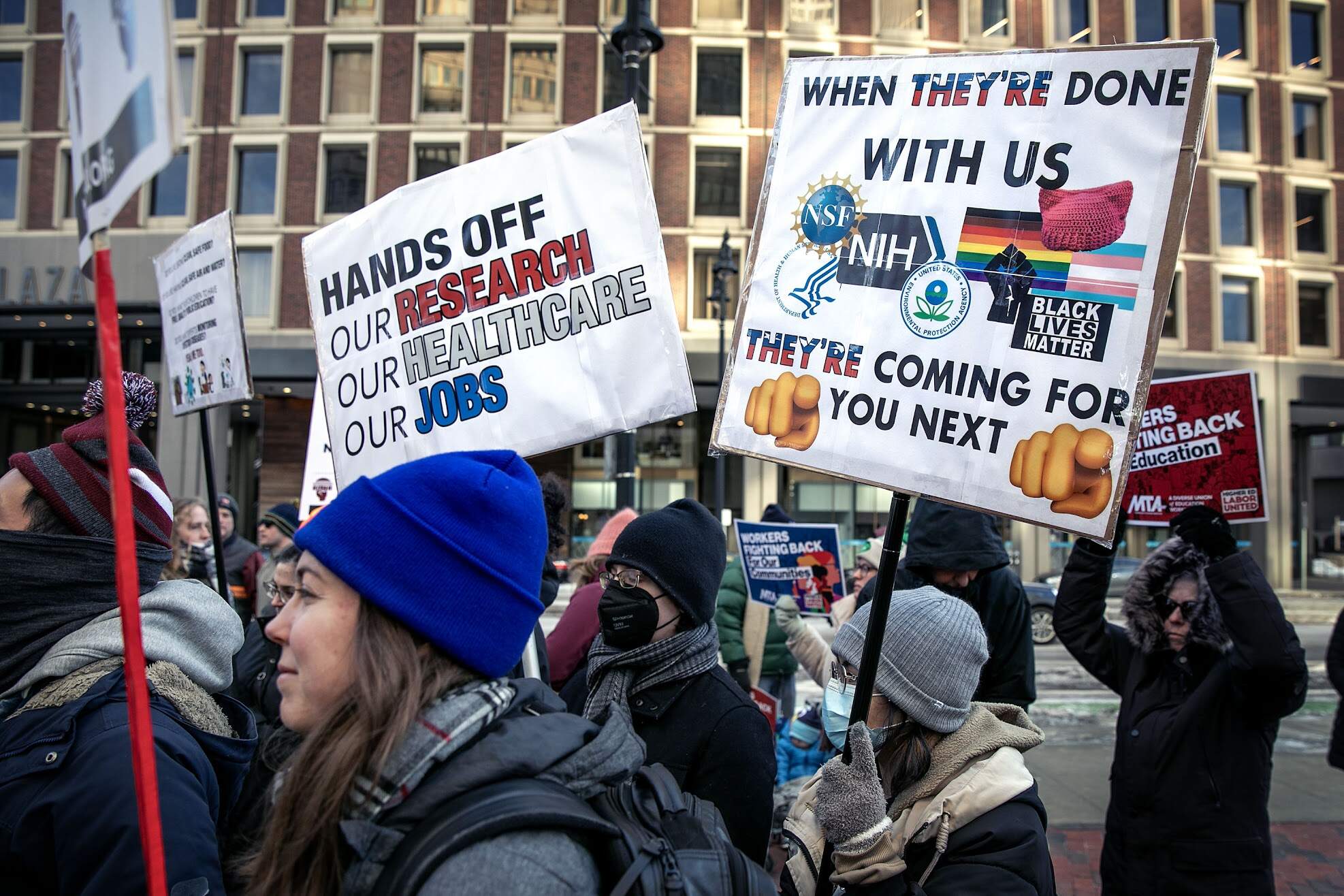
Gina Turrigiano, a neuroscience professor at Brandeis University, said she’s relieved by the court’s temporary ruling but fearful of what comes next. Turrigiano relies on NIH funding for her research into autism spectrum disorders.
“ Pretty much every scientist in the country is terrified at the moment,” she said. “We're looking at an abyss. Every little win like this, we're breathing a sigh of relief, we are living to fight another day — but it's terrifying.”
The Trump administration’s funding cut targets expenses that are not specific to one project but shared across different projects, such as building maintenance and electricity.
Indirect costs often represent half or more of what NIH pays. The Trump administration wants to cap these costs, immediately.
“A lot of people think of overhead and think about a bunch of secretaries that push pencils, and that's not at all what it pays for,” said Takashi Kozai, associate professor of bioengineering at the University of Pittsburgh. “It pays for the electricity. It pays for the HVAC system. It pays for clean rooms and chemical waste hazard disposal, so that it doesn't end up in people's drinking water.
“These are not cheap things,” Kozai said.
This week, a group of more than 40 mayors, including Boston Mayor Michelle Wu, from red and blue states across the country filed a court brief in support of the lawsuits that seek to stop the budget cuts.
This article was originally published on February 21, 2025.