Support WBUR
Boston's largest police union endorses Mayor Wu, a former police critic
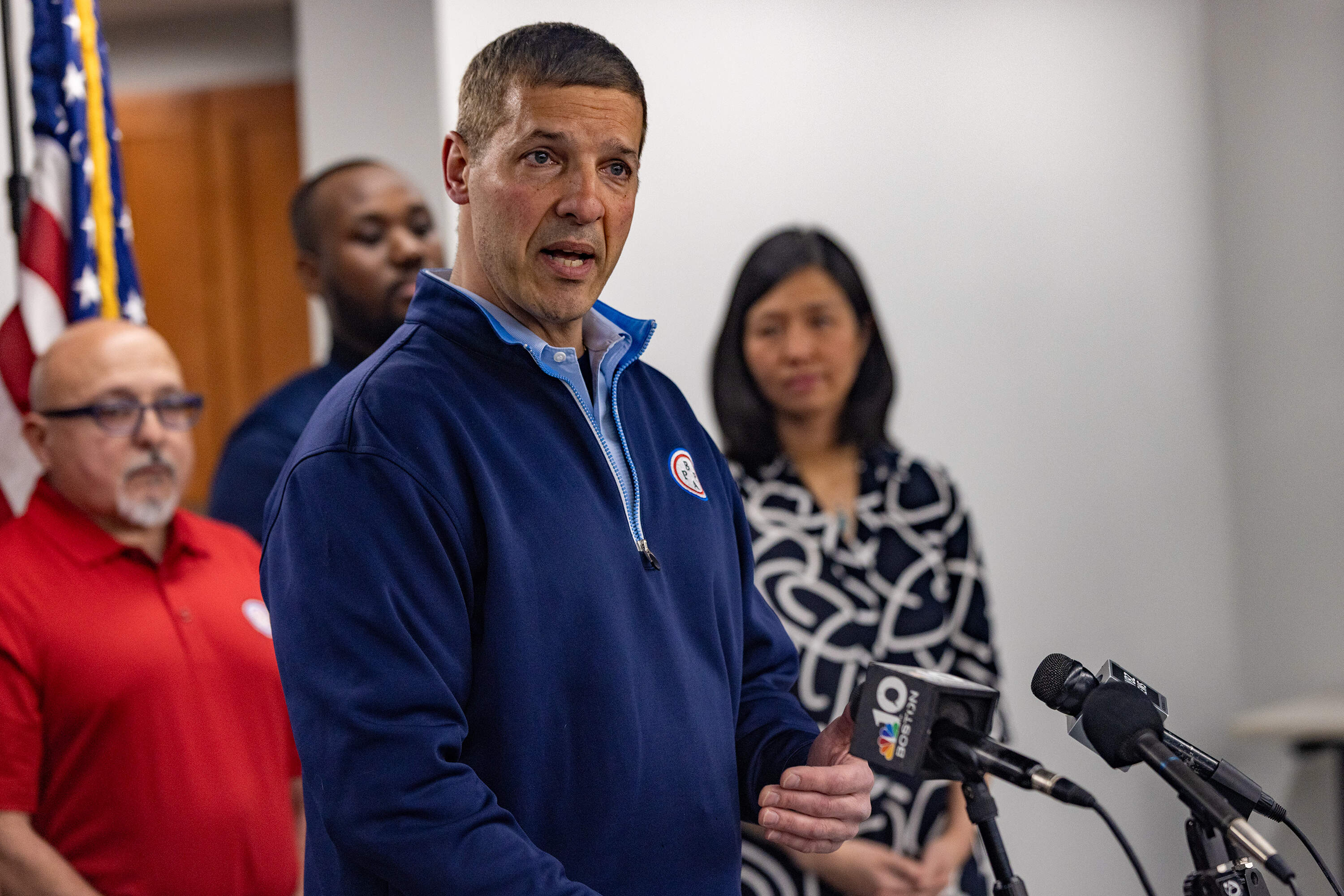
Boston Mayor Michelle Wu walked into the second-floor function hall of the Boston police union's Dorchester headquarters Thursday to a hero's welcome.
She shook hands with the police officers and EMTs assembled, and then hugged the Boston Police Patrolmen's Association's president, Larry Calderone.
" It is such an honor to be here," she said as she received the union's formal endorsement for re-election. "To look each one of you in the eye, and from the bottom of my heart, to say thank you."
"We are the safest major city in America because of your efforts," she said.
Wu is starting to ramp up her first mayoral re-election campaign, and the endorsement is the union's first of an incumbent in three decades. It marks a striking political transformation for a candidate who once called for slashing the department's budget and abolishing its intelligence center.
Now, Wu "is a friend of law enforcement," Calderone said Thursday. "I can't say enough wonderful things about the mayor next to me."
Calderone pointed to the newly minted $82.3 million police contract, which includes 9% salary raises over five years, retention bonuses, and new educational incentives.
The contract also included what Wu identified as priorities, like reforms to the disciplinary system and opening some traffic safety assignments to civilians.
" We were able to deliver what I believe is the best contract in the history of our great organization," Calderone said. " And at the end of the day, in the last waning weeks before I was able to bring this agreement back to our membership, it was because the mayor and I were in a room, hammering it out with one another."
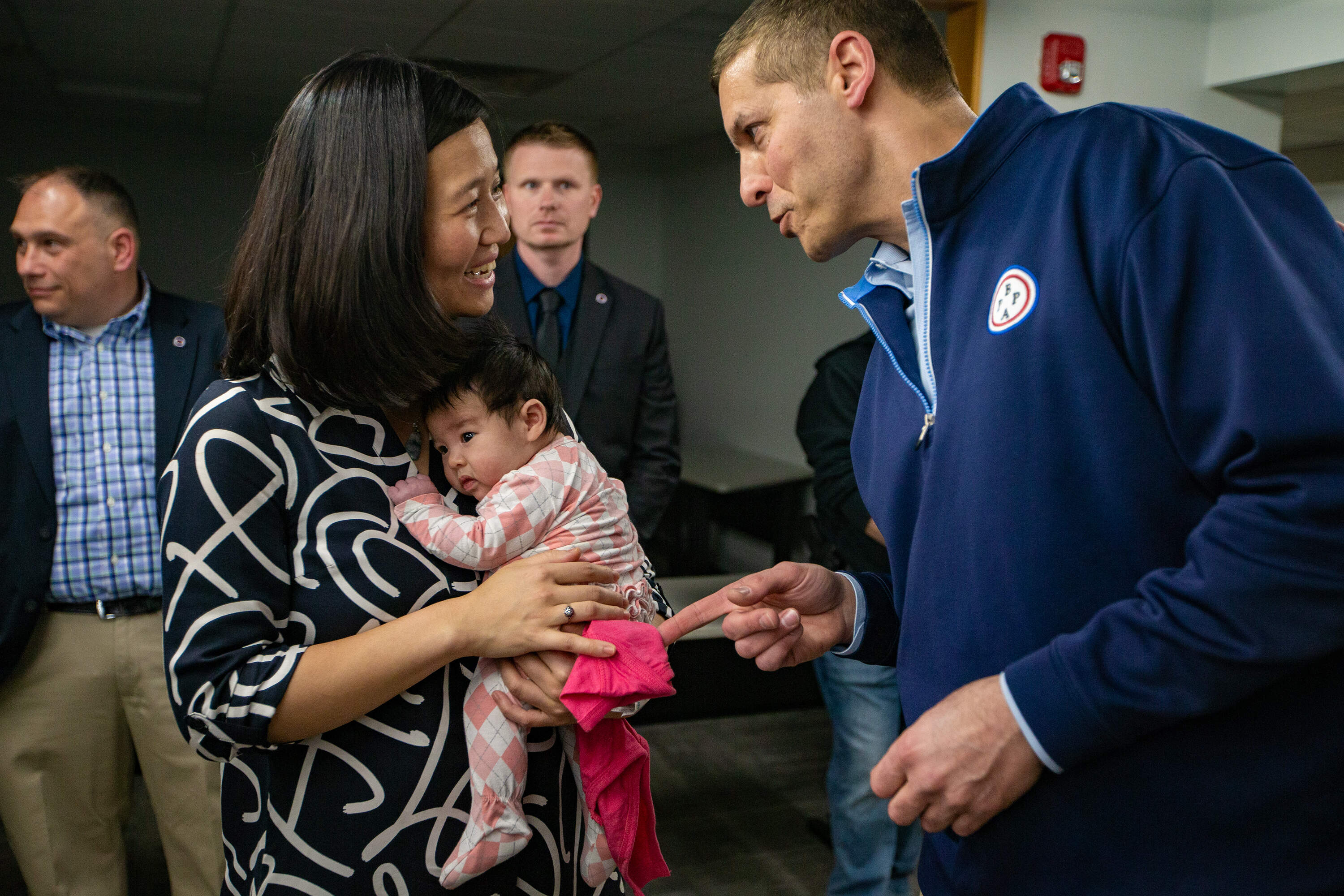
The endorsement from the city's largest police union surprised many political observers in Boston. But Wu's shift away from some of her more hardline progressive stances on policing began before the ratification of the new contract.
In 2023, for example, Wu sparred with the City Council over federal grants for the Boston Regional Intelligence Center, the police department's intelligence-gathering arm. The center has been known to surveil activists, and runs a gang database a federal court once called "erratic" and built on "unsubstantiated inferences."
Despite her pledge to abolish the intelligence center and dismantle the gang database while campaigning, as mayor, she muscled $3.4 million in grants through the council after members had first rejected them.
The intelligence center and Boston Police Department "operate in a significantly different environment today," Wu wrote in a letter to the council at the time, pointing to new leadership and a suite of council-approved reforms.
As a councilor, Wu had called for a 10% cut of the police department's budget. But as mayor she vetoed budget cuts to the department.
"I think it's just really concerning to see someone do a 180 on a number of policing issues," said Fatema Ahmad, executive director of the Muslim Justice League, a Boston-based civil liberties group.
"Many community members have been disappointed that she didn't follow through on the policies that she was advocating for as a city councilor and advocating for during her campaign," she said.
Wu's Democratic opponent in the upcoming mayor's race, philanthropist Josh Kraft, also criticized Wu for accepting the police union endorsement.
"This marks a strange turn of events for Mayor Wu, who just three short years ago bragged about her refusal to accept donations from police officers and police unions," his campaign said in a statement. "Over his 35 years of community work, Josh has always partnered with and supported law enforcement."
A spokesperson for Wu's campaign said the mayor is "proud" to have worked with police officers and leadership "to deliver unprecedented reforms through the police union contract and to strengthen community policing."
The campaign said Wu would not reject donations from police unions and officers this year.
Kraft is attempting to coalesce constituencies upset with Wu's leadership, like residents opposed to bike and bus lanes, real estate developers, and factions of the Irish Catholic and Italian "old Boston" political establishment.
"The patrolmen's endorsement is going to cut into that," said Jerold Duquette, a political science professor at Central Connecticut State University who studies New England politics. "That's what makes it such a great endorsement."
Duquette said the endorsement shows that local politics are still predominantly transactional, rather than ideological: the union was happy with the collective bargaining process and its resulting contract, so wants to work with the mayor again.
Wu "has created that partnership sufficiently well that they're actually doing something extraordinary to assist her political career," Duquette said.
The police endorsement comes at an opportune time for the mayor, who has been called to testify in Washington this Wednesday over what Republican legislators call the city's "sanctuary" policies.
Earlier this month, President Trump's border czar, Tom Homan, lashed out at Boston Police Commissioner Michael Cox, and threatened to bring "hell" to the city. Homan and House Republicans are looking for more cooperation from local law enforcement to detain immigrants without legal status.
Calderone, the union's president, acknowledged his previously adversarial relationship with Wu while speaking to reporters after the endorsement announcement.
"What has changed? The mayor has become the mayor," he said.
"She knows you can't defund the police department. No one wants to live in a lawless society. Everybody wants civility, and she's delivering that," he said. "And we're backing her up on that promise."
This segment aired on March 3, 2025.