Support WBUR
Gloucester gallery opens to cement Jon Sarkin's artistic legacy
“You're going to get a WBUR exclusive back room tour here.”
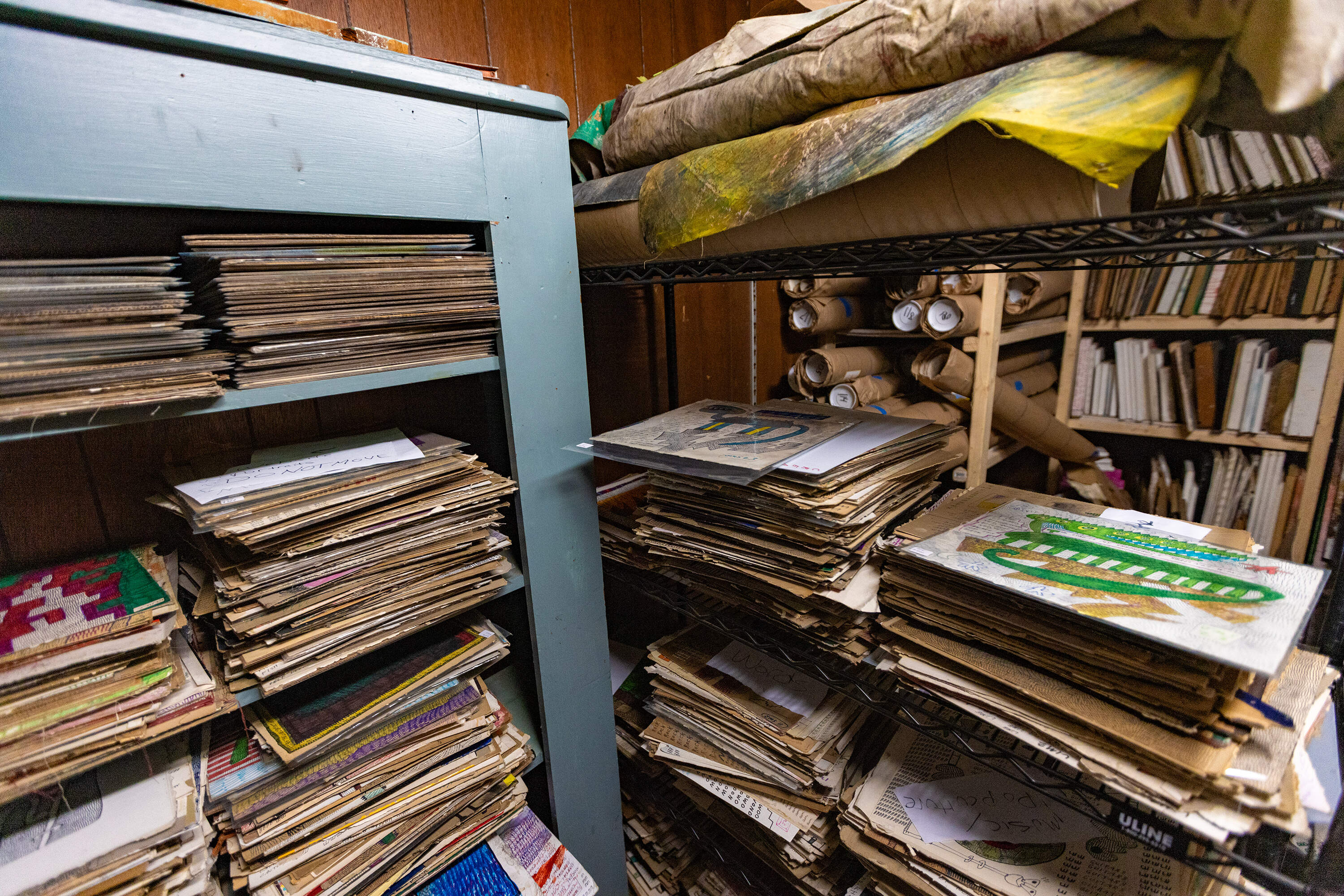
Mark Henderson squeezed through a dusty passageway at the back of the gallery that he manages in Gloucester. The corridor opened into a dark store room filled to the brim with art: rolled up canvases, a bin of works on cardboard, and stacks upon stacks of drawings. Henderson estimated there were around 20,000 pieces, each a strange, distinctive missive from the mind of the late artist Jon Sarkin.
In 1988, Sarkin, then a 35-year-old chiropractor, was playing a round of golf when he felt something twist inside his brain. Surgery to fix a terrible ringing in his ears caused a massive stroke; doctors ended up removing part of the left side of his brain. Sarkin emerged with an insatiable urge to make art. His zany, visually arresting drawings and mixed media paintings invited comparisons from Warhol to Basquiat, but he struggled to break into the mainstream.
Sarkin died last year at the age of 71, in the very studio where he spent most of his days. Henderson transformed the space into a gallery called Fish City Studios, part of an effort to solidify Sarkin’s legacy as an artist worthy of serious attention. The gallery celebrates its grand opening on May 3.
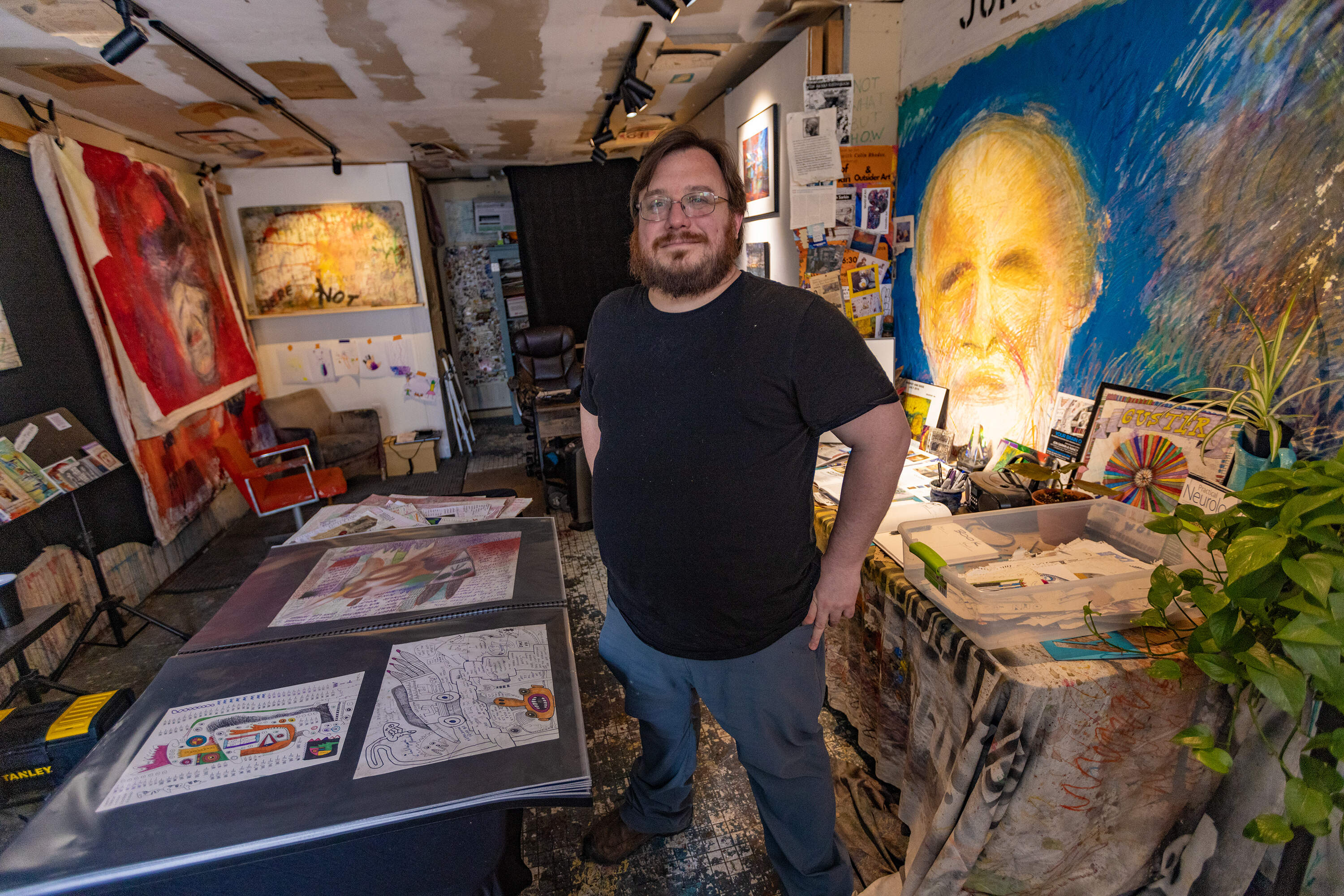
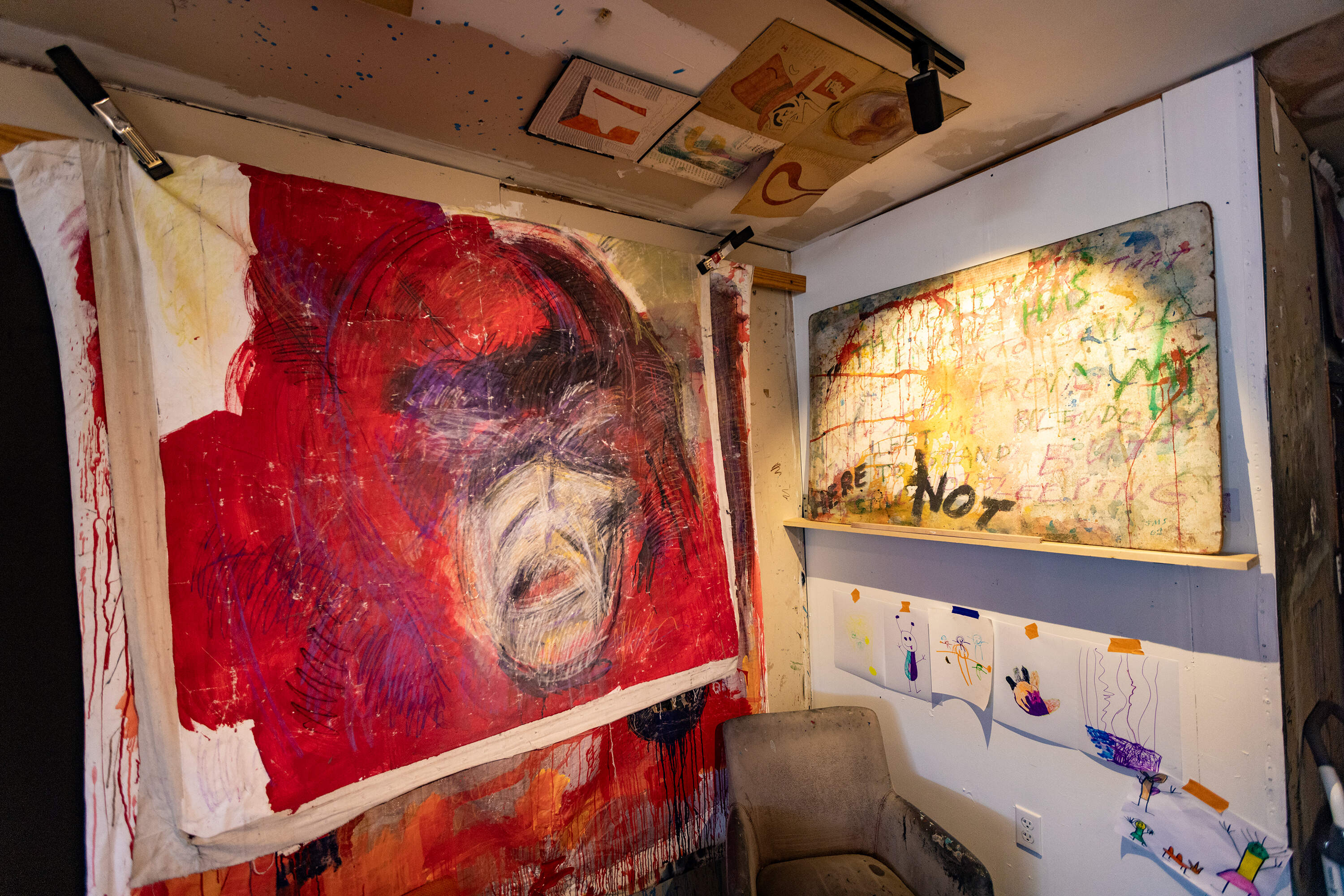
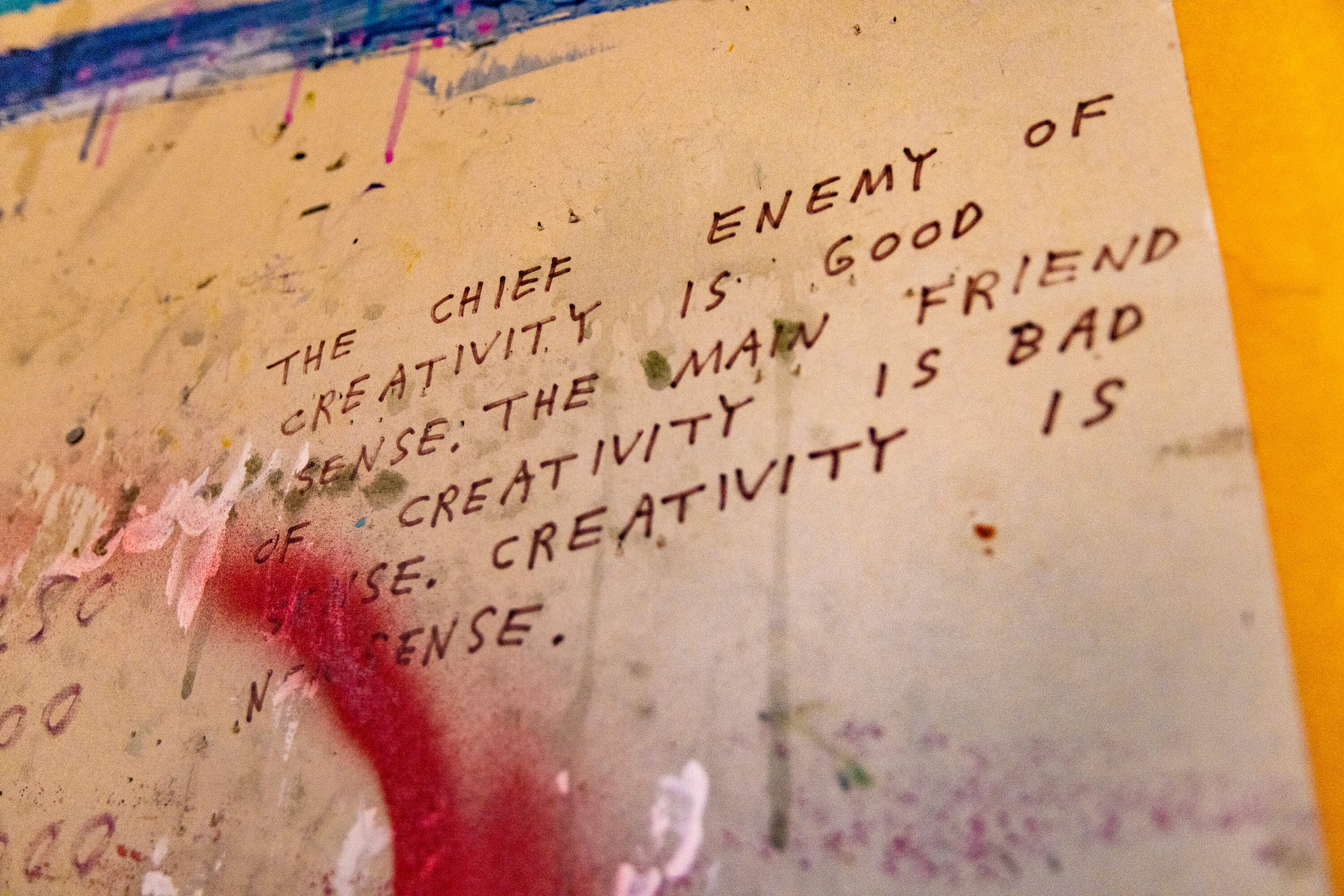
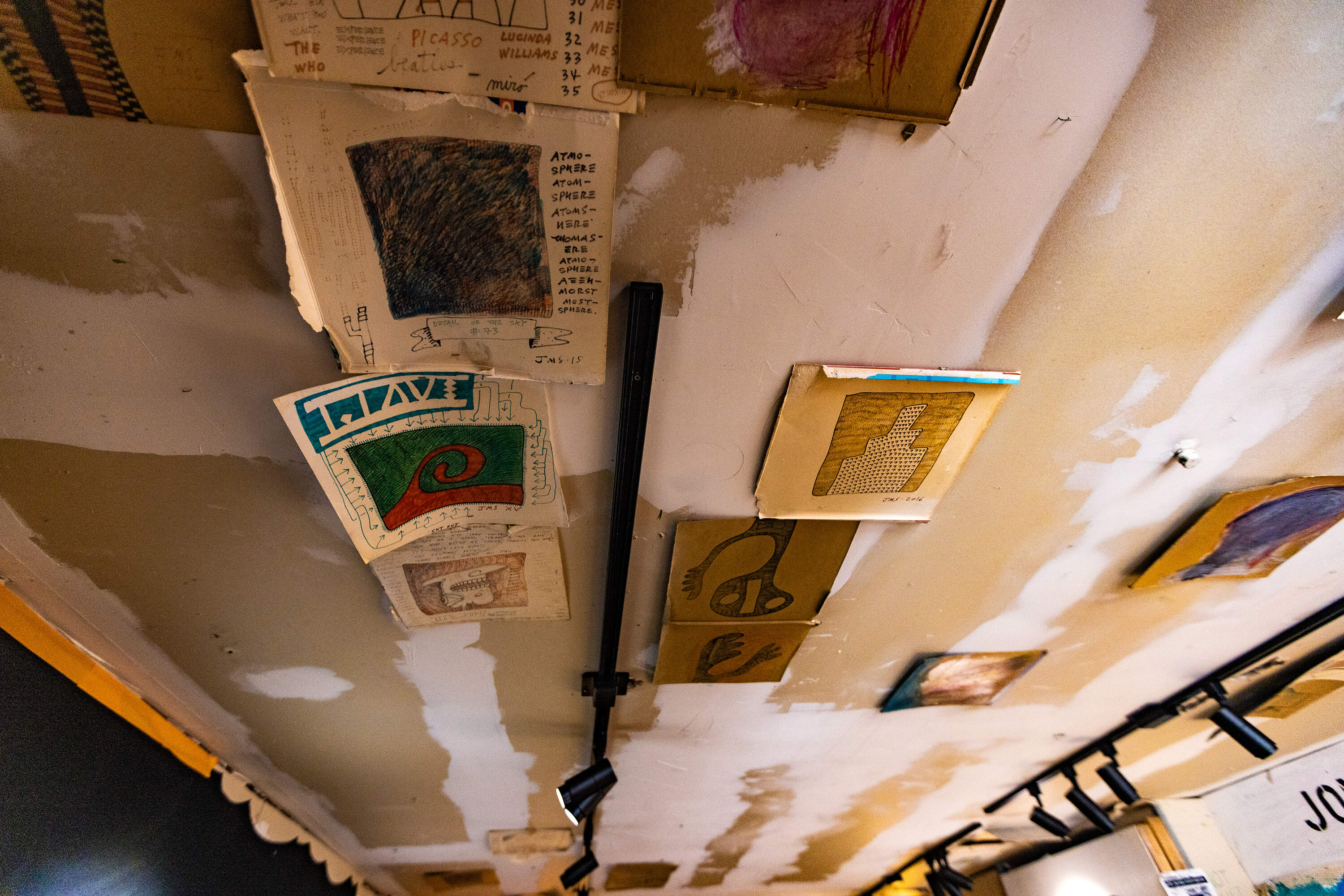
“I don’t think there’s a surface in here that he hasn’t touched,” Henderson remarked, looking around. The gallery’s walls were still splattered with paint and scrawled with Sarkin’s stray musings. There were quotes by Alan Watts and William S. Burroughs, and the password to Sarkin’s email account. Some of his drawings were affixed to the ceiling.
When Sarkin was alive, the space was chaotic. “ It looked like some sort of art bomb had gone off,” Henderson said. But he had since tamed it, distilling Sarkin to his most essential forms. One wall was dominated by a huge portrait of the comic book hero Daredevil, a riot of angry red paint. Propped up nearby was an old ceiling tile splashed with color and scribbled with disjointed words. A large self-portrait, ghostly and impressionistic, loomed above a display of magazine articles about Sarkin.
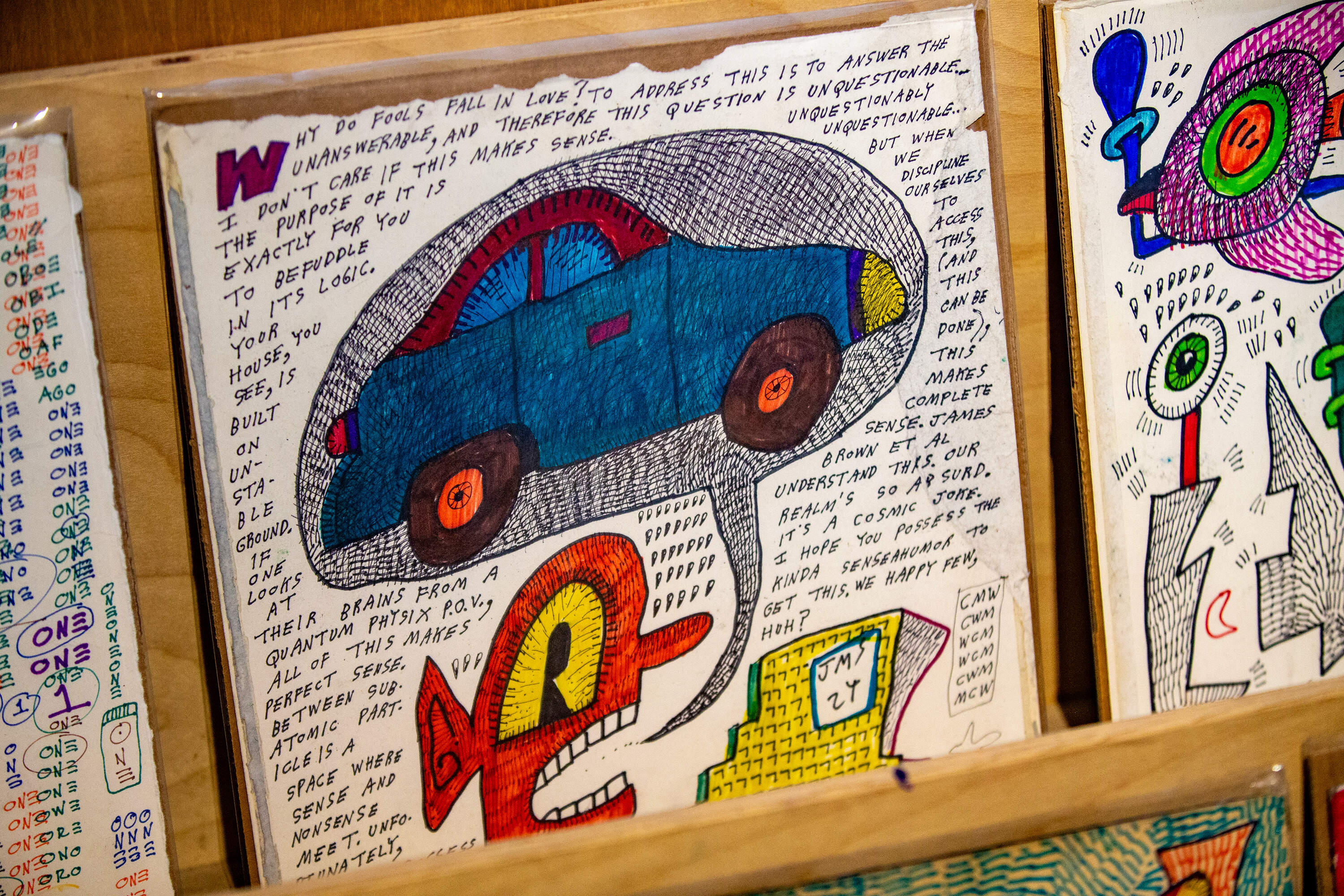
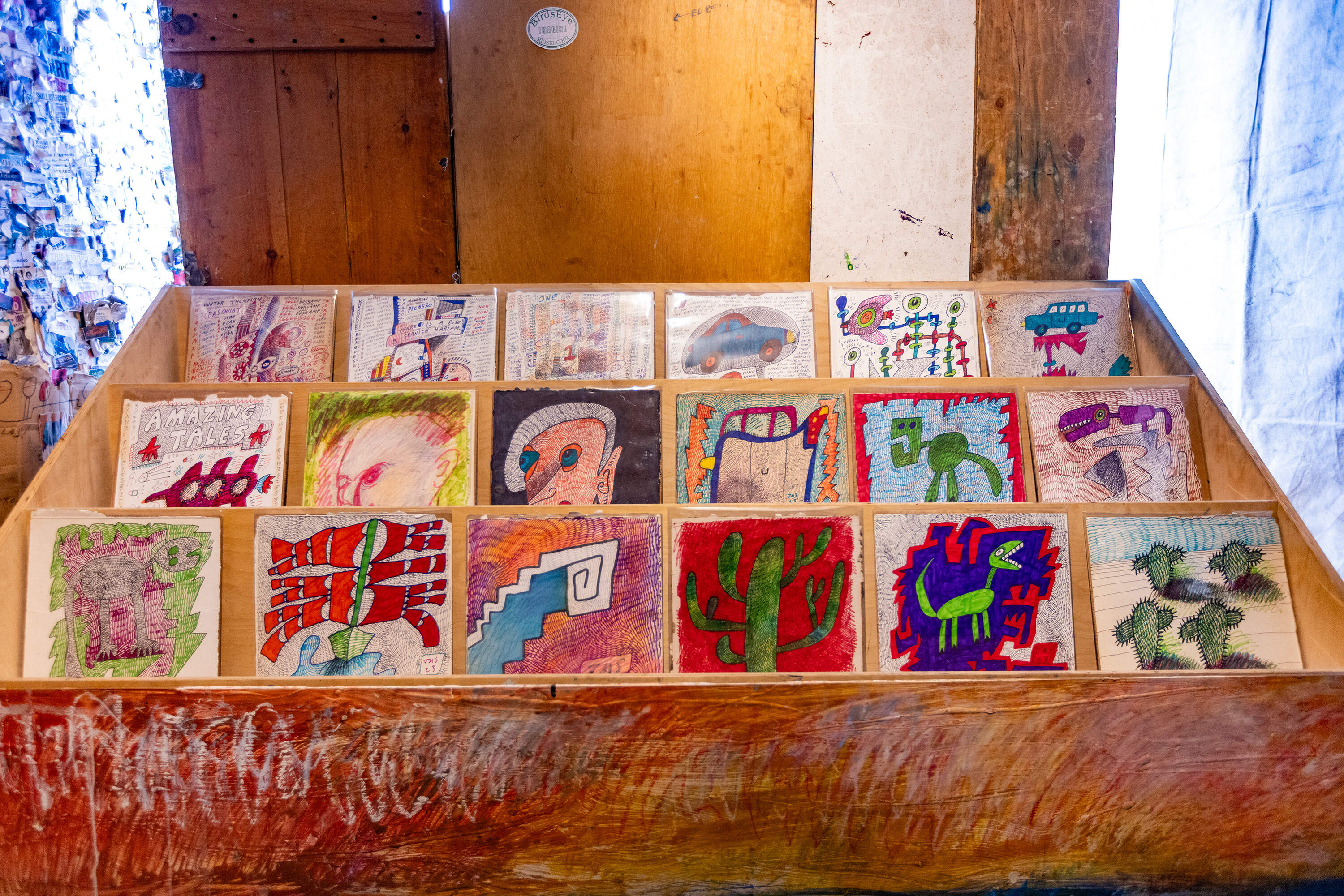
By the window was a rack of Sarkin’s drawings, which he produced prolifically. The surreal, cartoony illustrations were dense with text and crosshatching, warped variations on the same images: cactuses, ships, dinosaurs, cars. Sarkin drew them on album covers salvaged from the free vinyl rack at the record shop down the street.
“He would go over there, grab a handful of albums, tear apart the album covers, draw on the back,” Henderson said. “And he would just do probably three to six of these a day.”
Henderson met Sarkin in 2005 on a visit to Gloucester, and later became his business manager. He recalled being skeptical, at first, that the odd-looking guy he met on the street was the artist he claimed to be.
“I said ‘Yeah, okay buddy, whatever.’ And I walked off,” Henderson said. “‘Cause he looks like a drunk pirate. … You know, he walks with a cane, he sways. People dismiss him constantly.”
Sarkin’s stroke resulted in considerable damage to the parts of his brain that controlled balance and executive functioning. He experienced lifelong symptoms, including double vision and almost constant nausea. His brain injury also had the effect of turning his view of the world unnervingly fresh, as if he was continuously perceiving his environment for the first time.
“Everything is new, but because everything is new, everything is alien,” Sarkin told Terry Gross in a 2011 interview on Fresh Air. “You know the ‘Alice in Wonderland’ story? She falls down the rabbit hole, and everything is cool, but everything is weird, too.”
The interview was to promote a book by the journalist Amy Ellis Nutt, called “Shadows Bright As Glass.” The book probed the neurological impacts of Sarkin’s surgery, and pondered the nature of identity in the wake of a catastrophic brian injury. Was Sarkin the same man as he had been before the stroke?
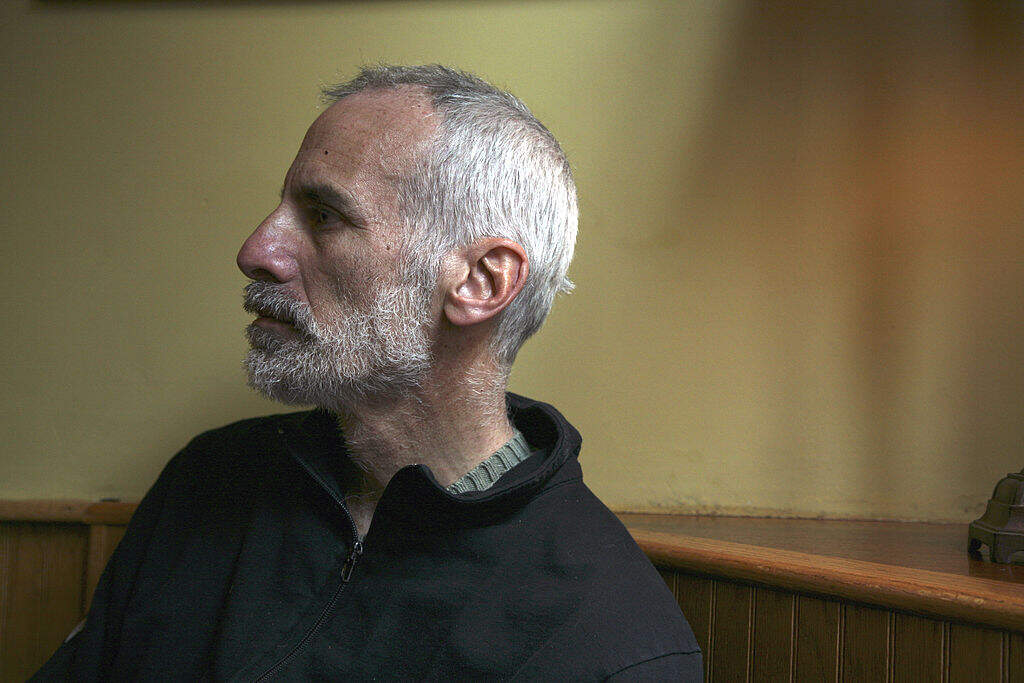
Sarkin was the subject of countless articles and documentaries. Many treated him more as a neurological curiosity than as an artist, said Colin Rhodes, author of the book “The Art of Jon Sarkin.”
“ Most of the underlying stuff is, ‘Oh, it's a real shame that this guy who had a proper job and earned real wages every week and played golf suddenly had this brain injury, and all he could do is make pictures, which are very nice. But wouldn’t it be nice if he could still be a chiropractor?” said Rhodes, who is also an art professor at Hunan Normal University in China.
According to Rhodes, Sarkin’s urge to create was an effort to capture the ideas in his disordered mind before they disappeared. As a result, he drew compulsively, in a stream-of-consciousness style.
“Very often people say, ‘Oh, you know it’s just this kind of spontaneous, compulsive thing and he doesn’t know what he’s doing, blah blah. Well, that’s not true,” Rhodes said. “ It is all real knowledge and real emotion and real feeling about the world.”
Sarkin was represented by the Henry Boxer Outsider Art Gallery in London. The term “outsider art” broadly describes work by artists who don’t have a conventional “art world” background, though its historical roots are in art made by psychiatric patients and people with intellectual disabilities. The term can imply a lack of sophistication. But Rhodes compares Sarkin’s work to jazz: improvisatory, with flashes of brilliance, and very much in conversation with contemporary art and popular culture.
“It’s American art,” Rhodes said. “There’s no doubt you’re looking at American art when you’re looking at Jon Sarkin, when you’re looking at Bob Rauchenberg, when you’re looking at Jasper Johns.”
At the time of his death, Sarkin had made some inroads into the mainstream. He received commissions and sold to collectors, with his most expensive pieces priced in the mid five figures, according to Henderson. The deCordova Museum in Lincoln acquired five of his works, and the band Guster commissioned him to draw the cover art for their 2010 album “Easy Wonderful.”
“It's at times obsessive, and at times childlike and so simple,” Guster drummer Brian Rosenworcel said of Sarkin’s work. “I've never seen anyone incorporate text so seamlessly into their art in a way that feels so aesthetically whole to me.”
Henderson, who has taken on the monumental task of managing Sarkin’s art, hopes to push the artist further into mainstream consciousness.
“We need to transition the narrative from, ‘Let’s all gawk at this guy that does funny pictures after his stroke’ to, ‘This is a serious, valid artist with a serious statement that they're making who just happened to have a stroke when they were in their thirties,’” he said.
The project is starting to produce results. Several art institutions, Henderson said, were in talks to acquire Sarkin’s work – a sign that Sarkin may be on his way from outsider artist to art world insider.
This segment aired on May 2, 2025.