Support WBUR
Mass. among 17 states suing Trump administration for blocking the development of wind energy
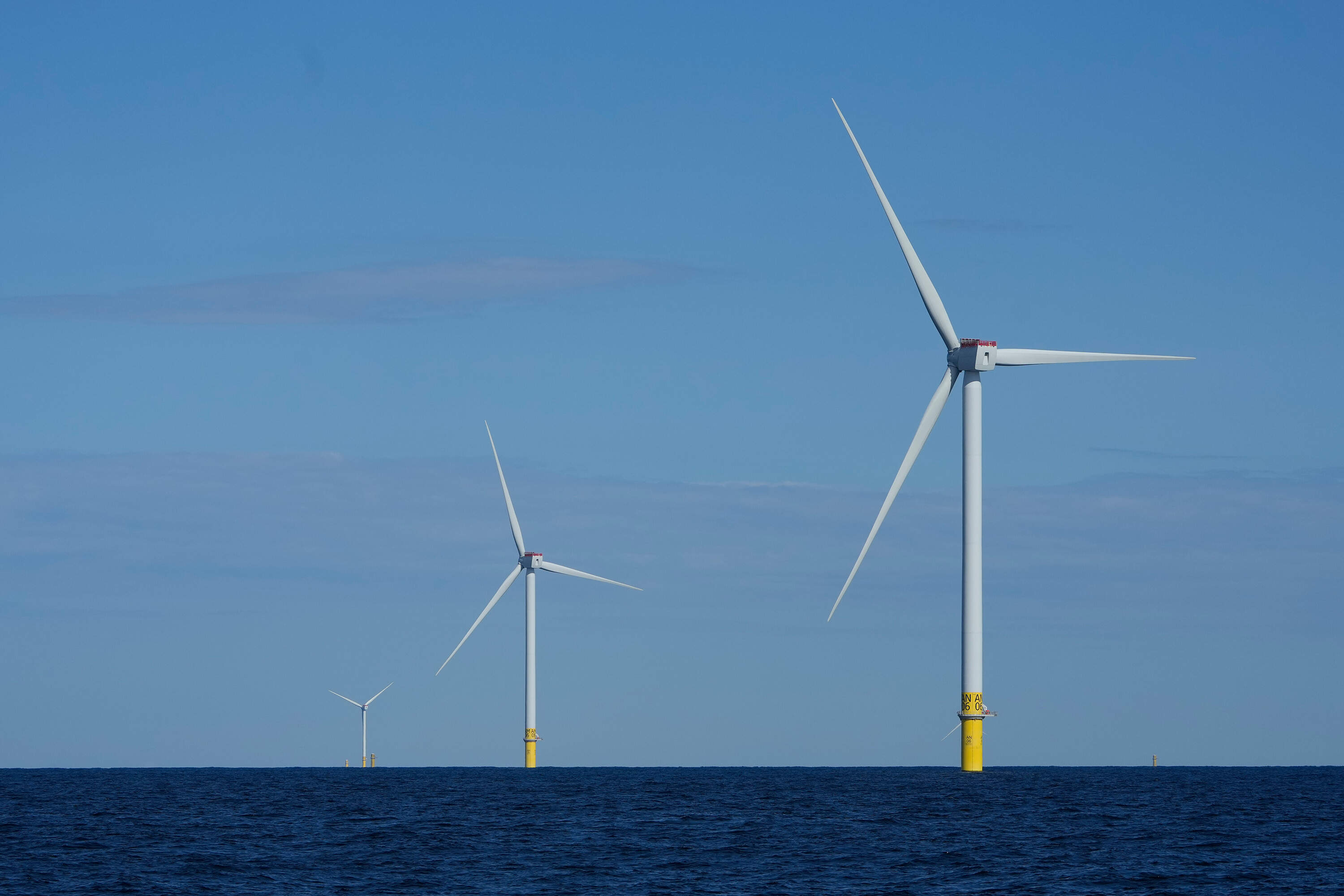
Massachusetts Attorney General Andrea Campbell is part of a coalition of state attorneys general that filed a lawsuit Monday against President Donald Trump's attempt to stop the development of wind energy.
Attorneys general from 17 states and Washington, D.C., are challenging an executive order Trump signed during his first day in office, pausing approvals, permits and loans for all wind energy projects both onshore and offshore. They say Trump doesn't have the authority to unilaterally shut down the permitting process, and he's jeopardizing development of a power source critical to the states’ economic vitality, energy mix, public health and climate goals.
They're asking a federal judge to declare the order unlawful and stop federal agencies from implementing it.
“This arbitrary and unnecessary directive threatens the loss of thousands of good-paying jobs and billions in investments, and it is delaying our transition away from the fossil fuels that harm our health and our planet," New York Attorney General Letitia James, who is leading the coalition, said in a statement.
In the lawsuit, which was filed in federal court in Massachusetts, the attorneys general ask the judge to declare the order unlawful and stop federal agencies from implementing it.
" I'm so glad it was filed," said Amy Boyd Rabin, vice president of policy and regulatory affairs at the Environmental League of Massachusetts. "I think that this is a crucial role for the attorney generals to be playing — to defend the rights of people of their state against arbitrary and illegal actions by the federal government."
Trump vowed during the campaign to end the offshore wind industry if he returned to the White House. His order said there were “alleged legal deficiencies underlying the federal government’s leasing and permitting” of wind projects, and it directed the Interior secretary to review wind leasing and permitting practices for federal waters and lands.
Massachusetts Attorney General Andrea Campbell says these claims of "deficiencies" are baseless, and that the order itself "violates federal permitting statutes."
If it's allowed to stand, she added, it will "create significant harm not only to Massachusetts, but also to other states."
The lawsuit was filed in federal court in Massachusetts.
The Biden administration saw offshore wind as a climate change solution, setting national goals, holding lease sales and approving nearly a dozen commercial-scale projects. Trump is reversing those energy policies. He's boosting fossil fuels such as oil, natural gas and coal, which cause climate change, arguing it's necessary for the U.S. to have the lowest-cost energy and electricity in the world.
The Trump administration took a more aggressive step against wind in April when it ordered the Norwegian company Equinor to halt construction on Empire Wind, a fully permitted project located southeast of Long Island, New York, that is about 30% complete. Interior Secretary Doug Burgum said it appeared the Biden administration rushed the approval.
Equinor went through a seven-year permitting process before starting to build Empire Wind last year to provide power to 500,000 New York homes. Equinor is considering legal options. The Norwegian government owns a majority stake in Equinor.
Wind provides about 10% of the electricity generated in the United States, making it the nation’s largest source of renewable energy. The attorneys general argue that Trump’s order is at odds with years of bipartisan support for wind energy and contradicts his own declaration of a “national energy emergency,” which called for expanding domestic energy production.
The coalition includes Arizona, California, Colorado, Connecticut, Delaware, Illinois, Maine, Maryland, Massachusetts, Michigan, Minnesota, New Jersey, New Mexico, New York, Oregon, Rhode Island, Washington and Washington, D.C. They say they've invested hundreds of millions of dollars collectively to develop wind energy and even more on upgrading transmission lines to bring wind energy to the electrical grid.
Large, ocean-based wind farms are the linchpin of state plans to shift to renewable energy, particularly in populous East Coast states with limited land. The nation’s first commercial-scale offshore wind farm opened a year ago, a 12-turbine wind farm called South Fork Wind 35 miles east of Montauk Point, New York. A smaller wind farm operates near Block Island in waters controlled by the state of Rhode Island.
Massachusetts has three offshore wind projects in various stages of development, including Vineyard Wind, which is actively under construction near Martha's Vineyard. Two other projects, SouthCoast Wind and New England Wind 1, are working to finalize power contracts with the state.
Massachusetts state leaders have long said that offshore wind is a critical source of reliable and affordable electricity, as well as an economic engine capable of creating thousands of good-paying job and helping to revitalize old port cities.
"There are so many [reasons] as to why we need these projects to continue," Campbell said. "And our lawsuit today makes it clear to the court the harm that it would cause Massachusetts if the Trump administration is allowed to continue their unlawful actions in stopping or slowing down the permitting for these projects."
The Trump administration has also suspended federal funding for floating offshore wind research in Maine and revoked a permit for a proposed offshore wind project in New Jersey.
Elsewhere, political leaders are trying to rapidly increase wind energy. U.K. Prime Minister Keir Starmer announced a major investment in wind power in April while hosting an international summit on energy security. Nova Scotia plans to offer leases for five gigawatts of offshore wind energy by 2030, Nova Scotia Premier Tim Houston said in Virginia last week at an Oceantic Network conference.
WBUR's Miriam Wasser contributed to this report.
The Associated Press’ climate and environmental coverage receives financial support from multiple private foundations. AP is solely responsible for all content. Find AP’s standards for working with philanthropies, a list of supporters and funded coverage areas at AP.org.
This article was originally published on May 05, 2025.