Support WBUR
WBUR's local Tiny Desk Contest superlatives

More than 200 Massachusetts musicians entered NPR’s Tiny Desk Contest this year, all hoping to win a coveted spot in the station’s beloved concert series. (The honor went to Bay Area rapper Ruby Ibarra.)
We convened a panel of musicians and critics to seek out WBUR’s Local Favorite. It is never an easy task, given the sheer amount of musical talent in the state. As we gear up to announce the Favorite later this week, here are a few other local entries that stood out.
Best Arrangement
Anna Vtipil, “too clear”

A hallmark of the Tiny Desk Contest is the image of way too many musicians crammed into a very small space. That’s the challenge (and charm) of the contest, and the concert series it’s based on — how to capture a powerful performance in an intimate setting. Often, artists mistake more for more and risk cluttering up a great song or a compelling voice with too many bells and whistles.
Anna Vtipil, by contrast, understands how to deploy a large group of musicians in service of an intimate performance. Vtipil’s ethereal voice is the lynchpin of this song, and she wisely keeps it in the foreground; a pair of backup singers, skillful and precise, buoy it further. The arrangement builds slowly. When the song reaches its crescendo, it does so not by becoming loud or overwrought, but by every performer synchronizing in lock step, the sum of many subtle details adding up to a greater whole.
Best Voice
Tiril Jackson, “Truman”

There’s a lot to love in Tiril Jackson’s engaging performance of her song “Truman:” charisma, musicianship, an irresistible groove. But what sets this entry head and shoulders above others is Jackson’s voice. Today’s female pop vocalists tend toward the airy upper ranges — think Taylor Swift, Sabrina Carpenter, Phoebe Bridgers — so a deep, husky voice like Jackson’s stands out. Hers brings to mind divas of an earlier era: Aretha Franklin, Amy Winehouse, Cher. In her rendition of “Truman,” Jackson shows off a range of color and timbre, from silky to brash. One gets the sense that she is holding back a little; the power of her voice comes from the intimation that there’s yet more to be unleashed.
Most Original Video
Jo Saza, “Hoop Dreams”

The video for Jo Saza’s “Hoop Dreams” is shot like a film, in widescreen, with credits at the top and a stylish font. The concept is straightforward: it’s a song about striving, with basketball as the central metaphor, so the performance is set in a high school gym. Saza’s band is arrayed at the sideline, against backdrop of beige wall padding. As the performance begins, players streak across the foreground in a brief blur of movement. This happens only a few times at the top, just enough to set the scene. Director G. Vani shoots Saza from several angles, including a closeup, but he wisely sticks to a full shot as the song reaches its climax, capturing the rapper’s expressive, full-body performance. A final cinematic flourish brings us inside the perspective of the story’s young protagonist, though only momentarily. No need for a framing sketch or dialogue; with just a few deft details, Saza is able to tell a visual story as lived-in and textured as the one he penned in song.
Most Moving Lyrics
Cloudbelly, “Poppa”
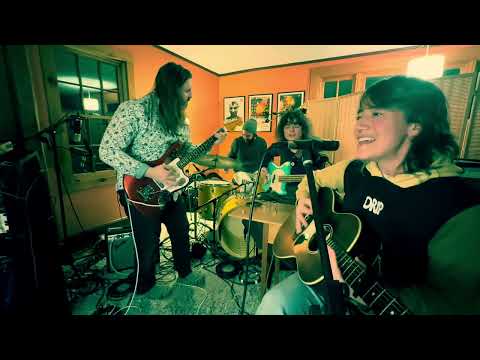
“You always told me you would’ve done well in the woods,” Cloudbelly’s Corey Laitman sings in the first verse of “Poppa.” This bucolic vision is soon punctured in the song’s chorus: “Now you're living in a strip mall of a city / On the 17th floor of a building.” In a few swift strokes, Laitman evokes an entire life — its hopes, its disappointments and its bitter decline.
Laitman elaborates on the inspiration for “Poppa” in the video’s description. The song, unsurprisingly, was written about their grandfather. “A few years ago, he had a massive, benign tumor removed from his brain,” Laitman writes. “The landscape of his personality has changed since then — the angry, reactive, aggressive, disorganized features have gained prominence.” But “Poppa” doesn’t allude directly to these personality changes, which no doubt have been painful to witness. It is mostly an exercise in memory — not nostalgia for a happier time, but a tender homage to a formative relationship. The man may have diminished, but for Laitman, the value of his love has not.