Support WBUR
As Mass. closes shelter hotels, state funds for rent subsidies run out
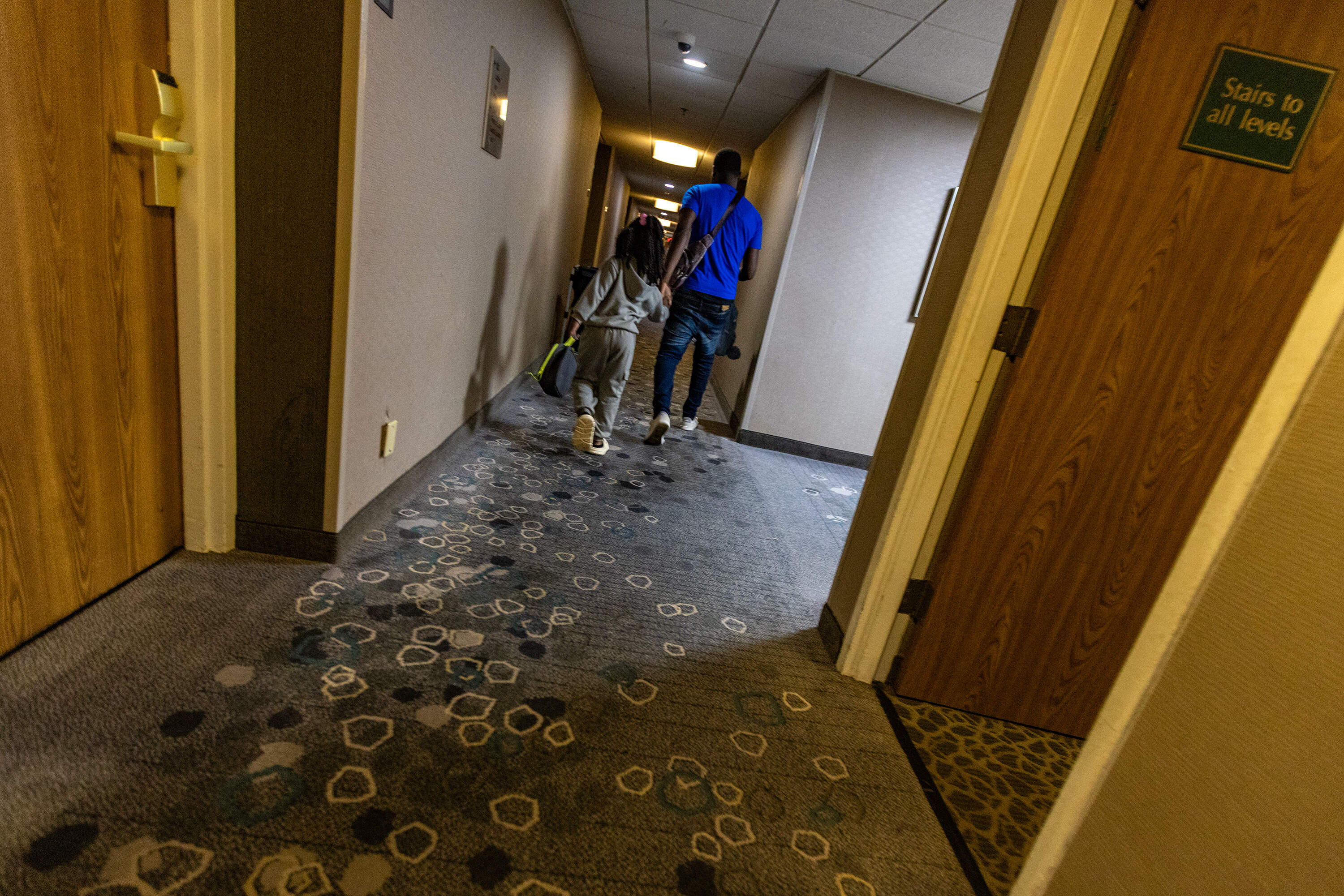
As Massachusetts shutters nearly all of its remaining hotel shelters, a key rental subsidy program offered to those leaving shelters has run out of money.
Housing advocates say if lawmakers don't fund the HomeBASE program, some of the more than 7,000 families enrolled could face eviction.
On Monday, Massachusetts housing officials closed 24 hotels that had been used as shelters. There are four remaining hotels being used as shelters that are slated to close by the end of the month. At the height of the state's shelter crisis, more than 100 hotels were leased by the state as migrant families sought shelter in Massachusetts.
The state continues to operate emergency family shelters in non-hotel settings, and some leaving the hotels this month could be placed there, advocates say. Those include 91 group sites, and roughly 2,000 state-subsidized apartments.
Others are destined for housing on the private market, bolstered by subsidies through HomeBASE. About half of the 11,300 families that have exited emergency shelters in the last two-and-a-half years have received support from the program, which provides renters up to $30,000 over two years.
During that time, HomeBASE enrollment has seen seen a fivefold increase, to nearly 7,800 families, according to state data.
The state continues to enroll people in the program, despite a projected overrun of roughly $18 million. HomeBASE was funded at $57.3 million for the fiscal year that ended this week.
Even amid a growing financial shortfall, groups administering the funds say HomeBASE is working. But Metro Housing Boston executive director Chris Norris says he worries about what will happen to tenants if lawmakers don't address the deficit.
“ If the money was to be exhausted and the assistance was to end, you would have a situation where owners then become responsible for evicting tenants,” Norris said.
To avert that scenario, lawmakers would need to add more funding for HomeBASE through a supplemental budget. That’s how the state has funded the broader Emergency Assistance shelter system last year, as actual expenditures have outstripped budgets by hundreds of millions of dollars.
“HomeBASE should be funded at the level that's required to ensure folks remain housed and out of the shelter system,” Norris said. “We should honor commitments that were made both to owners who are participating in this program as well as to tenants.”
This week, the state rolled out new limits to HomeBASE. It's pausing an expansion that would have allowed renters to apply for a third year (and additional $15,000 of assistance).
The state will also implement more consistent annual income checks, and improve data collection “to better understand exit outcomes,” Massachusetts Housing Secretary Ed Augustus said in a statement.
The new HomeBASE limits, first reported by the Boston Herald, come as the state closes two dozen hotel shelters across Massachusetts.
The shelter population roughly doubled by the end of 2023 as thousands of migrant families arrived in Massachusetts. That prompted the state to cap the number of families in shelter at 7,500 and limit the length of their stay. Officials also put a residency requirement in place, as well as rule that families have legal immigration status.
State data shows that since the start of 2025, the percentage of migrants as a share of the total family shelter population decreased significantly. In early January, 53% of families were considered migrants — by this week, the number had dwindled to 38%.
And many of those could be on track to lose their immigration status. In late June, the Trump administration ended Temporary Protected Status for roughly 500,000 Haitians. Advocates say many Haitians placed in the Massachusetts shelter system had TPS.
“Some of the people that we have been helping … could possibly be deported,” said Jeff Thielman of the International Institute of New England, one of the groups helping shelter residents find housing and navigate work permitting.
Thielman said starting in September, TPS recipients will no longer be eligible to work.
“ Our state invested heavily in these folks, and what we want in return is for them to give back to Massachusetts by working and paying taxes — and that's what they want to do,” he said.
But Thielman said the federal government has made that very difficult.
The hotel shelters were operated by several nonprofit groups, including Commonwealth Care Alliance, which ran 10 facilities in the Boston area.
Lauren Easton, a senior vice president at CCA, said the group closed two of the shelters in April. The other eight closed on Monday. She said the wind-down happened over the last six months, so the hotels were mostly empty by the Monday deadline.
“At any given month, we were transitioning folks to permanent housing — anywhere from 80 to about 125 per month,” Easton said.
Over nearly two years, CCA hosted a total of 1,400 families and helped nearly 1,000 secure permanent housing upon exiting the shelters. As for the other 400 families, Easton said some moved in with family locally, others left the state, and some went “perhaps back to their own country.”
Easton said she’s grateful to the host communities: "the school systems, the public safety, the urgent care centers,” she said. “It was the towns, the city managers — just the incredible collaboration and support.”