Support WBUR
Boston's Morning Newsletter
Invasive spotted lanternflies are sticking around in Massachusetts
Editor's Note: This is an excerpt from WBUR's daily morning newsletter, WBUR Today. If you like what you read and want it in your inbox, sign up here.
Meteorologist Danielle Noyes is forecasting a cool Labor Day weekend to cap off the hot summer we've had here in Boston. (You know what that means.)
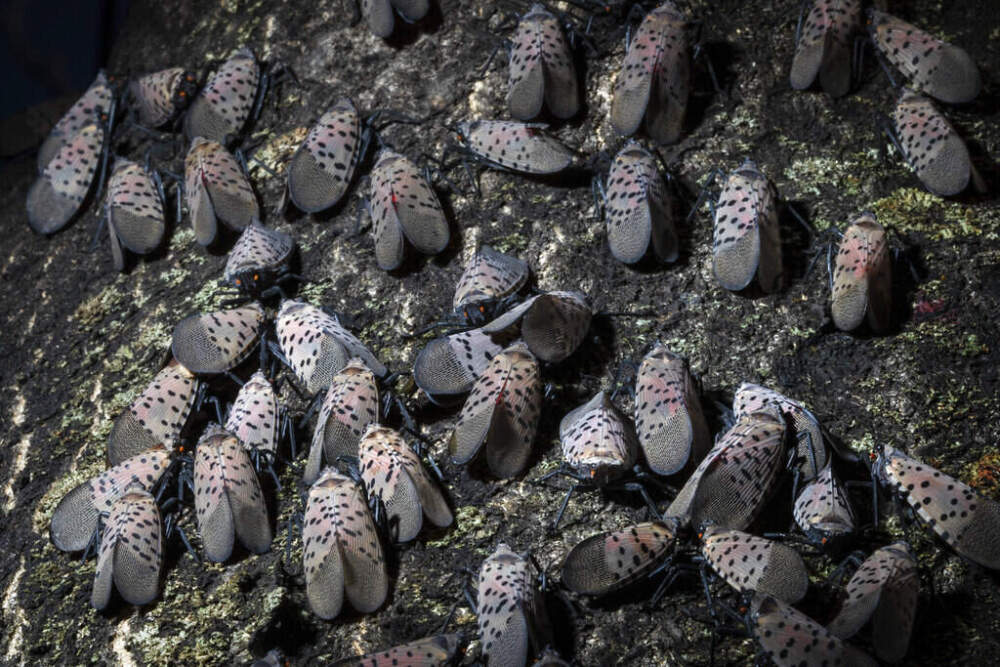
Bug off! Invasive lanternflies have been reported in more than 50 Massachusetts cities and towns, from Seekonk to Westfield to North Andover. And while they don't bite, the invasive insects do pose a threat to some of the states' agricultural commodities. WBUR's Dan Guzman spoke to Jennifer Forman Orth, an environmental biologist with the Massachusetts Department of Agricultural Resources, all about lanternflies' impact on the local environment and how to keep these pesky bugs away from your area.
- What's a lanternfly? Not to be confused with fireflies, lanternflies are inch-long insects with black-spotted pinkish-tan wings. They feed on the sap from black walnut trees and grapevines, which isn't good news for the many wine producers in the state. Lanternflies also excrete a sticky, sugary residue called "honeydew" while they're eating. "Sometimes it gets this secondary fungal infection that can be kind of smelly," said Forman Orth. (It's been described as having a "smoky bacon" scent to it.) Overall, they're a nuisance, she said.
- Stop bugging us: You'll usually find lanternflies around highways, trees, backyards and vineyards in the summer. If you're dealing with an infestation, Forman Orth suggests setting up bug traps, calling a pest control company or simply vacuuming them up as they gather in large numbers.
- As time goes on: "We're expecting them to continue to spread in Massachusetts," Forman Orth said. Her department is trying to reduce the insects' population by eliminating their eggs in the winter and removing some of the trees they flock to. "Unfortunately, what has been going on in other states has shown us that this is not a pest that can really be eradicated," she added. (So keep that vacuum — or a fly swatter — handy.)
And it's off: Amtrak's new "NextGen Acela" train departed from South Station this morning a little before 6 a.m., marking a new era in East Coast train travel. The new trains can reach a top speed of 160 miles per hour, WBUR's Zeninjor Enwemeka reports, about 10 miles per hour faster than the original Acela. That means less time in transit for riders going between Boston, New York and Washington, D.C. Amtrak spokesman Marc Magliari says the company is planning to roll out 28 NextGen Acela trains by 2027 — with the hope of replacing the old fleet.
- What it's like on board: The new trains promise a quieter ride, free 5G wifi onboard and USB ports, power outlets and adjustable reading lights nearby each seat. The ticket price isn't changing, though. You can see a map of the NextGen Acela's route here.
Follow up: The family of Enrique Delgado-Garcia — the Massachusetts State Police recruit who died in 2024 after being injured during a boxing exercise at the training academy — now knows his cause of death. The medical examiner ruled he died accidentally of blunt-force injuries to the head.
- Delgado-Garcia's death resulted in changes to the state police academy's training methods, but the 25-year-old recruit's family still wants answers. Mike Wilcox, an attorney for the family, told WBUR's John Bender they haven't taken any legal action yet. "He was senselessly and needlessly killed at the state police academy because he wasn't being properly supervised, nor properly trained," said Wilcox.
P.S. — Our new "Jaws Island" podcast is live now. WBUR's Andrea Shea talks to collectors, cast members and Jaws "finatics" all about Steven Spielberg's iconic shark film and its lasting legacy. Dive in — we promise we won't bite!