Support WBUR
The Trump administration suggested Mass. is gerrymandered. Is that true?
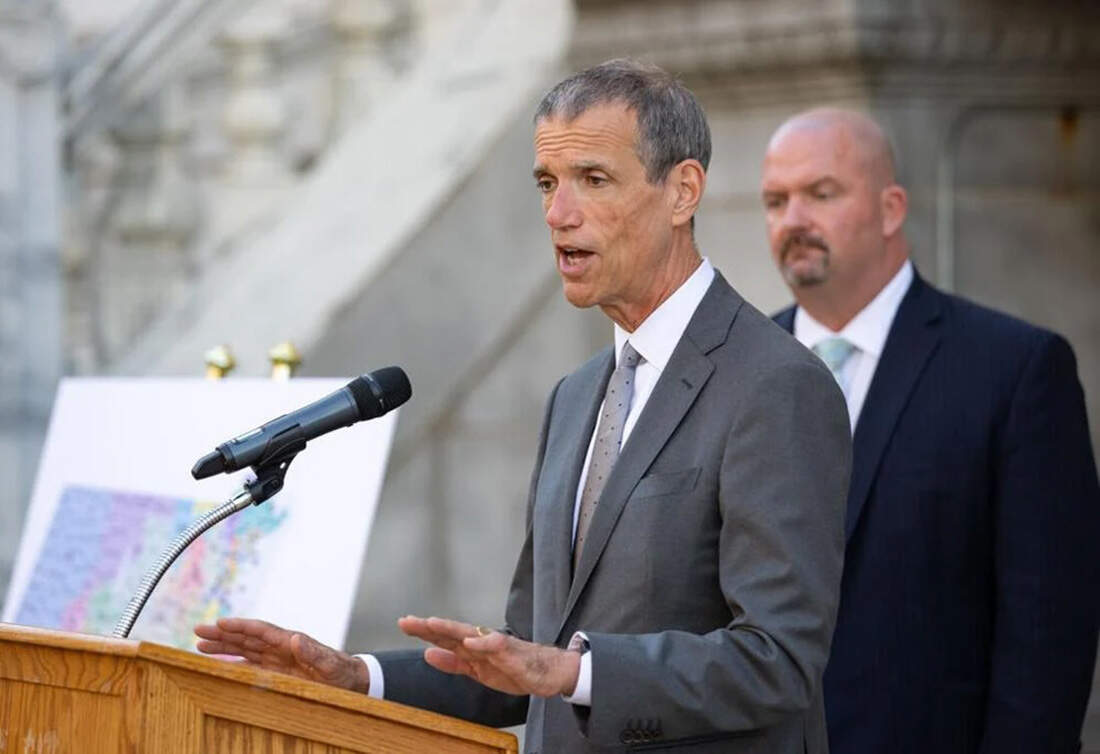
The Trump administration has called out Massachusetts amid a bruising national fight about redistricting, but one of the lawmakers responsible for the congressional maps here argued the all-Democrat delegation is a result of the way voters are distributed, not partisan gerrymandering.
Sen. William Brownsberger, who co-led the effort to reshape the Bay State's political boundaries following the 2020 Census, said it's "not possible to draw a district in Massachusetts that would favor a Republican."
"They're distributed evenly, so they're a minority all over the state," he said of voters who would back Republicans. "There are some towns that are more heavily Republican. There are some parts of the state that are red, but not enough to put together a congressional district in which Republicans will be a majority."
"It's just not a thing. You can't do it here in Massachusetts," the Belmont Democrat added. "And by the way, no Republican ever approached us and asked us to attempt to do that."
While pressing Republicans to redraw maps in their favor elsewhere, President Trump has sought to portray Massachusetts as a gerrymandered state, suggesting a disconnect between his performance in the presidential election and Democrats' nine-for-nine performance in congressional districts.
"In Massachusetts, I got, I think, 41% of the vote, a very blue state, and yet [Democrats] got 100% of Congress," Trump, who received 36% of the vote here in 2024, said in an interview on CNBC on Aug. 5. "One hundred percent. I got 40, 41% or something, and yet 100% of Congress in Massachusetts? No, it shouldn't be that way. I should have, we should have a couple of Congress people but we have none."
Vice President JD Vance echoed a similar point in an interview with NBC News that aired Sunday, pointing to "Massachusetts, where 32% of residents of Massachusetts voted for Republicans, [but there are] zero Republican federal representatives."
"All we're doing, frankly, is trying to make the situation a little bit more fair on a national scale," Vance said. "The Democrats have gerrymandered their states really aggressively. We think there are opportunities to push back against that. That's really all we are doing."
The maps in Massachusetts drew little opposition from Republicans on partisan grounds before Trump pulled the Bay State into the fray.
In 2021, when a Democrat-led panel unveiled the latest proposals, 23 of 29 Massachusetts House Republicans and two of three Senate Republicans voted in favor of the congressional map. GOP Gov. Charlie Baker then signed it into law.
The points of contention at the time were more about which communities should fall into which districts, not whether one party would be favored. A heated battle erupted over the decision to keep South Coast cities Fall River and New Bedford split between two different districts.
A dozen Senate Democrats ultimately voted no — a larger percentage of the majority caucus than the share of House Republicans who opposed the redistricting plan.
Voters in exactly one year might get a chance to cast ballots for the state's nine Congressional races, if lawmakers embrace Gov. Maura Healey's proposal to schedule the statewide primary for Sept. 1, 2026.
Massachusetts has not elected a Republican to the U.S. House since 1994, when Peter Blute won the Third Congressional District and Peter Torkildsen won the Sixth Congressional District. They have, however, supported several Republicans for statewide office, including a string of governors and U.S. Sen. Scott Brown.
In 2024, Trump won about 36% of the vote across Massachusetts, but did not secure a majority of votes in a single county.
Brownsberger said he's "kind of amused" by the attacks Massachusetts now faces from national Republicans over its congressional map.
He pointed to a study published in the Election Law Journal in 2019 in which researchers suggested that the decades-long history of Massachusetts picking only Democrats for U.S. House seats "is not attributable to gerrymandering, nor to the failure of Republicans to field House candidates, but is a structural mathematical feature of the actual distribution of votes."
"Several of these elections have a remarkable property in their vote patterns: Republican votes clear 30%, but are distributed so uniformly that they are locked out of the possibility of representation," authors wrote. "Though there are more ways of building a valid districting plan than there are particles in the galaxy, every single one of them would produce a 9–0 Democratic delegation."
The New York Times's Upshot also attributed the all-Democrat delegation in Massachusetts to "the geographic distribution" of voters.
NYT reporters found that "it's not impossible to draw a Republican district" here, "but it's not easy." They crafted a sample Republican district, which snaked from northwest of Worcester down along the Connecticut and Rhode Island borders before ballooning to encompass parts of Bristol and Plymouth counties.
However, the Times reported that "the typical standards for nonpartisan redistricting — and the rules of many states — would argue against the creation of this Trump district."
"If you took any person in Massachusetts and formed a district around the 780,000 people who lived closest to that person, every one of those districts would have voted for Kamala Harris," the Times's Nate Cohn and Eve Washington wrote.
Some of the Bay State's existing congressional districts might catch the eye as having an odd shape, especially the Fourth District, which stretches from Boston suburbs all the way down across Rhode Island border communities to Fall River.
Brownsberger said the maps "have a long history behind them," including a practice of trying not to "scramble" districts.
"You don't just redraw the map randomly every 10 years," he said. "Respect for existing boundaries is a consideration in the redistricting process."
Conversations about politics do take place during the process. Brownsberger said sitting members of Congress "may have different preferences about adjustments they'd like to see," but that he does not remember "any explicit conversation from any of them about, 'I need to protect myself from a Republican.'"
Asked if the last round involved discussions about protecting incumbents from primary challengers, Brownsberger replied, "I wouldn't want to try to recall exactly what those conversations were, and I think people would be fairly oblique in what they said about that, but I'm sure that that's a consideration for some members."
Massachusetts has reliably picked Democrats for Congress for decades, but most Bay Staters are not themselves registered Democrats. In 2024, nearly 65% of registered voters had no political party affiliation. About 26% were registered as Democrats and 8% as Republicans, according to the secretary of state's office.
Redistricting typically happens across the country every 10 years based on the latest population count in the decennial U.S. Census.
Texas Republicans set off an intense conflagration this summer by pursuing a mid-decade change to the state's congressional maps. After weeks of political sparring, Texas Gov. Greg Abbott on Friday signed new maps into law that would reportedly give the GOP five additional seats in the U.S. House heading into midterm elections — when the president's party typically loses ground — next year.
That tipped over electoral dominoes elsewhere. In California, Democrat Gov. Gavin Newsom proposed a round of redistricting that would flip five congressional seats toward his party, effectively offsetting the changes in Texas.