Support WBUR
Review
Two theater productions contend with old familial wounds
When trying to heal from life’s traumas, the present and the past often collide. But what does one do with the ensuing wreckage? And what does it look like to move forward?
Two shows, “The Hills of California” at the Huntington Theatre and “The Ceremony” at the Joan and Edgar Booth Theatre, contend with old familial wounds. Both of these poignant narratives reckon with the wrongdoing of a parent and how those choices impact the lives of their children.
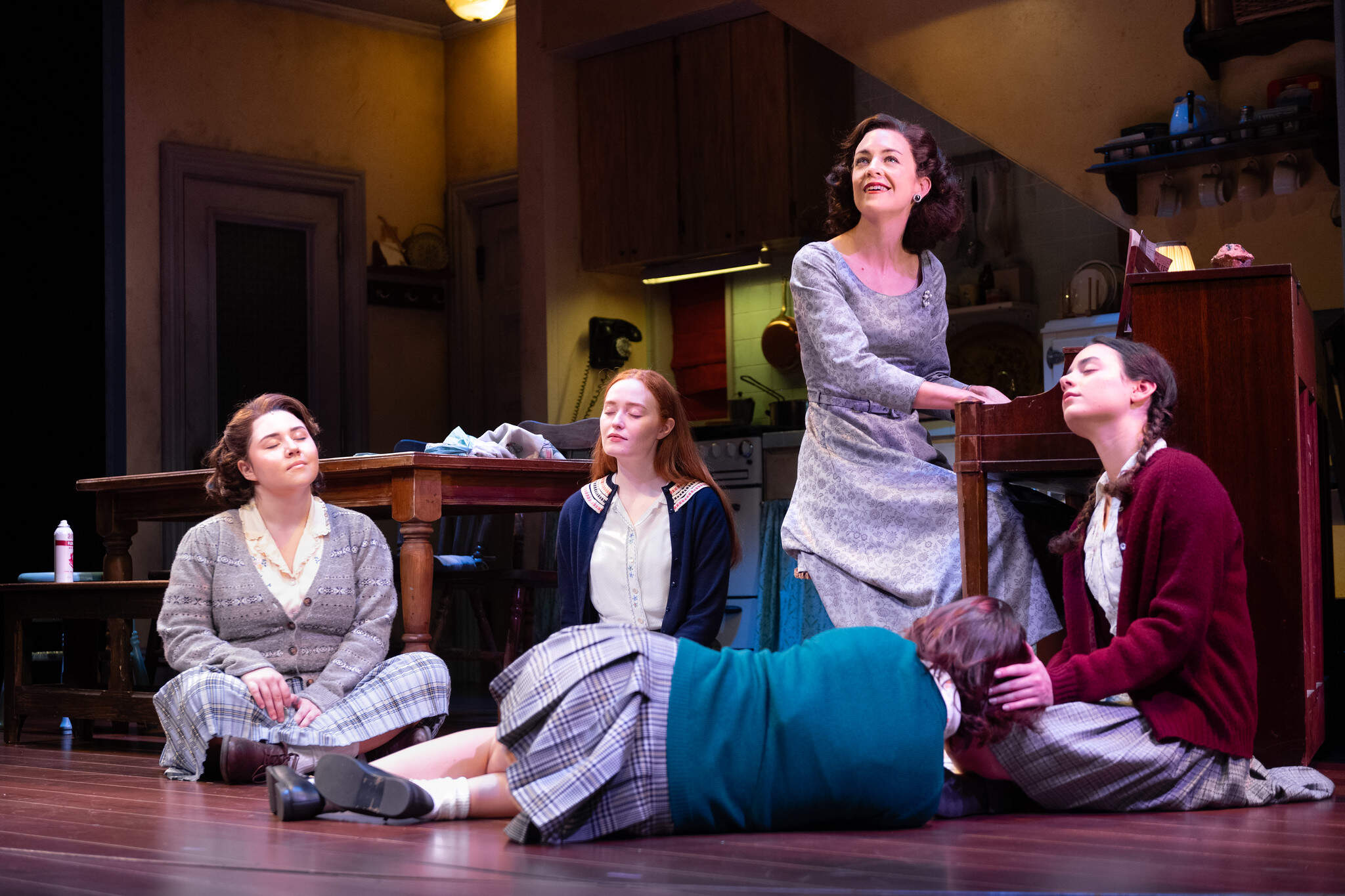
In “The Hills of California” (through Oct. 12), four sisters raised to be singers gather one by one at the seaside guest house they grew up in to support their dying mother, Veronica, and mull over their broken dreams. As they wait, the daughters wistfully reminisce, sing and laugh about the past while drinking too-old gin. The action flashes back and forth from 1976 to 1955, as the impressive three-story set, by scenic designer Andrew Boyce, rotates. It moves from the present-day lobby and bar area, with its non-working jukebox and tiki-esque bar, to the kitchen of the past, where the young sisters eat their meals, practice routines by a brown piano, and hope for stardom.
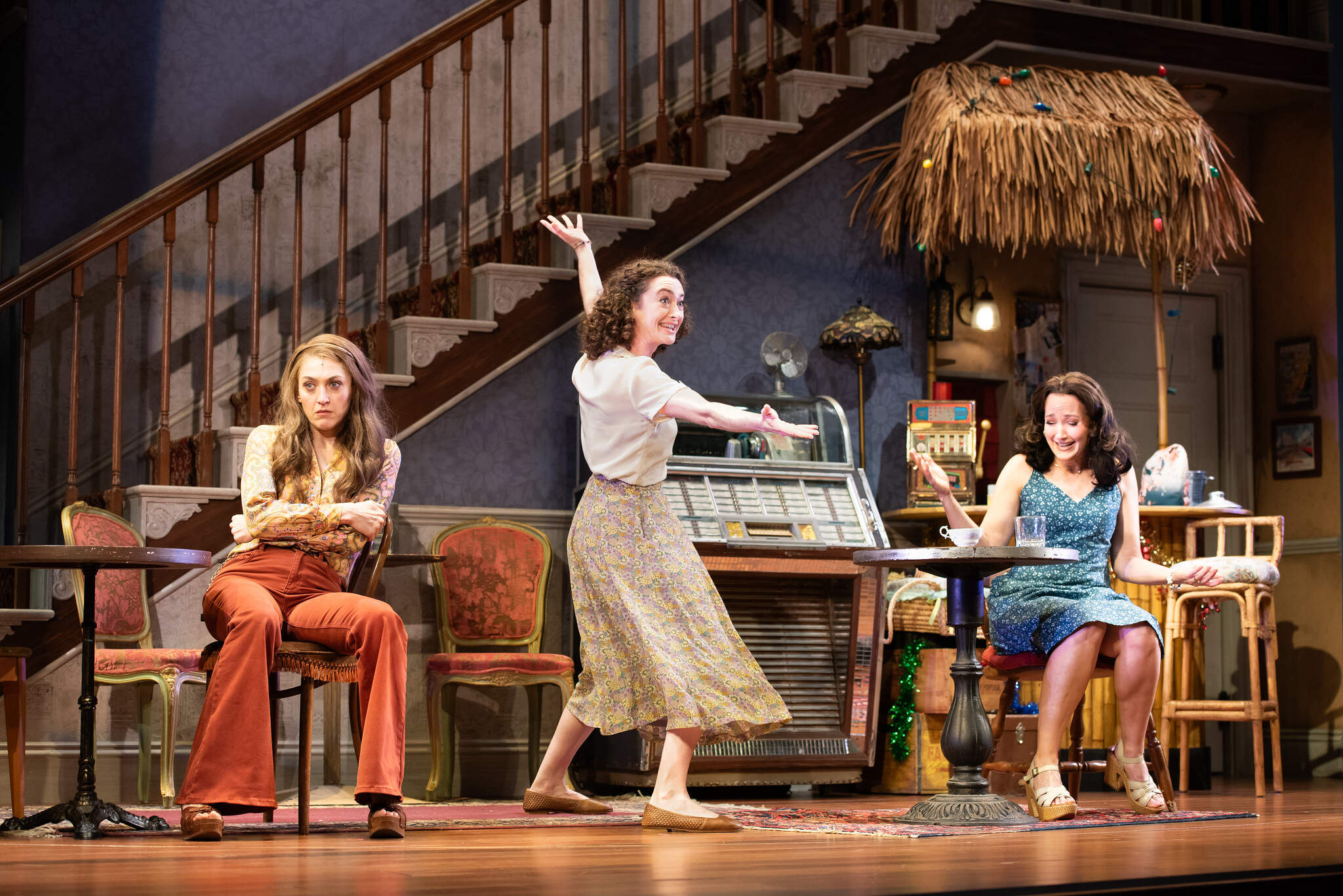
In the present day, when the third eldest sister, Gloria (Amanda Kristin Nichols), arrives at the family home, the tone shifts. Something is gnawing at her and she can barely contain her fiery anger as she and two of her sisters wait for Joan who got closest to the life they all dreamed of. (Allison Jean White portrays Joan and also doubles beautifully as the sisters’ mom, Veronica.) When Joan does show up, the real hurt of the past is unleashed.
Playwright Jez Butterworth (“Jerusalem” and “The River”) takes his time fleshing out the characters. (The experience feels reminiscent of the long brushstrokes Kirsten Greenidge uses in “Our Daughters, Like Pillars,” where the people are just as important as the story.) But the sacrifices matriarch Veronica made for her girls to have a career are startling, and who to blame seems unclear to some.
One compelling, yet painful moment comes when the adult Joan, who has the right to be more furious than she looks, ascends the stairs toward her mother’s room and meets her young self along the way. There’s a crushing silence between the two that stops them both in their tracks. It feels like a physical reminder of the toll trauma takes on one’s life. Will Joan and her sisters hide from it, or confront it head-on? Loretta Greco’s graceful direction propels this saga forward as the siblings’ mounting tension creates a powder keg poised to explode.
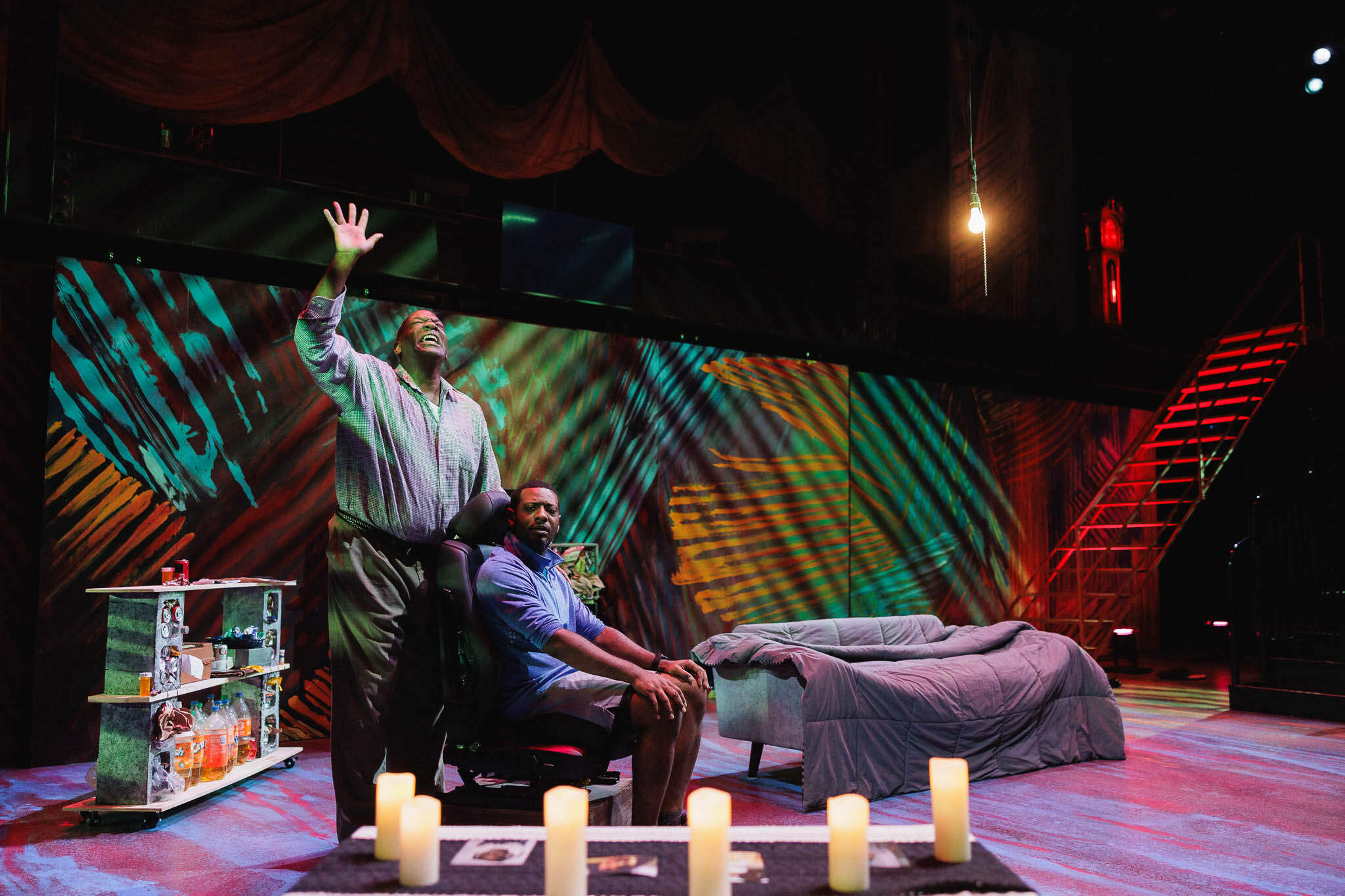
A more minor eruption seems likely, at least initially, in playwright Mfoniso Udofia’s “The Ceremony” (through Oct.5), centered on the upcoming marriage of Ekong Ufot (Kadahj Bennett) and his Nepali bride-to-be Lumanti Shrestha (Mahima Saigal). This world premiere, produced by CHUANG Stage in partnership with Boston University School of Theatre and Boston Playwrights’ Theatre, is the sixth installment in Udofia’s nine-play cycle chronicling the lives of the Nigerian American Ufot family. In the show, the audience meets Lumanti’s mom and aunt, Ekong’s mom, Abasiama, and his two sisters, Adiaha and Toyoima. As the couple prepares for their big day, it seems they’ve made peace with the notion that their fathers won’t be present for their wedding. But one day, Lumanti’s dad changes his mind, which prompts Ekong to reconcile with his father.
Smartly directed by Kevin R. Free, the cast in this dynamic play is incredible. The actors skillfully move in and out of the native languages of two distinct cultures. And Udofia’s sharp writing helps audience members, or at least this one, feel as though they’re part of the wedding preparation. There are some tender moments in between the drama: Lumanti’s mom oils her scalp and her auntie Anjali Kapali (a fantastic Natalya Rathnam), who was shunned for marrying someone the family didn’t approve of, builds up Lumanti’s confidence. Adiaha searches YouTube to prepare a traditional dance routine, and everyone works to include both cultures in the ceremony, from geles to saris.
Ekong spends nearly all of his free time watching “The Fresh Prince of Bel-Air” and wishing for a more perfect family. Reconciliation is what he aims for, but achieving it might not be easy. His father, Disciple, has now relegated himself to the basement of his and Abasiama’s home. He’s a far cry from the confident man carving out his blessings in the first play, “Sojourners.” He’s haunted by the Biafran War, and whatever he’s endured has impacted him and his ability to show up for his family.

Udofia uses the story of Ekong and Lumanti to illustrate what happens when two people choose to resolve their issues rather than letting them fester. As they work to mend fences with family members, they’re also trying to create healthy communication patterns. Still, not everyone in this tale is easily forgiven, but a pathway is forged.
Unlike in “The Hills of California,” where the hurt is explicitly stated, audience members must speculate about what’s occurred between Disciple and his children since it remains unspoken. In both productions, the pain runs deep.
What is clear is the love that these family members have for each other is far more ferocious than any hurt that’s occurred. Pivotal moments like the death of a loved one or the wedding of another are times to assess the myriad missteps of life. We might be called on to step up, to try and be the best versions of ourselves and reckon with historic hurt with honesty and forgiveness, not just for ourselves, but for generations to come.
“The Hills of California” runs through Oct. 12 at The Huntington Theatre. “The Ceremony” runs through Oct. 5 at Boston University’s Joan and Edgar Booth Theatre.