Support WBUR
Boston's Weekly Health Newsletter
Reporter's notebook: Inside a Harvard cancer research lab that lost federal funding
Editor's Note: This is an excerpt from WBUR's weekly health newsletter, CommonHealth. If you like what you read and want it in your inbox, sign up here.
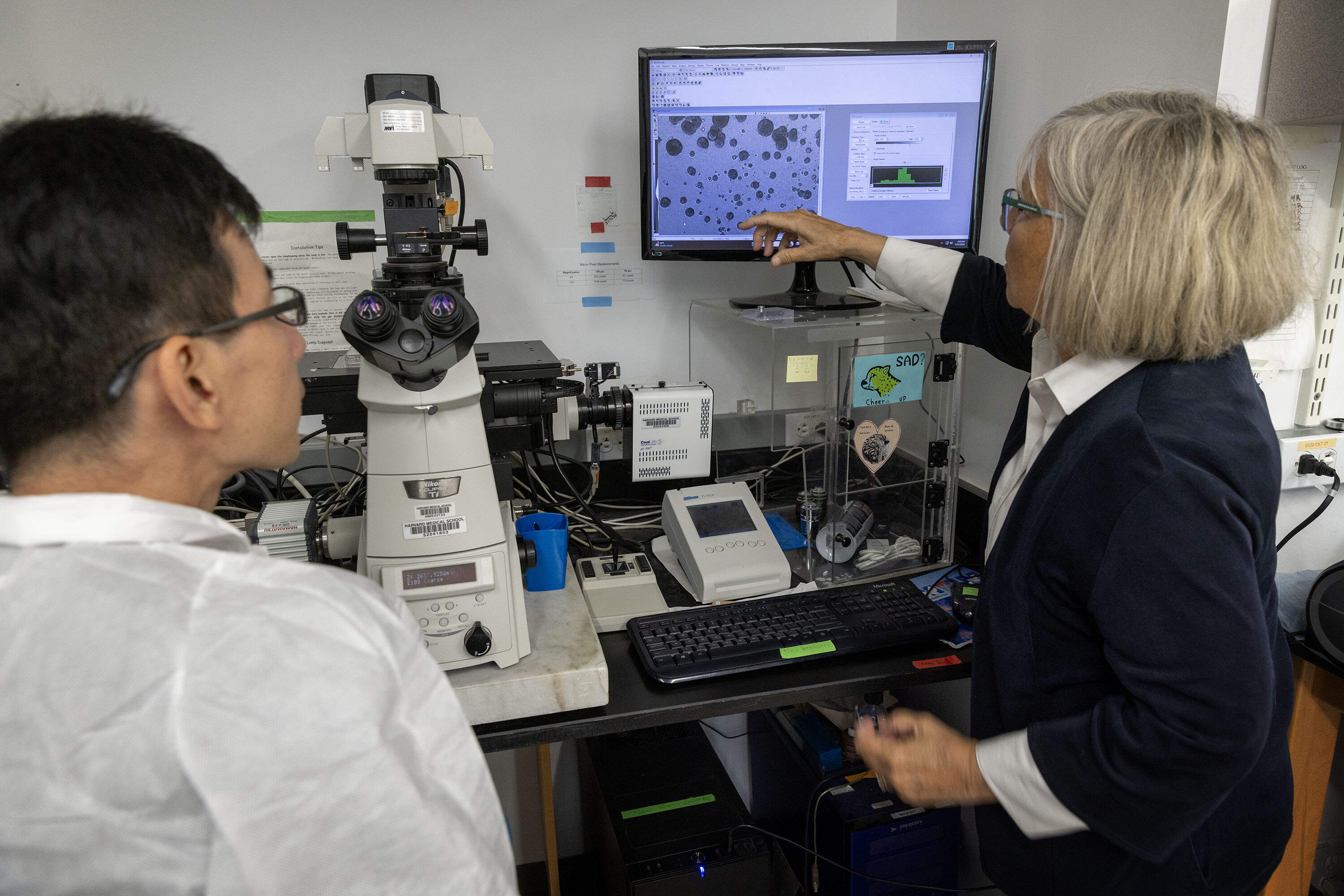
In May, after the Trump administration decided to freeze federal research funding for Harvard because of alleged failures to protect Jewish students from antisemitism, I called up a veteran scientist named Joan Brugge. She was attending a cancer research conference when she picked up the phone.
“I’m in shock,” Brugge told me. “To have my ability to do that research terminated for what you could consider political reasons is unimaginable.”
Brugge had recently published a study that identified the exact cells that form breast tumors. And her research found evidence we’re all walking around with these cells. Her lab was searching for ways to isolate and kill them when the federal funding freeze hit.
Women in the United States, on average, have a 1 in 8 chance of developing breast cancer in their lifetimes. And the disease touches us all.
I hate getting a mammogram. I hate getting the call that says, “We found something, can you come back in?” I hate having someone stick a needle in my breast to biopsy that something. Luckily for me, any breast cancer scare has ended there, so far. My adored colleague, Lisa Mullins, survived that diagnosis 20 years ago. And I’ve known so many people who didn’t survive the disease, including several men.
Critics of the National Institutes of Health, which is the largest funder of cancer research in the world, argue that research institutions such as Harvard have become too dependent on the federal government and should rely more on private-sector funding.
The conservative Heritage Foundation says grants like Brugge’s disproportionately benefit blue states such as Massachusetts, and are inflated by what the NIH calls “indirect costs,” — funding to support lab facilities, equipment, supplies and administrative work. Brugge had a seven-year grant from NIH worth $7 million; 40% of the money went to those indirect costs.
Many scientists acknowledge the need for some changes at NIH and other federal research agencies. But as Pierre Azoulay, a professor at the MIT Sloan School of Management, told me last week, “we need a scalpel, not a hatchet, in thinking about reforming the system.”
Azoulay co-authored an analysis that illustrates how President Trump’s proposed 40% cut to NIH funding might affect scientific advances. He and his colleagues found that since 2000, NIH-funded research directly contributed to at least 7% of drug patents and played a role in nearly 60%.
Earlier this month, the federal government resumed sending a portion of Harvard's grant funding, but Brugge said she has not seen any of that. Then this week, the Trump administration took steps to bar Harvard from receiving any future federal research funding.
Brugge told me that a third of her staff have left since the initial freeze took effect. I talked to a remaining lab member who plans to leave soon. She’s a computational biologist who was analyzing breast tissue cells, aiming to sort the good from the bad — the ones that could develop into cancer within any of us. She’s trying to leave a clear summary so that someone else can resume her work at some point — if funding is restored.
You can read more about my visit to Brugge’s lab here. I don’t know what happens next with her research, but I do know I want to live in a world where fewer people get breast cancer.