Support WBUR
Boston School Committee approves changes to exam school admissions
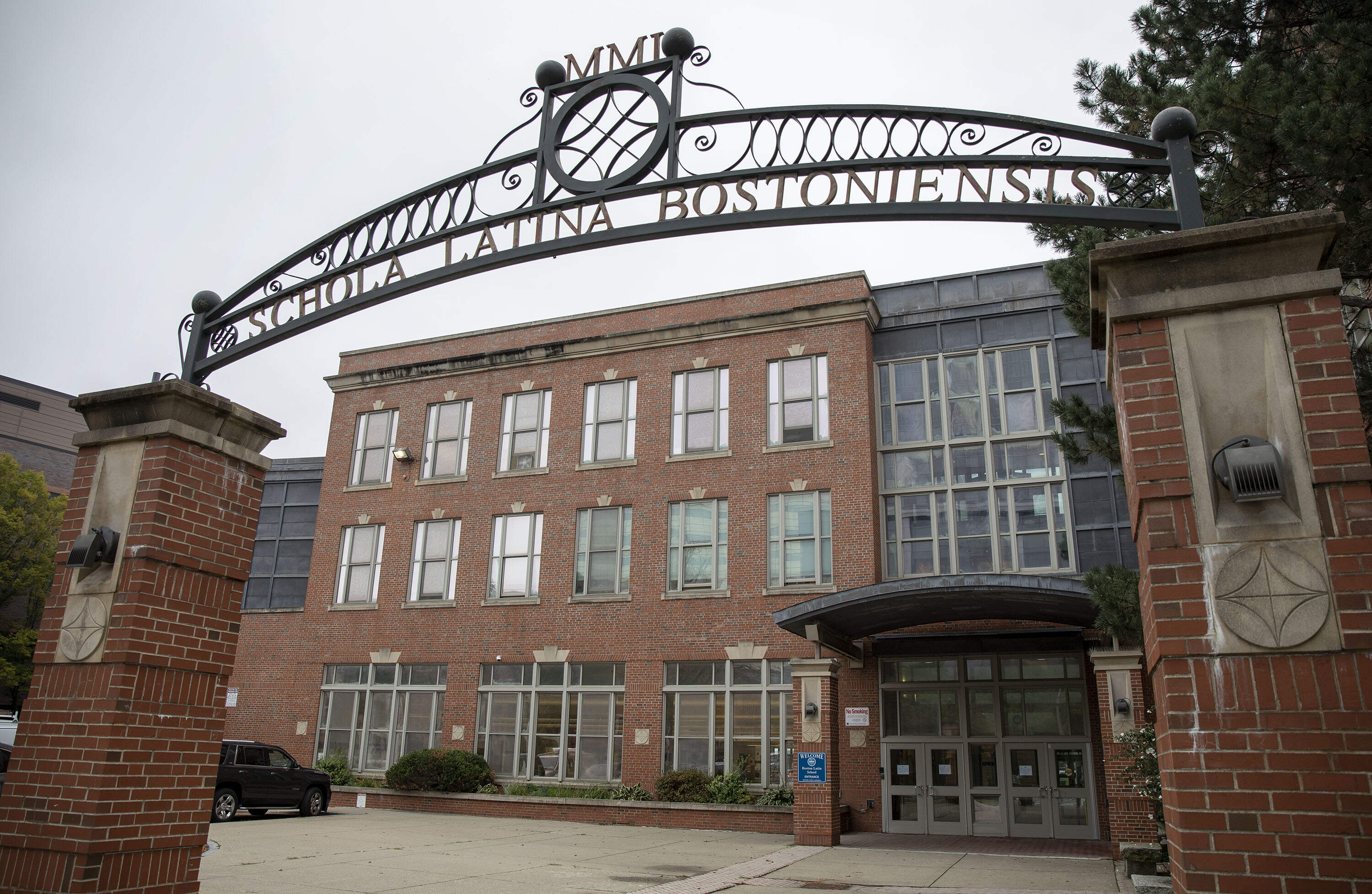
The admissions policy for Boston’s prestigious exam schools is once again changing, after the school committee approved a proposal Wednesday evening that could result in fewer Black and Hispanic students earning spots.
Under the new policy, a fifth of open seats at the three schools will be offered to top-performing kids citywide, based on grades and test scores. Bonus points for applicants attending high-poverty schools will be eliminated, and extra points for kids without stable housing will be reduced.
The remaining 80% of open seats will be distributed as they are now: Applicants will vie for spots against other kids in their same socioeconomic tier based on grades and test scores.
“Even though I may not like all of the options that we have … we have to move forward,” said Boston Schools Committee Chairwoman Jeri Robinson, who voted in favor of the changes. “Stopping this process now only frustrates actual families for whom this will be a next step.”
The proposal is meant to simplify the policy for more “fair and equitable access to the exam schools,” Superintendent Mary Skipper said at the meeting. She said it can be “sometimes mathematically impossible” for an academically-qualified student to earn a coveted seat because of where they live in Boston.
The new admissions policy, approved by a 4-2 vote, will affect students applying for next school year.
Annually, there are about 1,000 seventh grade seats offered at Boston Latin School, Boston Latin Academy and John D. O’Bryant School of Mathematics and Science. The exam schools, which span grades seven to 12, have a rigorous curriculum and a high graduation and college admissions rate among all of the district’s 32 high schools.
Parents hoping to position their child for a better shot at admissions under the bonus points sometimes begin "school shopping" as early as the fifth grade, one father testified at a Sept. 25 debate over the proposal.
The admissions structure has gone through several iterations in the past. The current tiered system was approved in 2021 to make the schools — which tended to enroll a higher number of white and wealthy kids — more representative of the district’s student population.
Black students comprised 30% of the district, but only 14% of exam school invitations in 2020-21. Hispanic students made up 42% of the district but only 21% of invitations.
In the four years since the existing policy took effect, the percentage of Black students admitted to exam schools increased to 20% and Hispanic students to 25%.
Meanwhile, the percentage of white students invited dropped from 40% to 27%. The change among Asian students was minimal, changing from 21% to 20% in that span.
Simulations by the district show that under the new proposal, the balance would once again tip: invitations to Black students would decline to 15% while those for white students would go up to 33%.
The percentage of seats awarded to multilingual learners and students with disabilities would also go down under the new plan, the district's estimations show.
School committee member Stephen Alkins voted against the new proposal. He said exam schools are “not just educational options” but “gateways to better outcomes, better lives.”
“These are also gateways that have for a long period of time been shut out by many of our most marginalized populations who now represent the majority of our district,” he said at Wednesday's meeting.
Committee member Rachel Skerritt, a former Boston Latin head of school, voted in favor of the plan. She noted the exam schools “are not just schools with high demand and high interest.”
“They're schools with a specific curricular design intended to provide an accelerated course of study beyond what is considered typical grade level work,” she said.
However, Skerritt argued that raising academic achievement standards for students across the district should be the longer-term policy solution when not enough city students are considered proficient in English language arts and math.
“ The students we serve in BPS who are predominantly Black, Latino, and or low income, deserve the opportunity to compete within their tier and citywide regardless of their school and circumstance,” she said.
“If we sustain the low expectations that readiness and preparation is not a responsibility of BPS, we will continue to educate with an ethic of mediocrity,” Skerritt added.
The application process kicks off soon, with testing dates approaching next month. Skipper requested the new policy remain fixed for at least three years to evaluate its impact.
Along with Robinson and Skerritt, committee members Michael O’Neill and Quoc Tran voted in favor of the proposal. Rafaela Polanco Garcia joined Alkins in voting against it.