How cranberries go from Mass. bogs to your Thanksgiving plate
Editor's Note: This is an excerpt from WBUR's Saturday morning newsletter, The Weekender. If you like what you read and want it in your inbox, sign up here.
I’ll be the first to admit that I don’t think of cranberries much outside this time of year. The tart-sweet sauce is an essential addition to the Thanksgiving table, but much like stuffing, it’s not on my plate (or in my mind) until November hits.
The case is the opposite for local cranberry growers. As the fall harvest wraps up, this month offers a brief reprieve from months of caring for and about cranberries. The work for next year’s harvest begins again in December, not long after the many of us have had our fill of cranberries for the season.
“It’s like Bill Belichick says, next season starts tomorrow,” said Steve Ward, a cranberry grower from Carver, which was once the top cranberry-producing town in the world.
Each year, Massachusetts’ cranberry farmers grow and harvest roughly 200 million pounds of cranberries, which are then sent off to be dried, juiced, boiled into a sauce or, if you’re bold, eaten raw. Here’s a glimpse at their yearlong effort to bring their crop to your plate in time for Thanksgiving.
Growing season
Though cranberries technically grow between April and November, farmers say maintaining a bog is a year-round endeavor. “We joke that there are 365 days of the year, and the last day of picking is day 365. Then day one of next year starts,” said James Ross, a cranberry grower from the Cape Cod town of Barnstable.
Like strawberries, cranberries grow on thick, trailing vines that sit low to the ground and do not need to be replanted annually. “Next year’s crop is technically already in the bog,” said Ward, who has been working on his family bog for 50 years.
The challenge is making sure that crop can survive as temperatures drop in the winter. Early on, cranberry buds can handle temperatures close to zero, Ward said. But they become more sensitive to cold as they grow from December to March.
To protect them, farmers will monitor the temperature in their bogs — anything below 25 degrees could kill the crop — and flood them with water to protect the vines from freezing. It also helps to intermittently spread sand over the area, a practice that dates back to the 1800s, when Henry Hall, one of the first commercial cranberry growers in the state, discovered that sand blowing in from the dunes in Dennis helped fertilize and protect his cranberry vines, among other benefits.
Through early spring, the bogs are regularly irrigated and inspected for weeds and pests. “And in April, the plants start to wake up,” said Ward. This begins the period of active berry growth that stretches through the summer. Freezing is less of a concern during this time. Instead, farmers worry about bugs, fruit rot and over-fertilization. Ward said he spends a lot of time in June and July “walking in the bog, just looking for problems.”
Despite careful maintenance, this year was not without its problems, thanks to the weather. “A cranberry vine can handle about one stress event per year, and we had three,” said Ward. “We had a very cold winter, a very wet spring, and we got pounded with drought.”
The difficulties resulted in a lower than average harvest, said Ward. He predicts Massachusetts farmers will glean a total of 160 to 170 million pounds of cranberries from this year’s harvest, down from 220 million pounds in 2024.
From bog to table
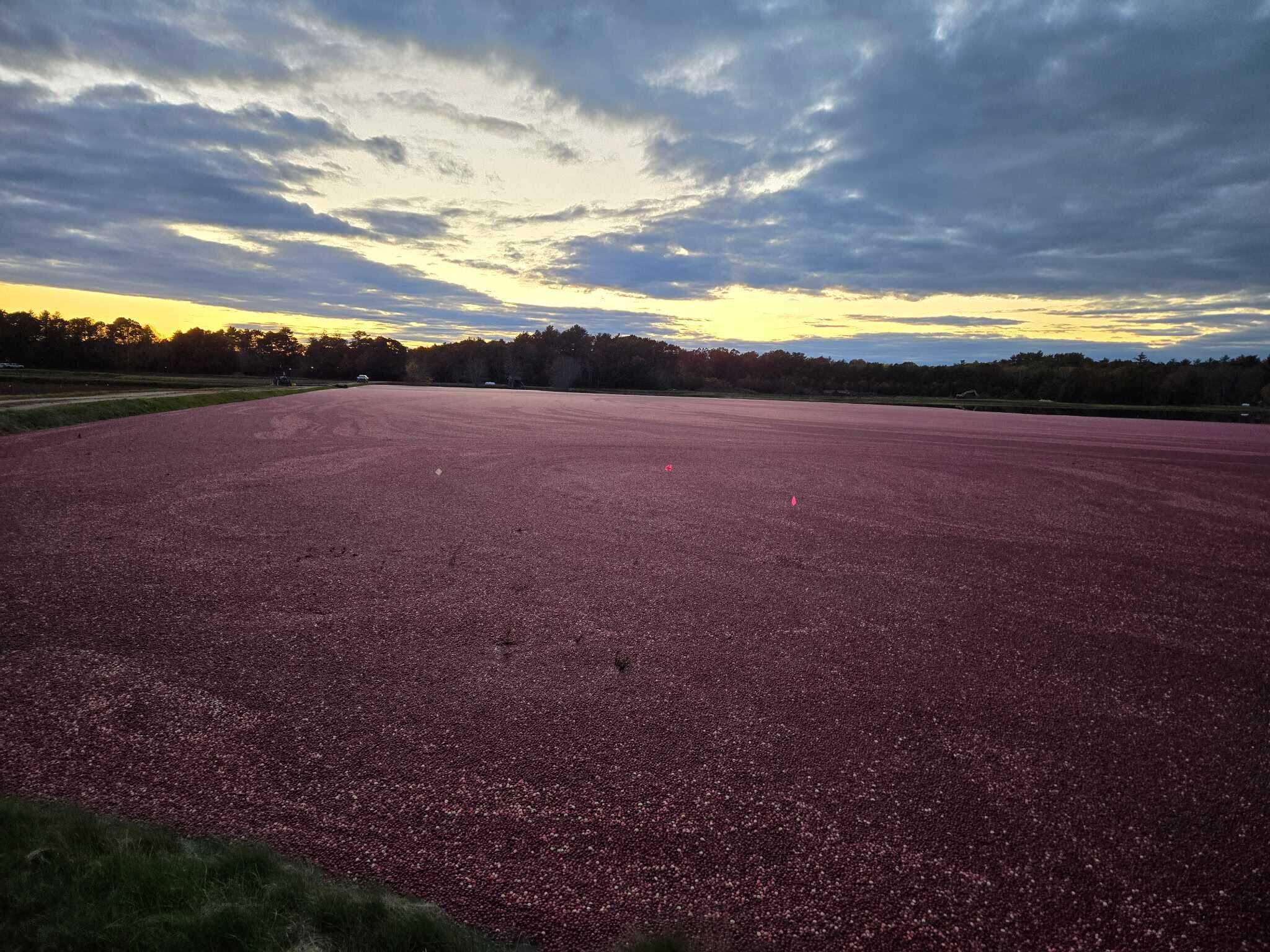
The image we have in our minds of cranberry growers wading through a big bog isn’t the way most fruit is harvested. Farmers primarily use a method called “wet harvest,” in which bogs are flooded with water so that harrow machines can till the vines. Berries then float to the top of the water where they can be collected. According to the Massachusetts cranberry growers' association, about 95% of cranberries are harvested this way — the other 5% are harvested dry, which produces the fruit you’ll see at farm stands.
Once a day’s harvest is complete, cranberries are packed into 1,000-pound barrels and sent to a number of processors. Ross primarily grows fruit for Decas Cranberry Products in Carver, while Ward’s fruit generally goes to Ocean Spray.
Cranberries grown in Massachusetts this year probably won’t be processed for a few months. (Larger companies tend to freeze the fruit before sending it to production, said Ross.) That means the can of cranberry sauce you’re having this Thanksgiving may very well be made with last year’s crop.
Cranberry capital competition
Despite the cranberry being Massachusetts’ official state berry, beverage and color, the Bay State lost its mantle as the nation's top producer in the 1990s. Now, the state is second to Wisconsin, which laps Massachusetts in annual production. Last year, Badger State produced approximately 600 million pounds of cranberries — about three times as much as Massachusetts. The competition doesn’t end with Wisconsin, either. Ward says Washington, Oregon and countries like Chile and Canada are quickly increasing their annual cranberry output. Massachusetts, on the other hand, has seen a slight dip in output in recent years. In 2020, a study found that 20% of Massachusetts’ 375 cranberry bogs were “highly likely” to be retired this decade.
“We’re playing with supply and demand,” said Ward.
Cape Cod also continues to be in a state of significant drought, which Ward said could affect next year’s harvest. Still, he is optimistic.
“Every year there are challenges. But what I know about cranberries is that when you don’t have a good crop, you’ve got some energy stored in those plants,” he said. “I wish, you know, I hope for that great crop.”
P.S. — What happens to cranberry bogs if growing fruit isn’t feasible (or profitable) anymore? Some farmers in the state have converted their bogs into wetlands, though the process can take years to complete. Read more about those efforts here.