Support WBUR
Fitchburg police said they were neutral during an ICE arrest. Onlookers and federal agents saw it differently
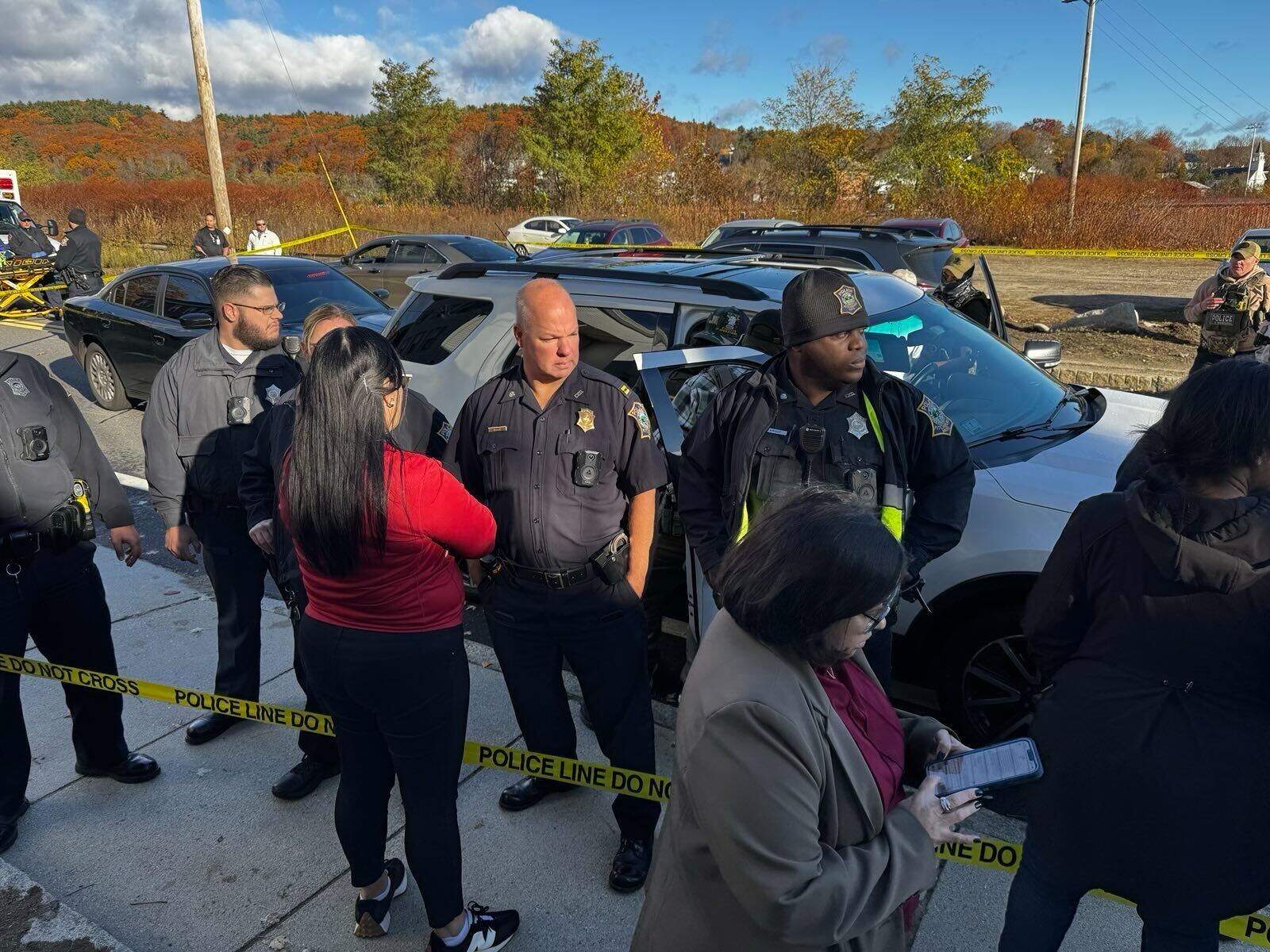
It was just after 7 a.m. when masked immigration agents pulled over a family driving in Fitchburg. The agents were there to arrest a woman in the car, whom they believed was in the country illegally.
A man inside the car, the child's father, was undocumented too, according to police reports obtained by WBUR, but agents did not want to arrest him “because of the child’s presence.”
In the police narratives of the events that Nov. 6 morning, Captain Jeffrey Howe wrote that upon arriving at the scene, “My intention was to serve as a resource and to ensure the safety and wellbeing of all involved, particularly the child.”
But what played out over the next two hours was a chaotic arrest that went viral, with footage showing the father appearing to have a seizure while agents grabbed him, sparking protests in Fitchburg and outrage online.
The police accounts highlight a delicate balance local officers say they’ve had to strike when responding to immigration enforcement actions. While police often want to avoid family drama and angry protests, they also face pressure to protect federal agents.
“I wanted both parties to understand that the [Fitchburg Police Department] was sympathetic to their situation, especially considering the child, but also that we had no authority over the actions of the federal agents,” Howe wrote.
Howe said when he arrived, he saw the mother in the car, holding the child, and the father embracing her. Howe asked his colleague, Sgt. Mei-Ling Polanco-Diaz, to translate for the couple. In the report, Polanco-Diaz said ICE had showed her an administrative warrant to detain the woman, Juliana Milena Ojeda-Montoya, who is facing charges for assault and battery with a dangerous weapon.
But it soon became clear the couple were not going to leave the car.
Howe said he ordered his officers to leave the scene, writing that the federal agents would need to "handle the matter."
As they were leaving, he wrote, a small crowd had begun to form nearby. An agent approached Howe and asked him to contact the feds’ supervisor.
When he called, speaking to a person whose name he didn’t know, “The individual demanded that I return to the scene and accused me of abandoning the agents. I assured him that the scene was secure and that I would have officers return if needed to keep the peace.”
A few minutes later, the same person called his cell phone, Howe said, to say a crowd was forming “and his agents were in danger.”
Howe said he immediately requested backup and returned to the scene. Howe said there were about 12 people watching from the side of the road by then, and others across the street. Some people yelled as they drove by. Howe had the roadway blocked and put up crime scene tape to keep protesters away from the federal agents.
Howe said he recognized one of the bystanders from prior community policing efforts and “relied on her to help calm the group, which she did several times.”
Tensions escalated, Howe said, when one of the federal officials “identified as the on-scene supervisor, began pointing and yelling at the crowd.”
Polanco-Diaz, in her report, said as the crowd grew larger and “increasingly hostile,” some people shouted “You should all be shot dead” toward ICE agents and Fitchburg officers.
Around this time, the man in the car, Carlos Zapata, appeared to suffer a medical emergency, according to the police narratives. Bystanders yelled that he was having a seizure. Polanco-Diaz called for an ambulance.
But when the medics arrived, an ICE agent waved them off saying “he’s fine,” according to Polanco-Diaz's report. The agents then put Zapata in handcuffs, only to later release him.
ICE agents asked Fitchburg officers to take custody of the child. But local police said they could not, and instead provided contact information for the Department of Children and Families.
The mother, Ojeda-Montoya, was arrested and taken away in an unmarked vehicle. She was later released from a facility in Maine.
Agents allowed Zapata to remain with the child as he waited for an immigration lawyer. He left with his kid, the attorney and one of the observing activists by 9 a.m., and the scene was finally cleared.
The family's lawyer did not respond to a request for comment on the version of events presented by Fitchburg police.
The Department of Homeland Security's account of the incident called into question Zapata's medical emergency. In a press release, the Department of Homeland Security said both parents had stated they were willing to put the child into state custody.
"Once Zapata realized he would be arrested for immigration violations if he did not agree to take custody of the child, he suddenly decided to be a good father and left with the child," the department wrote in a press release following the arrest.
While the police accounts described officers trying to keep the peace and stay out of federal business, Taylor Schneider, a volunteer with the LUCE Immigrant Justice Network, a local ICE watchdog group, said some bystanders had a different impression. They said police appeared to take the side of the ICE agents, standing between protestors and agents with their backs to the agents.
“I don’t think they were needed — not in terms of protecting ICE,” Schneider said of the police. “I think one of the ICE agents could have gotten out of control because he was very agitated with the presence of people watching.”
“It definitely felt like they were there for ICE.”
WBUR's Chris Van Buskirk contributed to this report.