Support WBUR
Review
22 years later, 'Kill Bill' is in theaters the way Quentin Tarantino intended
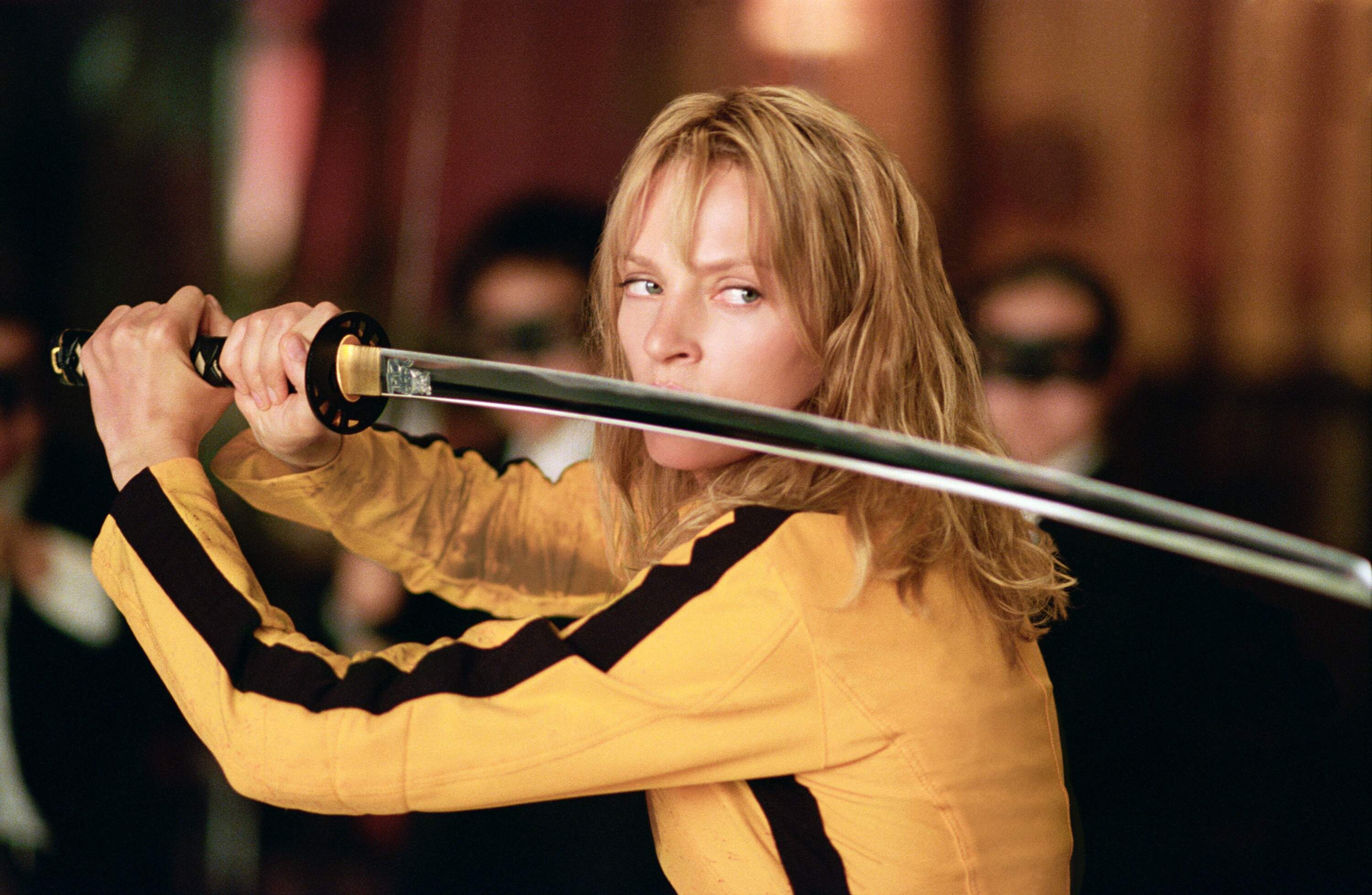
This weekend’s release of “Kill Bill: The Whole Bloody Affair” reminds me of when Quentin Tarantino’s “Kill Bill: Vol. 1” came out in October of 2003, and I joked in my review that it was the first time the deleted scenes you’d see on a DVD were released before the actual movie. Splitting films in half to maximize profits wasn’t common practice back then. Like a lot of awful things in Hollywood, it started with Miramax studio boss Harvey Weinstein, who was looking for a way to recoup costs when Tarantino’s massive martial arts epic came in over budget and way overlong. Cutting “Kill Bill” into two movies not only gave Miramax two bites at the box office apple, it also saved Weinstein from the kind of bad press he’d gotten the previous year during a public wrestling match with Martin Scorsese over the running time of “Gangs of New York.” (The mogul’s reputation for editing room interference had earned him the nickname “Harvey Scissorhands.”)
Nowadays, everybody does this. Just ask the vaguely dissatisfied audiences on their way out of “Wicked: For Good,” many of whom seem to be wondering why the filmmakers couldn’t have taken care of this all in one sitting, like they do every night on Broadway. The bifurcation of “Kill Bill” established a precedent that YA series adaptations really ran with. Whenever producers ran out of books, they’d stretch the final installment into two films to keep the gravy train going a little longer. This is how the second-to-last “Harry Potter” film ended up being a whole movie of kids walking around the woods, and why the wedding scene in “The Twilight Saga: Breaking Dawn – Part 1” was longer than the one in “The Deer Hunter.” My favorite of these was when “The Divergent Series: Allegiant – Part Two” went unmade due to lack of interest. Now we’ll never know what happens.
“Kill Bill” was conceived, written and shot as a single movie. Tarantino screenplays are structural marvels — achronological and dependent on complicated plants and payoffs. “Kill Bill” in particular backloads all the important character development and key story beats to the second half, so that they recontextualize the cold, brutal vengeance dished out by Uma Thurman during the first. Taken on its own, “Vol. 1” was an icy, sadistic spectacle with no arc or emotional reward. (Hence my deleted scenes crack.) The seven-month break in the action before “Vol. 2” hit theaters in April of 2004 did the film no favors, except in Miramax’s accounting department.
At the Cannes Film Festival in 2006, Tarantino unveiled “Kill Bill: The Whole Bloody Affair,” which recut the two films back into one, as originally intended. Over the years, he’s hosted rare screenings of this edit at the New Beverly and Vista theaters he owns in Los Angeles. Now everyone’s finally going to have a chance to see “Kill Bill” according to Tarantino’s wishes, as “The Whole Bloody Affair” is rolling out to more than 1,000 multiplexes uncensored and unrated at a whopping 275 minutes, including a 15-minute intermission. (The Coolidge Corner Theatre is one of nine theaters in North America that will be projecting it on 70mm film.)
This version is said to include a never-before-seen animated sequence from Japanese anime studio Production I.G, who also handled the Lucy Liu character’s grisly origin story in “Vol. 1.” This isn’t to be confused with “The Lost Chapter: Yuki’s Revenge,” a 10-minute short Tarantino recently made available via the massively popular video game Fortnite. Taken from a never-filmed sequence from the first draft of the original “Kill Bill” screenplay, it finds the twin sister of fan-favorite assassin Gogo Yubari tracking a motion-capture animated Thurman down in Los Angeles. Lackluster PG-13 mayhem ensues, as do inexplicable cameos from various Fortnite characters that I will need to have my nephew explain to me sometime. Blessedly, this promotional stunt is not included within the new edit of the film itself, but will be presented after the closing credits.
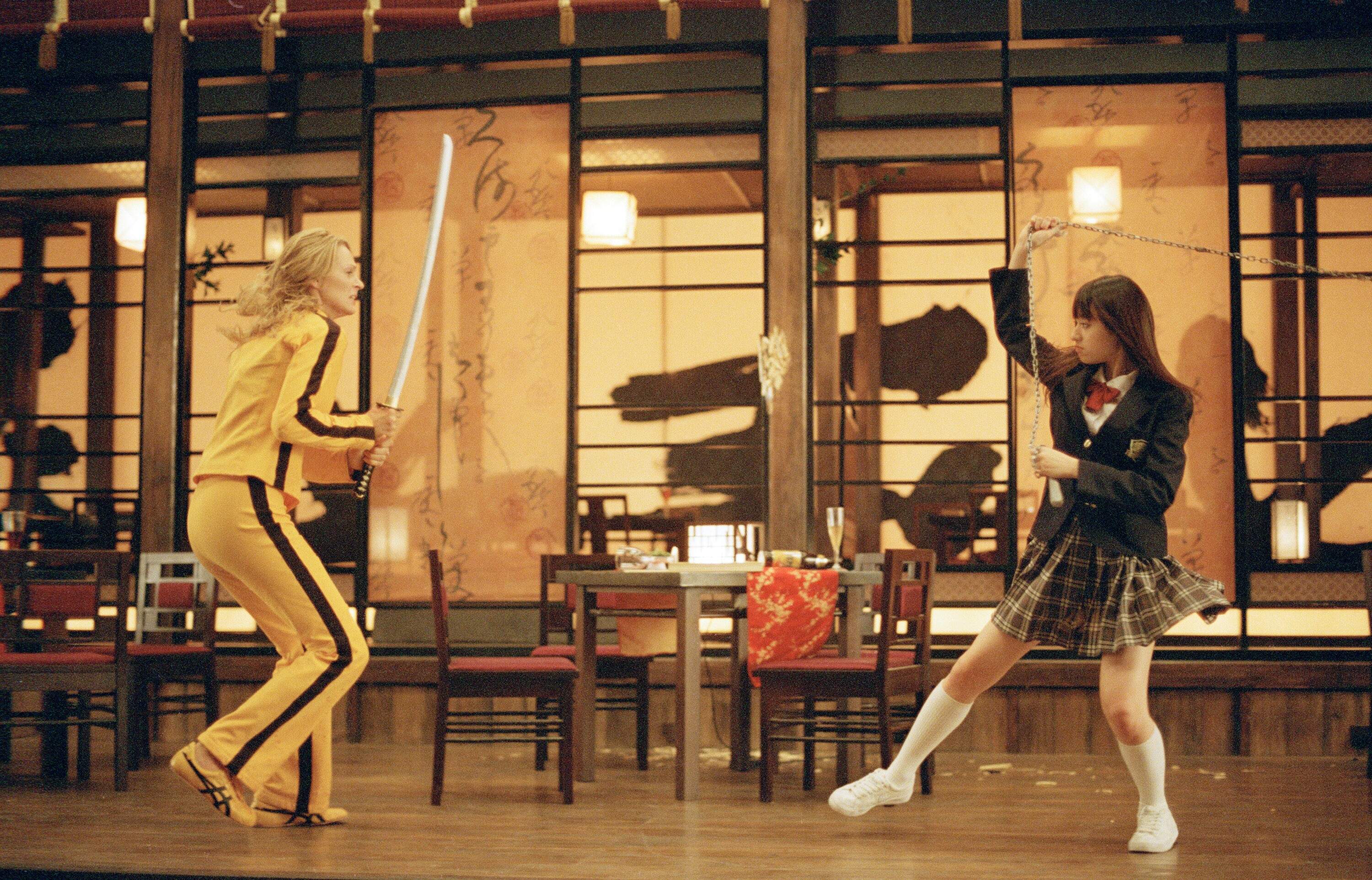
More exciting is that “The Whole Bloody Affair” is the first time U.S. audiences will be able to see the movie’s extraordinary swordfight massacre uncut and in full, eye-popping color. When the sequence proved too gory for ratings board censors, Tarantino was able to keep the extreme content by only showing it in black and white. (This is like when Scorsese saved “Taxi Driver” from an X rating by toning down the colors in the film’s final reel. The MPAA doesn’t seem to have trouble with blood so much as they don’t like the color red.) Choreographed by the legendary Yuen Woo-Ping, it’s one of the most astounding action sequences of this century, with Thurman dispatching dozens upon dozens of masked henchmen while wearing Bruce Lee’s canary yellow jumpsuit from “Game of Death,” an iconic look the actress instantly made her own.
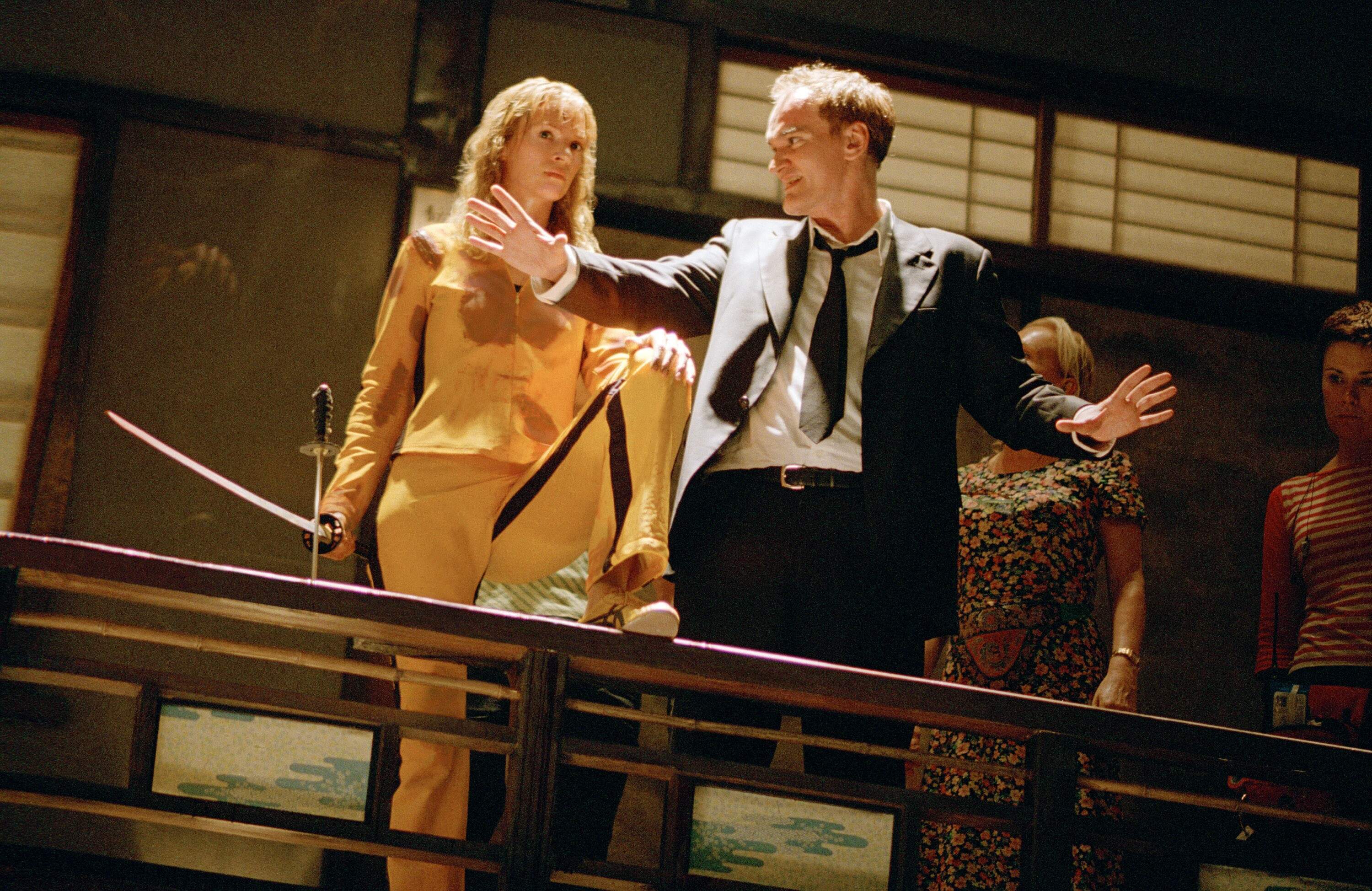
In whatever form you may find it, “Kill Bill” remains perhaps the purest distillation of its auteur’s fetishes and fixations, mixing and matching spaghetti westerns, samurai sagas, blaxploitation, kung fu epics and grindhouse rape-revenge pictures into a lavishly produced, cinematically sophisticated smorgasbord of low culture and high style. It was a huge aesthetic turning point for Tarantino, departing from the deliberately drab, workaday Los Angeles locations of his previous pictures and entering a hyper-designed, soundstage universe entirely of the filmmaker’s imagination. This was the beginning of his collaboration with the brilliant cinematographer Robert Richardson, whose trademark searing colors and blown-out overhead spots had already established the inflamed visual language for Oliver Stone’s “The Doors,” “JFK” and “Natural Born Killers,” as well as Scorsese’s “Casino” and “Bringing Out the Dead” before he became Tarantino’s go-to guy.
This was also when Tarantino started focusing exclusively on revenge pictures for the next decade or so. It’s a subject that obsesses him and one that I personally find of limited interest. “Kill Bill” can be a bit puerile and overly pleased with itself. It’s no accident that “Do you find me sadistic?” are the first words we hear in the film, and the director has never hidden his unseemly penchant for lingering on the helplessness of victims, both those who deserve it and those who don’t. A friend recently wrote that “in Tarantino’s world, violence is something the powerful do to the powerless,” and I don’t think I’m being squeamish or a prude when I admit that kind of wallowing can grow tiresome. (I’ve always been more of a “Jackie Brown” guy.)
The film is easily Thurman’s best work, as Tarantino was one of the only directors who ever really figured out how to use her distinctive physicality. I’ve also always adored Michael Madsen’s soulful performance as a rotten guy who knows he’s got it coming, but he’s not going to make it easy. The one casting whiff is the titular William. The role was originally written for Warren Beatty — the mind reels — and after he turned it down, Tarantino briefly considered Bruce Willis. He ended up going with “Kung Fu” star David Carradine, who can certainly play a killer of ladies, but doesn’t quite cut it as a ladykiller. It’s the one time I feel like the director’s flair for casting forgotten ‘70s icons failed him.
“Kill Bill” is electrifying, frustrating, revealing, impeccably crafted and about as thrillingly, embarrassingly self-indulgent as one might expect from a prodigiously gifted, grown adult man given seemingly limitless resources to make a four-and-a-half-hour movie about a team of sexy female assassins named after poisonous snakes. It is also, in its present form, finally complete. At this rate, in 2046, we’ll be sitting down to watch “Wicked: The Whole Bloody Affair.”
“Kill Bill: The Whole Bloody Affair” is now in theaters and starts screening in 70mm at the Coolidge Corner Theatre on Friday, Dec. 5