Support WBUR
Acting ICE director Todd Lyons faces a maelstrom — even on his home turf in Boston
As Massachusetts proposes action to rein in federal immigration agents, the Boston native who now leads them is under scrutiny. People who know Todd Lyons from his days working in the state say he's taking a harder line than he once did.
Before he became acting director of U.S. Customs and Immigration Enforcement last year, Lyons ran enforcement and removal operations at the agency's Boston office. In President Trump's first term, Lyons had said ICE was improving public safety, using specialized officers and focusing on dangerous criminals.
In a 2020 interview with WBUR, Lyons had said he wanted to change the perception that agents were targeting non-criminal immigrants.
"We're painted with a very broad brush in a very bad way," Lyons said. "I think by us getting out there and showing the public safety threat that we can work on and what we actually do — and that we're not rounding up everyday people just going about their business."
But since taking the top job in Washington, Lyons has led national ICE operations that have deployed aggressive tactics in cities across the country, including around his hometown of Boston.
The Trump administration's crackdown has drawn widespread public outrage and recently has faced criticism even by some in law enforcement, after federal agents fatally shot two U.S. citizens in Minneapolis.
In Massachusetts, Gov. Maura Healey has filed legislation and issued an executive order to curtail some of ICE's operations in the state. ICE did not respond to requests for comment for this story.
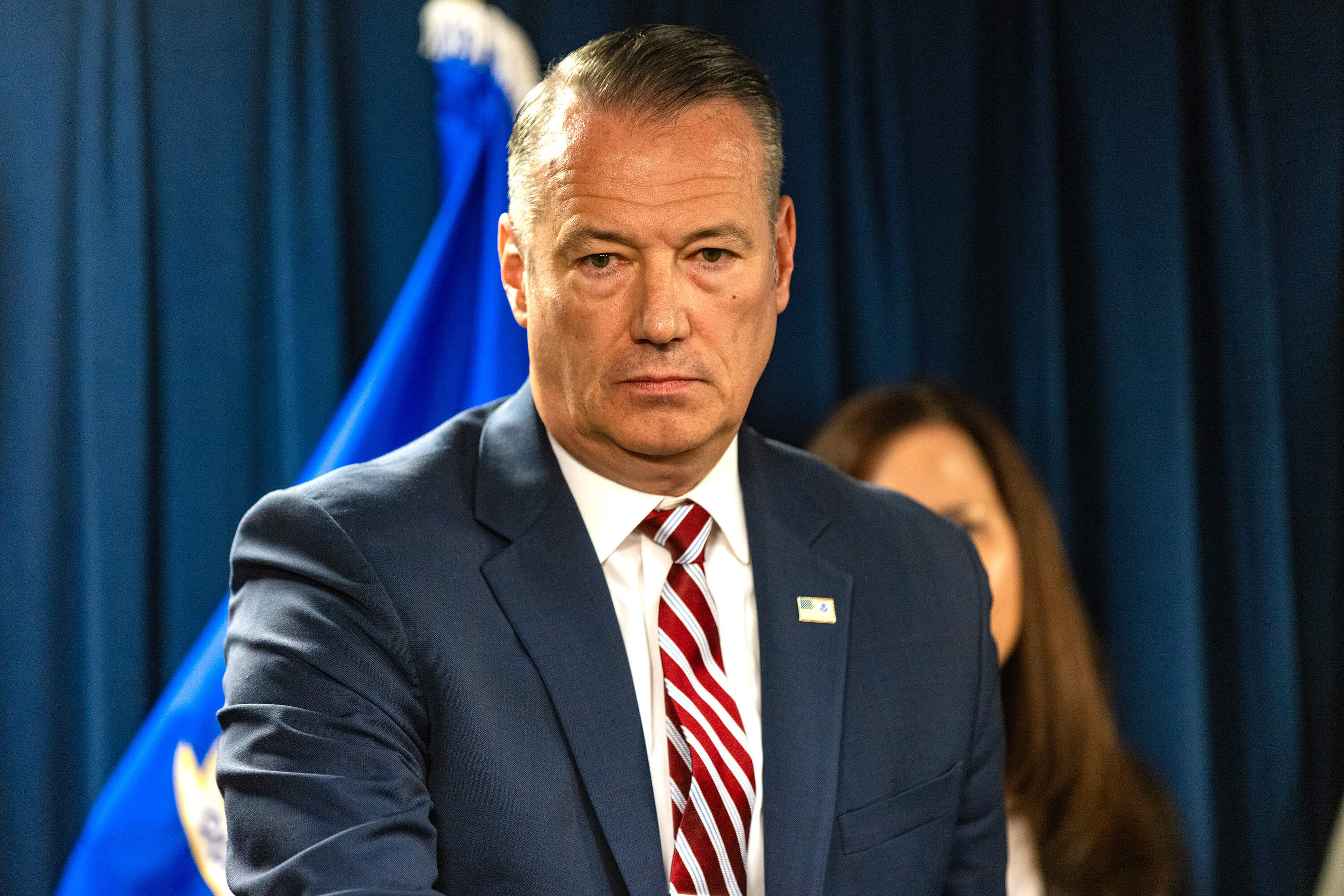
Lyons, 52, is a South Boston native who attended Boston College High School, holds a master's degree from New England College in New Hampshire and served in the U.S. Air Force.
He began working for the New England ICE office in 2017 and later became Field Office director for ICE Enforcement and Removal Operations in Boston. He was appointed acting assistant director of field operations for ICE in October 2024. Last March, he was made the acting head of ICE.
On his watch, the agency has been at the center of almost constant controversy. ICE and border patrol teams have smashed car windows to make arrests, detained many people without criminal records, sparked chaos in neighborhood arrests — and in Minneapolis, killed American citizens.
'A different persona'
Most recently, the chief federal judge in Minnesota ordered Lyons to appear in court — and threatened to hold him in contempt for refusing court orders to release a man who claimed he was unlawfully detained.
Judge Patrick Schiltz called it an "extraordinary step " to order the ICE chief to personally defend himself in court. But Schiltz said it was necessary because “the extent of ICE’s violation of court orders is likewise extraordinary.”
Schiltz, who was appointed to the federal court by Republican President George W. Bush in 2006, said Lyons had to appear before him unless ICE held a hearing for or released the detained man. ICE ultimately released him, and Lyons' Jan. 30 hearing was canceled.
Several local political and law enforcement leaders, as well as immigration advocates in Massachusetts, described Lyons as communicative and accessible when he was in New England. One advocate said Lyons sought to ease tensions after Florida Gov. Ron DeSantis sent about 50 migrants from Texas to Martha's Vineyard in a campaign stunt in 2022.
But about a month after his appointment as acting U.S. ICE leader, many of those same local leaders were shocked to hear Lyons talk about modernizing the agency to run more like a business. At a border security conference in April, media reports quoted Lyons as saying he wanted to see ICE run trucks rounding up immigrants for deportation the same way Amazon trucks deliver packages across the country.
Lyons has defended ICE agents wearing masks, a much-criticized practice that blew up in controversy after the March arrest of Tufts University graduate student Rümeysa Öztürk in Somerville. Lyons told reporters in an angry exchange that agents need to protect their identities because immigration protesters have publicly identified and doxxed agents to try to intimidate them.
"It does surprise me that Todd Lyons is acting director of ICE during this time of very aggressive activity," said Kerry Doyle, a former deputy general counsel for the Department of Homeland Security who's now an immigration attorney. "He is a different persona in this position now than the experience I had working with him when he was field office director."
Doyle said while Lyons' job likely requires him to follow White House directives, she's surprised he's been such a staunch defender of the crackdown.
"Historically, there has never been an issue regarding a collaboration between federal authorities and state and local authorities. This is a completely different level."
Suffolk County District Attorney Kevin Hayden
Lyons has said local officials and politicians are interfering with ICE and prompting protests, which have fueled hostilities in Minneapolis and other cities. He maintains ICE's actions are designed to target "the worst of the worst" and to identify dangerous criminals, even though it's been acknowledged by Trump administration officials that far more people without criminal records are being arrested..
Last June, federal immigration enforcement officials announced in Boston the arrest of 1,400 people in Massachusetts in what they called "Operation Patriot." At the press conference, Lyons said agents wouldn't have to surge into cities if local officials would cooperate with ICE.
"Boston is my hometown, and it really shocks me that officials all over Massachusetts would rather release sex offenders, fentanyl dealers, drug dealers, human traffickers, and child rapists back into the neighborhoods," Lyons said without offering specific evidence of that.
Suffolk County District Attorney Kevin Hayden is among the local authorities who dispute Lyons' claims. Hayden says state and local law enforcement do cooperate with ICE in criminal matters — not civil ones.
"Historically, there has never been an issue regarding a collaboration between federal authorities and state and local authorities," Hayden said. "This is a completely different level and a completely different time that we're seeing ourselves in now."
Hayden and several other local law enforcement officials say the high tensions in Minnesota and the deployment of ICE agents to cities in Maine have harmed public safety. He said victims and witnesses in Suffolk County are not going to courthouses because of fears of being deported.
"That has a chilling effect on our ability to do justice," Hayden said. "It has a chilling effect on public safety and our ability to hold offenders accountable."
The laws of ICE interaction
Healey, a former prosecutor and former attorney general, has said the conduct of federal agents in Minnesota runs counter to law enforcement standards and poses a threat to public safety.
The governor has called on Lyons' boss, Department of Homeland Security Secretary Kristi Noem, to resign.
Healey also has taken aim at an ICE memo, leaked by whistleblowers and apparently signed by Lyons. The memo gives agents broad authority to enter an immigrant's home to make an arrest without a judicial warrant, something immigration lawyers and advocates say violates the Constitution.
"That basically said, 'Throw away everything we’ve done for 250 years. Throw away the Fourth Amendment. You have the right to go into someone’s home,' ” Healey said at a press availability January 26.
The memo, dated May 12, 2025, said:
“Although the U.S. Department of Homeland Security (DHS) has not historically relied on administrative warrants alone to arrest aliens subject to final orders of removal in their place of residence, the DHS Office of the General Counsel has recently determined that the U.S. Constitution, the Immigration and Nationality Act, and the immigration regulations do not prohibit relying on administrative warrants for this purpose.”
For years, immigrant advocates advised people not to open their doors to immigration agents unless there is a warrant signed by a judge. The memo undercuts that advice.
The Boston-based group Lawyers for Civil Rights filed suit Friday over the memo, naming Lyons as a defendant. The group's executive director, Iván Espinoza-Madrigal, questioned its legality and said he's concerned about the "lawlessness" of ICE policies.
"All of this is intertwined in ways that not only make it unsafe for immigrants, but that impoverishes the rights of everyday Americans," Espinoza-Madrigal told WBUR.
"We are stuck in the middle. We certainly don't want to see anybody from the public get hurt, and we don't want to see any federal officers get hurt that have a mandate do a very difficult job."
Chief Michael Bradley
The Massachusetts Chiefs of Police Association said it has advised local police about handling public demonstrations involving ICE. Its main message to local departments is to de-escalate and keep the peace.
" We are stuck in the middle," the association's executive director, Chief Michael Bradley, said. "We certainly don't want to see anybody from the public get hurt, and we don't want to see any federal officers get hurt that have a mandate do a very difficult job."
Bradley said he's hopeful federal officials will meet with police associations to discuss best practices for collaboration when ICE agents are working in U.S. cities.
As protests against ICE continue, Lyons has defended his agency in recent interviews, saying ICE is keeping the country safe and following the nation's immigration laws. He promised the White House will target those states with so-called "sanctuary" policies that limit cooperation with federal immigration authorities.
Massachusetts isn't backing down. The bill Healey announced this week would prevent ICE agents from going into courthouses, schools, child care programs, hospitals and churches.
Healey also signed an executive order prohibiting the state from entering into any new 287(g) agreements to hold detainees on behalf of ICE, unless there is a public safety need. The order also bans ICE from making civil arrests in non-public areas of state facilities and prohibits the use of state property for immigration enforcement.
Lyons told the Boston Herald that Healey's actions are "reckless" and "inflammatory," and they "mislead the public and deliberately undermine federal law enforcement."
This segment aired on February 2, 2026.