Support WBUR
How the state's economic development chief is trying to make Mass. competitive and affordable
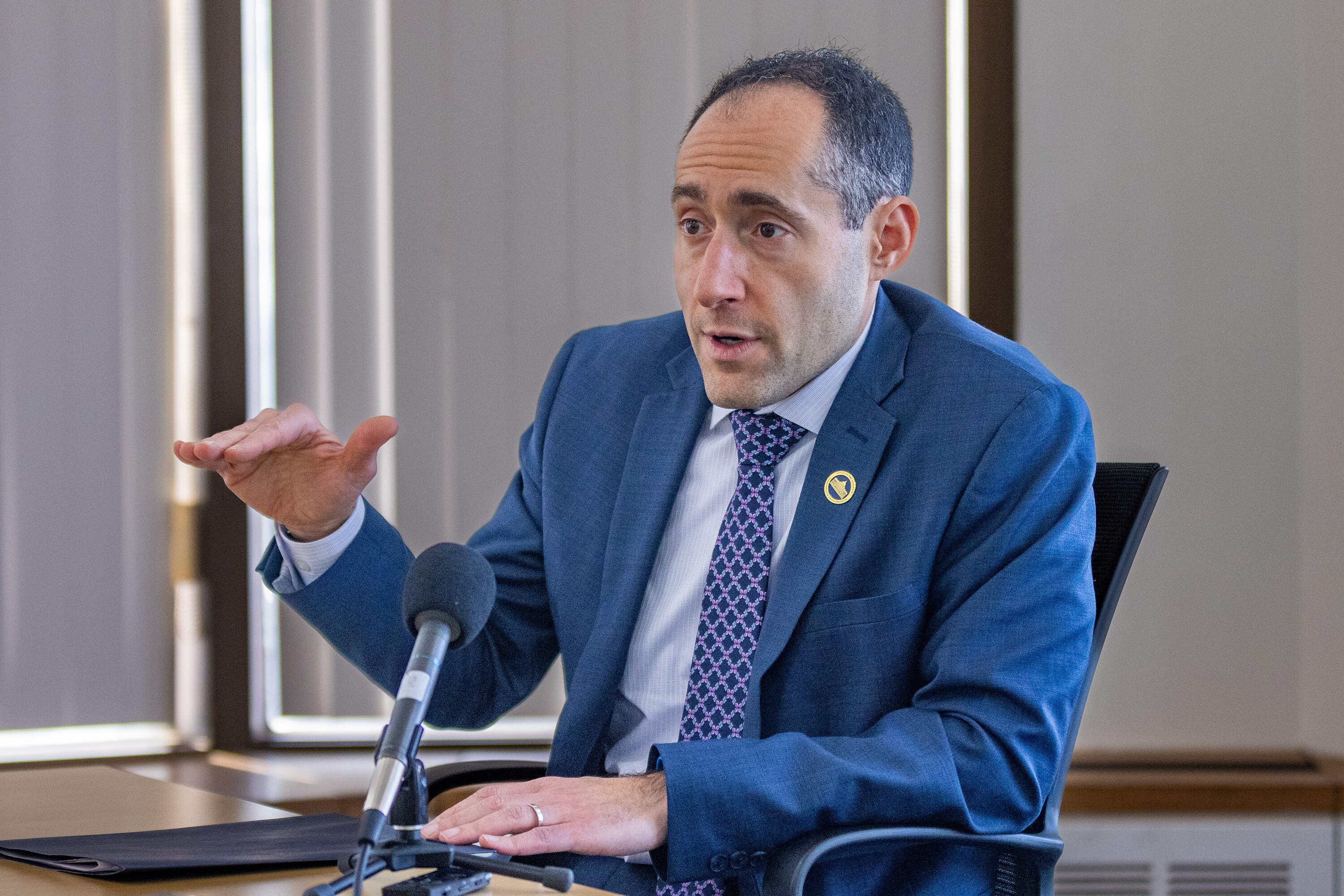
Eric Paley, a long-time venture capitalist, stepped away from a lucrative investing career last year, including being an early funder of Uber, to serve as Gov. Maura Healey’s second economic development secretary.
He joined amid turnover in the Healey administration and at a time when residents are grappling with rising costs of living. A leading trade group reported that businesses held a pessimistic view of conditions in the state for the last 10 months of 2025.
And the pressure is on: Healey has kicked off her bid for reelection against a trio of Republicans who regularly attack her over affordability, immigration and rising energy costs. In an interview with WBUR this month, Healey acknowledged the high cost to live in the state, and said she wants Massachusetts to be competitive — both in drawing businesses here and by making sure the state is an attractive a place to live.
Paley sat down with WBUR recently to talk about his role, how he views the state’s economy and the biggest challenges facing Massachusetts — and what an economic development secretary can actually do about them.
The following conversation has been lightly edited for length and clarity.
What did the governor task you with when you joined? What was the mission she gave you?
"We have a very complex economy with some really incredible strengths and some areas that really need to be improved. And the governor's charter to me is: Drive the economy the best you possibly can.
"We don't control monetary policy in Massachusetts. Deficit spending is not a possibility. We have to balance the budget every year...
"But there are ways we can be consistently thinking about how to invest in what I think of as laying the fertile soil so that we create ecosystems of growth across the economy."
You joined the Healey administration in the governor’s third year in office. Was the timing tough?
"I'd say the challenge is, most of the beginning period of the Healey-Driscoll administration, we've had a federal government that has been incredibly supportive of what we were trying to accomplish as a state. And that is not true anymore.
"Today the federal government is a headwind against many things we are trying to do. For example, I think if you want to have a globally leading economy for decades to come, investing in research and science is critically important. The federal government seems to have a different view of that, right, and is pulling dollars out of research and science as one example.
"So that is a real challenge, right? And so with the challenges we already had, which were also real things we needed to work on, I would say there's three areas of challenge. We've added a third and maybe the biggest challenge that we have to overcome economically."
If the federal government is the third challenge facing the state, walk me through the other two.
"Number one is affordability. We are one of the most expensive states in the country. When you income-adjust that, which is actually a very important thing to do, we are actually not nearly as expensive as it might look on the surface.
"But at the end of the day, we are an expensive state, and particularly around housing. So the governor's number one priority in her agenda is affordability, and the top intervention around affordability is housing.
"Two is competitiveness. There was, I think, a long period of time where other states were not so organized, not so forward-thinking, not so innovation-oriented. We are now seeing state competitiveness be very meaningful.
"And states are calling on our companies all the time, trying to recruit them, throwing a lot of incentives at them. And we need to create a climate where companies feel like Massachusetts is where they want to do business. It's the best place to do business, and we need to be doing more and more there."
On competitiveness, when you think about your day-to-day, are you reaching out to business contacts and trying to make the pitch that they should come to Massachusetts?
"There’s no question. I am out meeting with businesses that are expanding in the state, talking to businesses that want to expand into the state.
"We met with the Kingdom of Denmark, and we signed a [memorandum of understanding] and they brought a delegation of 20 business leaders who are looking at Massachusetts, and I co-facilitated the roundtable, talking about who matches best, and why they might want to consider Massachusetts. So definitely hands-on.
"But also, I'm very focused on trying to figure out, back to the fertile soil, how do we create the context so that it is more and more obvious that if you are a business here in Massachusetts, you wouldn't want to expand somewhere else."
There’s a ton of cynicism outside of government, in the business world, and in America at large about what government can actually do. Has your view of that changed since you took on this role? Has it evolved?
"I think there's so much cynicism about government because we spend so much time criticizing each other on both sides of the aisle, because there's so much horse trading that happens and stuff that ultimately isn't necessarily broad-based help. I'm more talking on a federal level.
"And then I think sometimes people think of government as slow and bureaucratic in ways that don't appreciate how much government needs to do stakeholder consensus building.
"And so what I think about a lot is, when I was in technology for the last 25 years, we'd always talk about your ICP — your initial customer profile. You'd pick a specific, very focused customer, you'd solve their need, and you push away everybody else.
"You'd say, listen, we're not trying to create a product that solves a problem for everybody. We want to describe exactly who this customer is and go straight after that customer. It allows you to do a great job moving quickly to define a product. Government can't do that. We cannot just say, ‘Oh, we only care about some singular constituency.’
"We have to be broad. We have to care about everybody broadly — doesn't mean we weigh everything exactly the same. We have to figure out what makes the biggest impact for the most people without also leaving people behind in ways that we should not be doing."