Support WBUR
Following outcry, BU president defends removing pride flags
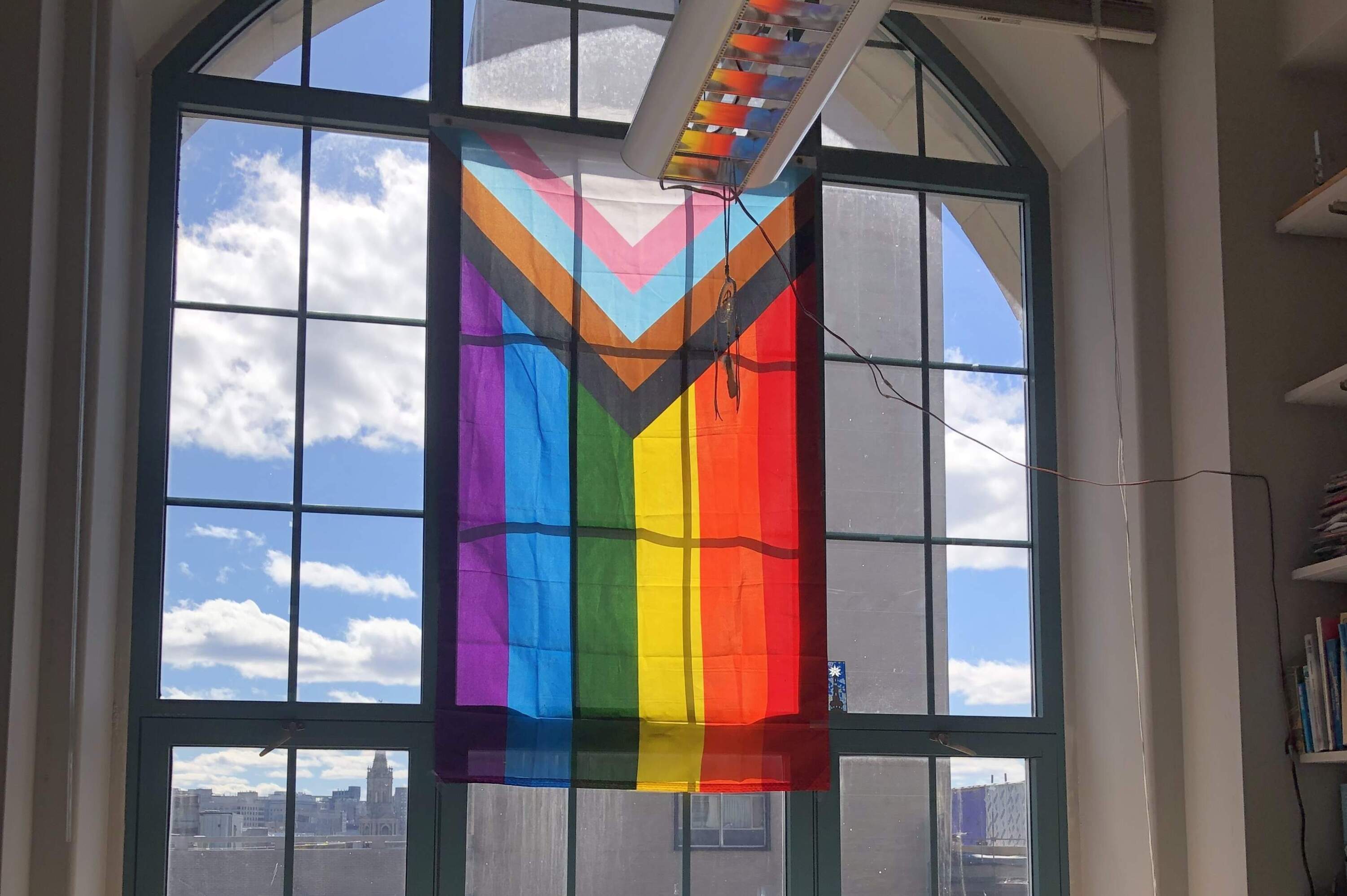
Boston University President Melissa Gilliam said there was “no targeting of any particular population” when school officials removed several pride flags from public view, insisting that the university's public signage policy is "content neutral."
“I want to be very clear that we have unequivocal support for our LGBTQIA plus community,” Gilliam said during a town hall-style event at the George Sherman Union Thursday morning.
Gilliam took about five minutes to address the topic following an hourlong presentation by senior level administrators regarding the financial health of the institution and plans for growth.
Gilliam invoked her years working as a pediatric and adolescent gynecologist in defending the university's support for LGBT rights.
“The experience of queer and non-conforming young people, all young people, minoritized groups, is my life's work,” Gilliam said. “So to suggest that we as an administration do not see and value this community is frankly untrue.”
She said working in a university community, however, “means that people have lots of different ideas and the privilege of being in an academic community is you get to say what you want no matter how wrong headed it is.”
“ But you speak as an individual,” Gilliam added. “We have time, place, and manner of rules, and these are content neutral. And so we've decided that if you have the privilege of having a window that faces campus, you don't get the privilege of speaking for the university.”
Gilliam’s remarks come days after several faculty members sent her a letter decrying the removal of pride flags from several windows, including one at the Women’s, Gender & Sexuality Studies department.
Some professors said they received prior warning from the administration to remove their pride flags under a BU policy that prohibits any placard, banner or sign to be posted where the public could see it unless it's in an approved location like a “Free Expression Board.”
The BU chapter of the faculty union American Association of University Professors sent a letter to Gilliam on Monday, urging a reversal of the policy. They also sent her a document listing at least a dozen examples in which they said the administration had chilled free expression around campus in the past year, including imposing discipline for actions taken by members of groups like Students for Justice in Palestine.
As of midday Thursday, the BU AAUP chapter had not received a direct response from Gilliam, according to co-president Joseph Harris.
Some faculty bristled at Gilliam’s defense of the university’s actions.
“I’m just really shocked that she’s going to dig in her heels about this. I don’t understand it,” said Keith Vincent, an associate professor in the Women’s, Gender & Sexuality Studies department.
He pushed back at Gilliam’s remark that faculty “don’t get the privilege of speaking for the university.”
“This is a set of values that the university has already spoken out about and on the record as supporting, so I don’t quite see how this makes any sense,” Vincent said, referring to the symbolism the pride flag conveys.
Vincent said BU’s new “Living our Values” framework includes the pillar of “inclusion.” That campaign was launched in fall 2024 soon after Gilliam took office, and it pledges that the university will “ensure that a broad range of voices are heard, supported, and empowered.”
Even as Gilliam suggested no softening of the university's sign policy on Thursday, Vincent said he would dig in his heels, too.
His office in the School of Theology building faces the Charles River on the edge of campus, but he has a pride flag up that others can see.
“ I have one on my window and I'm not gonna take it down until they take it down,” he said of administrators, saying he will put it right back up if it gets removed.
Other academic institutions recently reversed course on their signage policy. Harvard revised its guidelines after faculty pushback stemming from a directive last year for professors to remove a “Black Lives Matter” banner which had been visible from their windows since 2020.
Editor's Note: Boston University owns WBUR's broadcast license. WBUR is editorially independent.
This article was originally published on March 19, 2026.