Support WBUR
Ballot question hearings reveal tense divisions between lawmakers and policy advocates
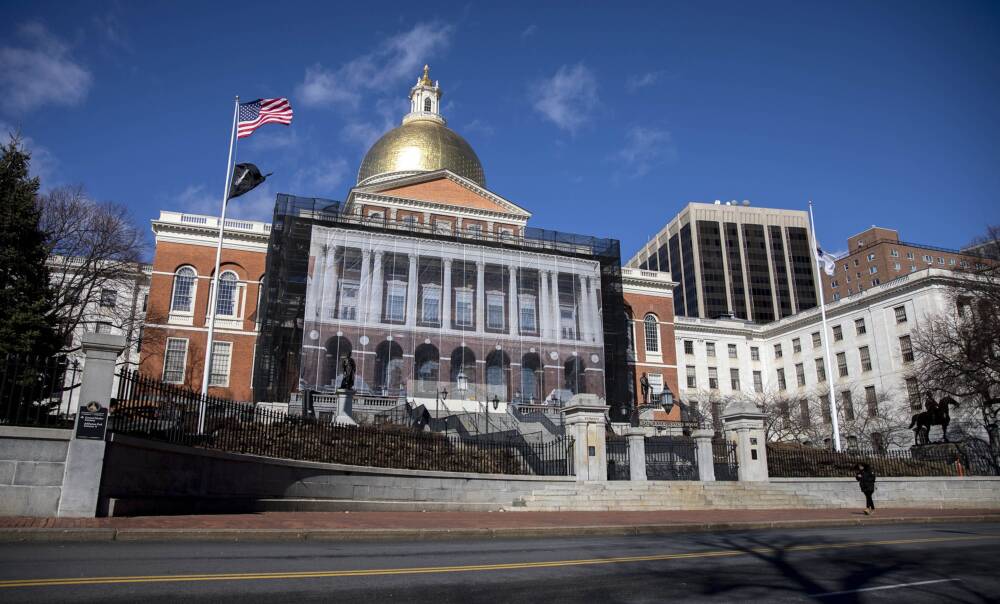
The gavel came down more than once, and with intent.
Over weeks of hearings on a wave of ballot questions, exchanges between lawmakers and advocates veered from technical to tense — revealing a rare look at lawmakers operating on the defensive and proponents of change on offense, arguing that Beacon Hill has left them little choice but to go directly to voters.
What unfolded before the Special Commission on Initiative Petitions was not just policy deep dives, but explorations of the Legislature itself: its responsiveness, authority and how voters are trying to work around it.
Lawmakers pushed back on what they described as sweeping, sometimes personal critiques embedded in ballot campaigns. Supporters maintained the ballot was not their first choice, but the only viable path left.
Taking it personally
Tensions surfaced often, and it was clear through the proceedings that some lawmakers viewed some of the questions as a personal attack on their integrity.
"I feel like there's a real disconnect between how all of us are running and what we face and what you are telling us," committee co-chair Sen. Cindy Friedman said after weeks of hearings. "We've sat here for the past month, and all we've heard is how inefficient we are, how bad we are at our jobs, how corrupt — we got that, we're corrupt."
It was a repeat theme. Earlier, summarizing testimony on a proposal to overhaul legislative stipends, Friedman said bluntly: "We heard from our last group, we're terrible, horrible, corrupt people."
Advocates have not used the word "corrupt" in hearings, but the perception that the pursuit of laws through the ballot equates to indictments of Beacon Hill seemed to shape lawmakers' responses.
Rep. Mike Day called advocates' framing of the legislative process "very immature," when they treat policy losses as proof that "the system's broken."
"The system's broken because my issue didn't make it over the hump?" Day said. "Ranked choice voting didn't get there — the system's broken. Same-day voting didn't get there — the system's broken." He repeated that argument throughout the month, pushing back as advocates said legislative inaction is forcing them to turn to the voters. Day countered that inaction is itself a deliberate choice.
Advocates are frustrated too
For many proponents, that frustration is the point.
Tom McKeever, representing public counsel employees seeking collective bargaining rights, said this was the "fifth or sixth legislative cycle" their issue failed to gain traction in the Legislature.
Others echoed that path.
Auditor Diana DiZoglio, pressing a measure to subject the Legislature and governor's office to public records law, framed it as a response: "This language is being presented as an alternative to this Legislature's inaction for decades."
Legislative leaders have long looked askance at the ballot question option, but the friction is heightened this year as a record number of measures could reach voters — many targeting government itself. Lawmakers also continue to resist a 2024 voter-approved audit of the Legislature.
House Speaker Ron Mariano has been one of the most vocal critics of the voters' access to the ballot in recent months, calling the "whole system fraught with peril."
During a hearing on a ballot proposal to allow people to register to vote and simultaneously vote on Election Day, Secretary of State William Galvin defended the process.
"There's been some speculation about how terrible it is that this is occurring," Galvin said. "The fact of the matter is, it's in the Constitution. It was deliberately designed by the reformers who participated in the Constitutional Convention in the early part of the 20th century to give voters a chance to make laws, and they seem enthusiastically anxious to do that."
Subtext: What happens after November
Questions about what happens after a ballot question passes have also surfaced across hearings, sometimes subtly, sometimes not. One top House Democrat gave voice to the possibility of amending initiative petitions.
Day described ballot laws as a "sledgehammer approach," adding: "Then we've gotta come in with the scalpel afterwards."
Lawmakers cannot change the language of a question before it goes to voters — a frustration for those who say the legislative process resolves issues in advance, while ballot measures can have implementation problems.
At the same time, legislators are not without options. While they cannot alter the wording that appears on the November ballot, they can work directly with question proponents to pass a version of a proposal through the legislative process. Lawmakers could modify policies to address concerns raised in hearings and if a deal is struck on a negotiated bill, advocates could withdraw their ballot question. In that sense, while the ballot language itself is untouchable, there remains a pathway for lawmakers to compromise, shape and possibly preempt policy plans before voters weigh in.
Lawmakers can also change voter laws after passage, and have done so in the past, though doing so can come with political peril.
Rep. Kate Hogan asked public defenders if parts of their proposal might benefit from "legislative refinement."
McKeever replied "well, yes," noting it would "set a precedent for other state agencies."
Hogan pressed: "So what you're saying is that, basically, when a question, whether it's passed or not: It's not the end of the road for the question itself. It then continues to be refined and negotiated beyond the election."
On a proposal to earmark certain sales tax revenue for land conservation, Rep. Alice Peisch noted that even if it passes, lawmakers still control appropriations.
"This could pass, and we could choose not to appropriate any of this money," she said.
"Seems like a lot of effort," she added, "to do something that, at the end of the day, is no different from the process we have right now."
Advocates acknowledged that reality but supporter Sam Anderson of Mass Audubon said the measure was meant to "set up this fund and send a message that it is to be supported" — and then "continue to advocate and partner with the Legislature."
Flashpoints: When the Legislature is on the ballot
The sharpest exchanges came when proposals targeted legislative powers.
During debate over public records access, a back-and-forth between DiZoglio and Friedman escalated, with Friedman banging the gavel.
"This is not personal," Friedman said, as DiZoglio responded: "Are we not allowed to ask questions?"
A similar clash occurred over an income tax cut when Day pressed supporters on the use of paid signature gathering, a traditional practice that is now cemented as commonplace among initiative petition campaigns.
"The process is no longer what it was back in 1916," Day said. "We're looking at these kind of paid drives to get out there and get on the ballot, to circumvent where we are."
When tax cut proponent Jim Stergios tried to respond "Can I ask one question, Rep. Day?" Friedman cut in: "No. We ask the questions."
The exchanges underscored a recurring divide: lawmakers emphasizing process and policy nuance, advocates pressing transparency and accountability.
On a proposal to regulate legislative stipends, Friedman bristled at what she saw as an attempt to dictate internal operations through the ballot measure.
"You're telling us how to do our business," she said. "That is the business of the Legislature."
Lenny Mirra, a former state representative, countered that legislative decisions are often "a foregone conclusion… based on whatever the speaker decides."
Peisch responded, in an unusually direct manner for a hearing chair.
"It is the general practice in committee hearings that we listen to the people testifying. It is not the general practice to refute or get into a debate about what is being said," she said. She continued, "I resent the implications that every chair here does not think for themselves and does not work hard."
Danielle Allen, leading the push for a question to introduce all-party election primaries, argued elections suffer from a "calcified" system.
Allen said though the Legislature may be made up of "many good individuals," through lack of public debate and electoral competition "you cease to have the dynamism that you need for really channeling citizen voice."
Friedman warned repeated claims of dysfunction risk becoming self-fulfilling.
"If you tell people long enough that there's no trust and your voices aren't being heard, you're going to start to believe there's no trust and your voices aren't being heard," Friedman said.
Competing narratives about Massachusetts
Even proposals not targeting the Legislature veered into broader debates.
At the hearing on the income tax cut, Sen. Paul Feeney challenged proponents' on why businesses stay in a state that they call unaffordable and uncompetitive.
“Is there anything you like about the commonwealth?” he asked, saying one of the state's main issues is "we have a narrative problem" due to groups like those pushing for the tax cut.
After a prolonged exchange where Feeney pointed to the state's high rankings in education and health care access, supporter Chris Carlozzi said "I'm telling you what our members are telling me. That it is very expensive."
"You couldn't drag me out of Massachusetts," said Chris Keohan, another supporter. "Because we are fighting right now on how we can do things better should by no means be taken as an accusation that Massachusetts is a terrible place."
Unresolved tension
Again and again, hearings returned to the same question: are ballot initiatives a corrective response to legislative inaction or a blunt tool that complicates governance by elected officials?
For lawmakers, the process improperly bypasses deliberations. For advocates, it is the only viable path left.
"We can hear your frustration," Allen told lawmakers. "I know you can hear our frustration, too."
Across 11 hearings, that shared frustration — sometimes restrained, sometimes combative — may signal what awaits if voters take up the questions in November: not an end to the debate, but the start of its next phase.