Support WBUR
'To Boston Police Dept. From: ICE:’ Late-night faxes pressing BPD to turn people over
It was just after 3 a.m. on March 30 last year when the fax machine at the Boston Police Department’s Back Bay district station whirred to life. Incoming was a message from U.S. Immigration and Customs Enforcement.
An immigration officer in Santa Ana, California, wanted to know when Boston police planned to release a person in their custody.
The faxed missive asked police to notify ICE “as early as practicable (at least 48 hours, if possible)” so officials could “determine whether there’s probable cause to conclude that he or she is a removable alien.”
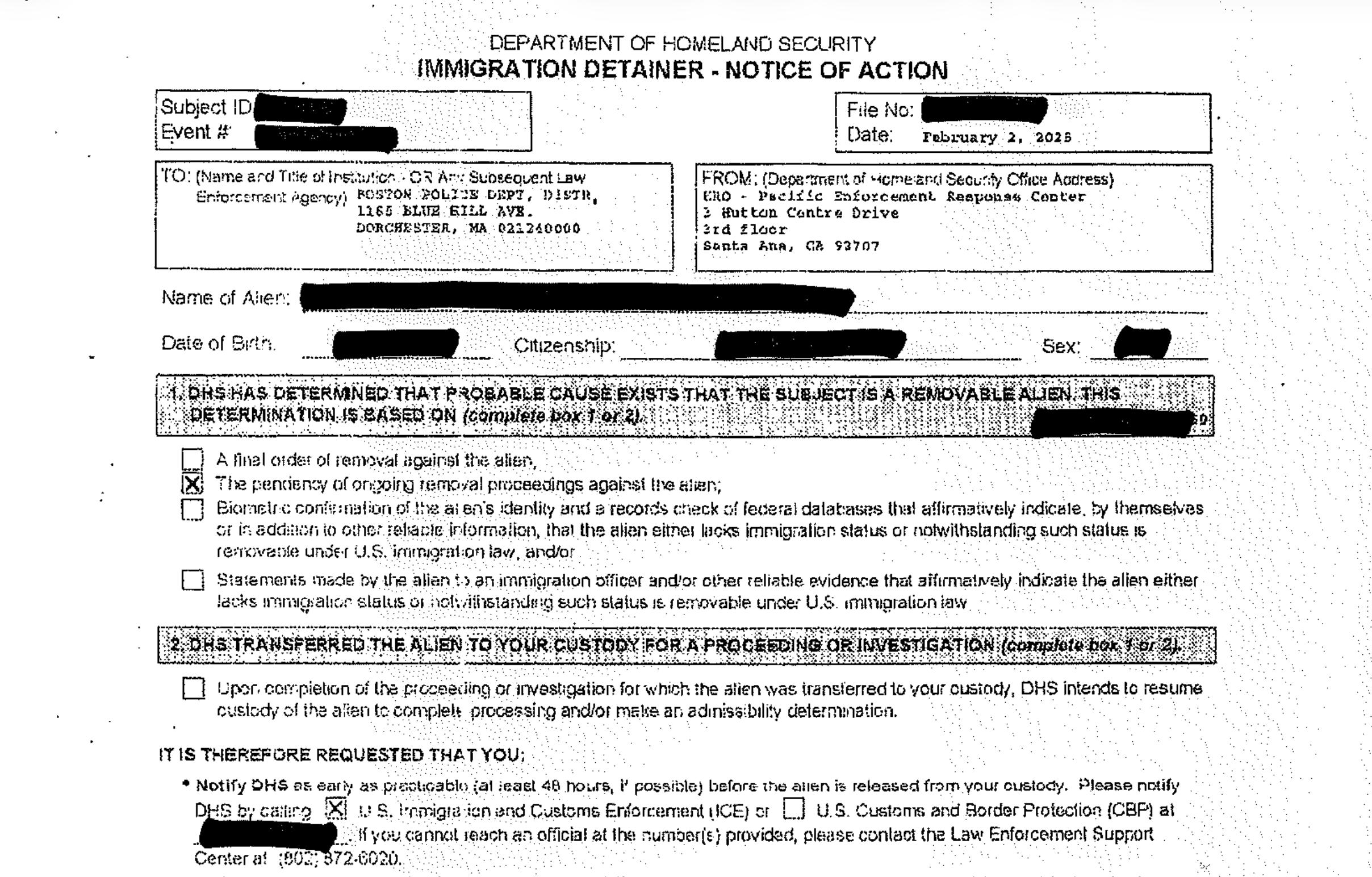
The notice from ICE was one of 57 requests asking Boston police to continue to hold people in their custody so ICE could pick them up. Most of the detainer requests came from ICE’s Burlington office, while others came from California, according to documents obtained in a WBUR records request.
A top ICE official has claimed the agency actually sent nearly three times that many requests.
In an emailed statement, ICE stood by its claim that it sent 167 detainer requests to Boston police last year — "far more than the Boston Police Department is admitting to." But the agency has repeatedly refused to provide documentation to back that up, instead sending a list of 10 individuals, with mugshots, whom it said “Boston police refused to turn over to us.”
“It shows Bostonians that local police leaders are so politically motivated that they would rather release criminals than work with ICE, which completely undermines public safety,” ICE acting Director Todd Lyons said in the statement.
Lyons, a Bostonian himself, ran the Boston ICE field office before being elevated last year to run the agency in Washington. Earlier this month, he announced he’s stepping down, following a controversial year of aggressive immigration enforcement.
The discrepancy between the police and ICE numbers has been a point of contention between the two law enforcement entities — and, more broadly, between the city and the federal government. The lack of evidence provided to support ICE's 167 figure reflects the agency's continued resistance to sharing why it targets specific immigrants, and when it seeks help from local law enforcement.
And Boston police, for their part, have been unwilling to explain more about their dealings with ICE, beyond an annual report provided to the city clerk.
That January report, signed by Boston Police Commissioner Michael Cox, cited the 57 ICE detainer requests, most sent by fax and some by email. In his letter, Cox said the department did not detain or transfer anyone based on the ICE requests.
The Boston Police Department initially refused to provide copies of the ICE detainer records. But WBUR appealed to the state supervisor of records, who required the department to release 300 pages of records.
While most names and identifying information were redacted, the records do shed some light on ICE’s allegations about the people it wanted to detain, and how the agency tried to get the police department to turn over immigrants in its custody.
Asked about ICE's claim it sent many more detainers than Boston police acknowledged, police spokeswoman Mariellen Burns said in an email, "We can't really address what we did not receive.” She added, “We established a dedicated fax for Detainer Requests and 57 were received in 2025.”
In 2024, ICE had complained that it sent 198 detainer requests to Boston police, while the BPD said it received only 15. At the time, there was speculation by the police that the gap had to do with where ICE sent those requests. BPD repeatedly told federal agents to use a dedicated police fax line, rather than sending detainers to individual booking locations or via email.
What’s in the detainers
It appears ICE used a shared fingerprint database to identify people in police custody. In 29 of the cases, ICE officials checked a box on the detainer form indicating they had probable cause for their request based on “Biometric confirmation of the individual’s identity and a records check of federal databases.”
To justify its requests, ICE included administrative arrest warrants 41 times. But these are controversial, because they come internally, from the Department of Homeland Security, rather than from a federal judge.
In 10 cases, ICE indicated on forms that individuals faced final orders of removal, and agents checked a box saying an immigration judge had ruled on deporting the person. But Boston police did not honor those either.
The forms show 23 people in police custody were in “ongoing removal proceedings.” And a half dozen had “voluntarily” made statements to an immigration officer — or ICE had “other reliable evidence” — indicating the subject “either lacks immigration status or … is removable under U.S. immigration law.”
Nine of the detainers ICE sent to the police were requests to pick people up at local courthouses, from Dorchester to East Boston. And 13 detainers were sent for people held at the Nashua Street Jail, which is run by the Suffolk County Sheriff’s Department. The sheriff has an agreement with Boston police to act as a regional holding facility for an array of arrestees, including immigrants.
"There are people who are in the custody of the Boston Police Department inside the Regional Holding Facility” at the Suffolk County Jail on Nashua Street, sheriff spokesman Peter Van Delft said in a statement. Once officially booked, they are in the custody of the Suffolk County Sheriff’s Department. Until then, if ICE arrives at the jail to pick someone up, “they could conceivably be bailed directly from Boston Police Department custody,” Van Delft said.
“In no instance does the Department hold anyone longer than their sentence prescribes, or past the time that it takes for them to post bail, based on the existence of a detainer,” Van Delft said.
The department is bound by the Lunn decision, a Massachusetts Supreme Judicial Court ruling that says local law enforcement agencies are prohibited from arresting or holding a person based solely on a civil immigration detainer.
In addition to that ruling, Boston Police follow the city’s Trust Act, which prohibits police from arresting someone based solely on a civil immigration violation, or from holding them beyond when they are otherwise eligible for release. Nor can they share information with ICE, although when people are arrested, their fingerprints go into a system that’s widely available to law enforcement, including ICE.
Police can work with federal immigration officials if someone is wanted for serious crimes, including child exploitation; trafficking of humans, weapons, or drugs; or cybercrimes. They can only detain someone for ICE when presented with a criminal warrant signed by a judge.
None of the detainer records reviewed by WBUR include specific criminal allegations. But in at least 17 cases, ICE agents checked a box on the form to indicate a person was subject to the Laken Riley Act. Passed early in the Trump administration, in January 2025, the act directs federal immigration enforcement to detain and deport those without legal status who are charged with a variety of crimes — from minor theft or shoplifting, to assault of a law enforcement officer, to crimes resulting in death or serious bodily injury of another person.
BPD said it did not comply with any of the detainer requests, including the ones that cited the Laken Riley Act. In one case, ICE sought a detainee who’d allegedly reentered the country illegally after being deported. That’s a criminal immigration matter, unlike overstaying a visa, which is civil.
Nationally, police departments have taken varying views on the Laken Riley Act. But Austin Kocher, a research professor at Syracuse University who studies immigration enforcement said BPD is in the right.
“You’re asking a local law enforcement agency to hold someone for ICE from a detainer, that’s a civil request,” he said. “They have no obligation to honor these, period.”
Boston police indicated that all the requests from ICE were civil in nature.
“We do not respond to Civil Immigration Detainer Requests, as we have discussed in great detail, which is in accordance with MA state law and the City's Trust Act,” said Burns, the police spokeswoman, in her email.
Police officials said they ignored all of the ICE detainers. But one of the requests obtained by WBUR includes a handwritten note indicating when a person would be released from Dorchester District Court — at 9 a.m. on April 4, 2025.
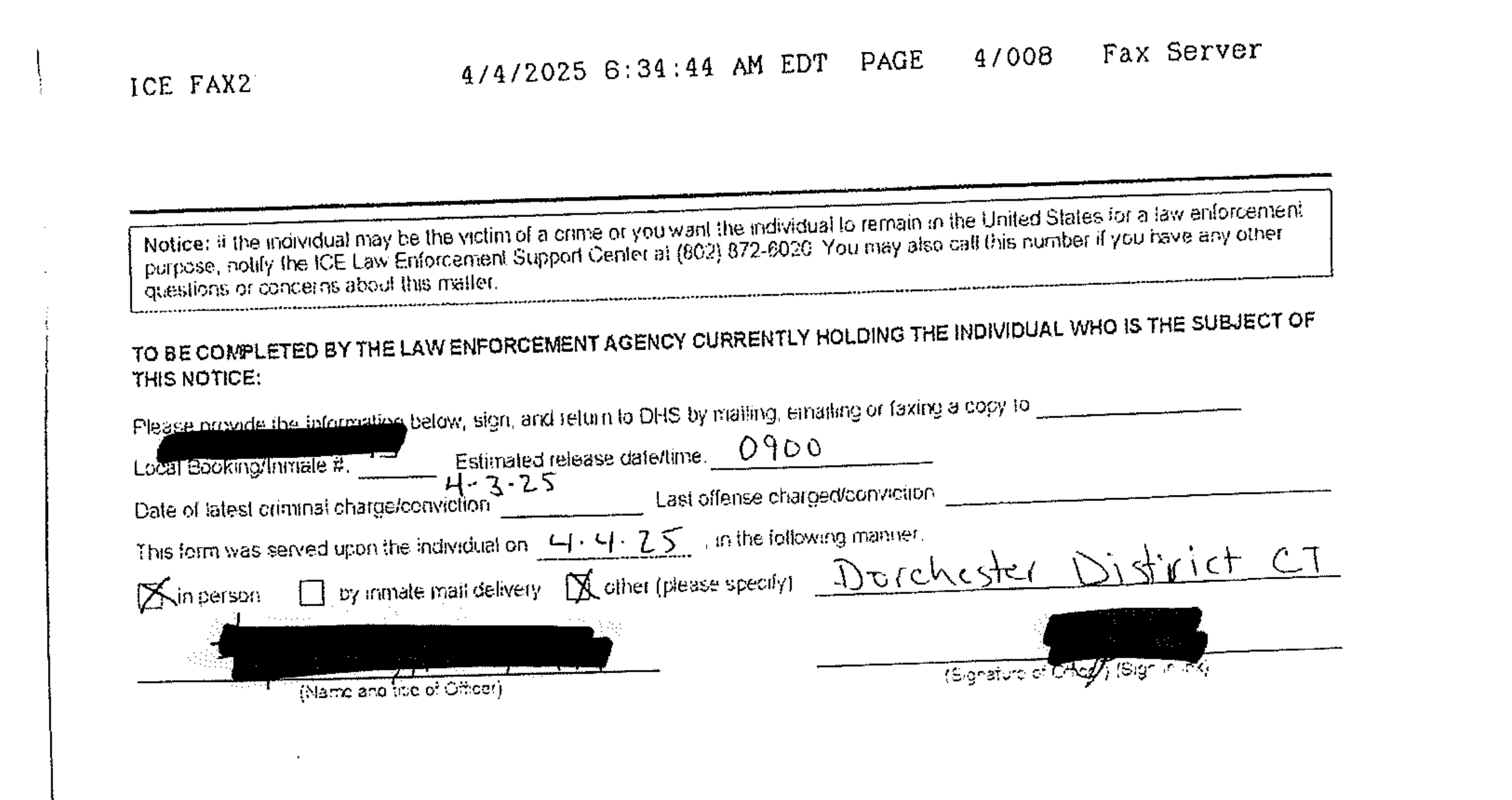
Burns declined to explain whether that information had been provided by the police, saying only, “Detainer Requests are included in a prisoner's arrest packet of paperwork which travels with them to either a bail hearing or to a court hearing.”
The ICE requests often accused individuals in police custody of posing a risk to public security. One person, they said, was a member of a “designated foreign terrorist organization.”
ICE provided no backup details to support that claim.