Support WBUR
Review
'Seek Immediate Shelter' captures the fall out after a near-death experience
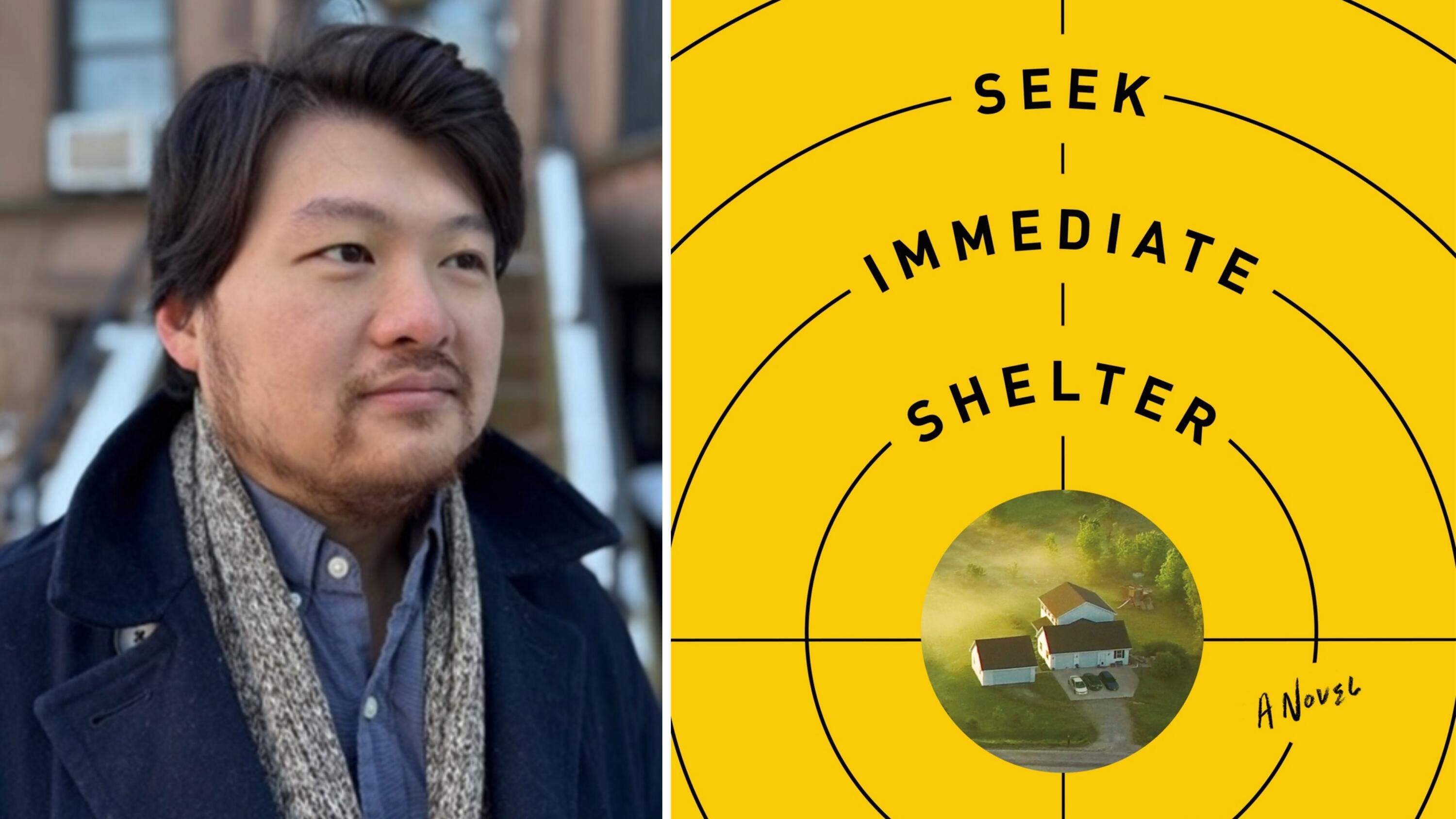
In the opening pages of “Seek Immediate Shelter,” Vincent Yu’s deeply thoughtful debut novel, a quiet spring morning in the (fictional) Berkshires town of Beckitt is loudly disrupted by a “symphony of cell phones throbbing in sudden unison.”
An all-caps alert lights up phone displays: “BALLISTIC MISSILE THREAT INBOUND. SEEK IMMEDIATE SHELTER. THIS IS NOT A DRILL.”
Nineteen terrifying minutes pass before residents receive a second message saying the alert had been sent in error. All clear.
But all clear does not mean all right.
During the interminable period when residents think their lives are about to end, some say or do things they instantly regret. Others take a stark assessment of their life. And now everyone must carry on.
It’s a premise rich with possibilities, and Yu is skilled at executing thorny scenarios.
The author of many short stories, Yu has been published in literary journals including Prairie Schooner, StoryQuarterly, Ninth Letter and Able Muse. In 2021, Yu was awarded the Ashley Leigh Bourne Prize for Fiction. In an interview that year with Ploughshares, he noted: “My fiction begins in a petri dish. I consider a difficult situation, often of moral ambiguity, and drop a character into the middle of it.”
That is the case with “Seek Immediate Shelter,” which poses the question: Would a life-ending crisis propel you to be the self you aspire to be, or a less attractive version you have kept buried?
Although “Seek Immediate Shelter” is labeled a novel, it reads like a collection of connected stories. Each of the nine chapters has a unique title and the name of the Beckitt resident who is the focus of that chapter. A main character in one chapter may appear as a minor character in another, enabling diverse views and building a small town with some relevant social texture.
All the principal characters are Asian American; ethnicity is an integral factor in certain narratives, while in others it is simply part of the community fabric.
In the chapter “Apology,” the missile alert impels Nina Chang to write a loving text to her 20-something daughter in San Francisco. Then she can’t stop herself from writing a second, spiteful message exposing a long-standing grudge. As the story unfolds, Nina is shown as habitually caught between the high expectations of her first-generation immigrant parents and her husband’s more relaxed third-generation style of parenting their daughter.
In a situation only lightly related to the alert, in “Birches” Chase Sun is dismayed to find that his partner Mick has cyberbullied another Asian American man with the same racist epithets that have been used against each of them. Mick makes lame attempts to reframe his action as “retaking” the hateful word and to dismiss his behavior as “like yelling at someone in traffic.”
Chase is one of many characters who have been floating along on a mild current of dissatisfaction with their jobs or relationships, almost waiting for a life-shaking event to force a change.
In “A Second Chance,” the missile alert impels Russell Zhang, a college textbook salesman, to examine the roots of his remote feelings toward his wife and young son.
Yu graduated from Yale with a degree in evolutionary biology and his science background shows in the details of “A Second Chance,” where Russell considers the “necessity of disturbance” in chemistry and in life. “Evolution Pressure” employs a theory of quantum mechanics (quantum entanglement) as a lovely metaphor to guide a newly widowed woman through revelations about her husband and her fraught sibling relationship with her sister toward a fresh perspective on herself.
Of course, realization and transformation are often miles apart. Part of the joy in reading “Seek Immediate Shelter” is the range of ways – always believable and sometimes surprising – in which Yu gets each character to a new start or a new place of gratitude.
While the missile alert is a catalyst in each chapter, Yu employs an elastic sense of time, setting some stories in the months or weeks leading up to the alert, with others that follow a character for more than a year after the alert.
The novel’s cohesive organization draws all the individual stories into one larger one about consequential choices, with lots of graceful writing along the way. And not without a little sly humor hardwired into the framework. As just one example, “Said and Done” deals with different kinds of grief, including the inner workings of competitive grief support groups (one is edging out the other because it serves edibles).
For many characters, revelation comes slowly and then quickly, with an ultimate bittersweet acceptance of how, as one character muses, “growing older [is] the methodical destruction of possibilities.”
Even with that – perhaps in the ability to accept that – this novel shows, with great humanity, how there can often be one more opportunity to make a new decision; one more chance at change. As depicted in “Seek Immediate Shelter,” it’s rarely easy but then, there is no existence without disturbance.