Support WBUR
With $63.3 billion budget, Senate shifts an eye toward future funding
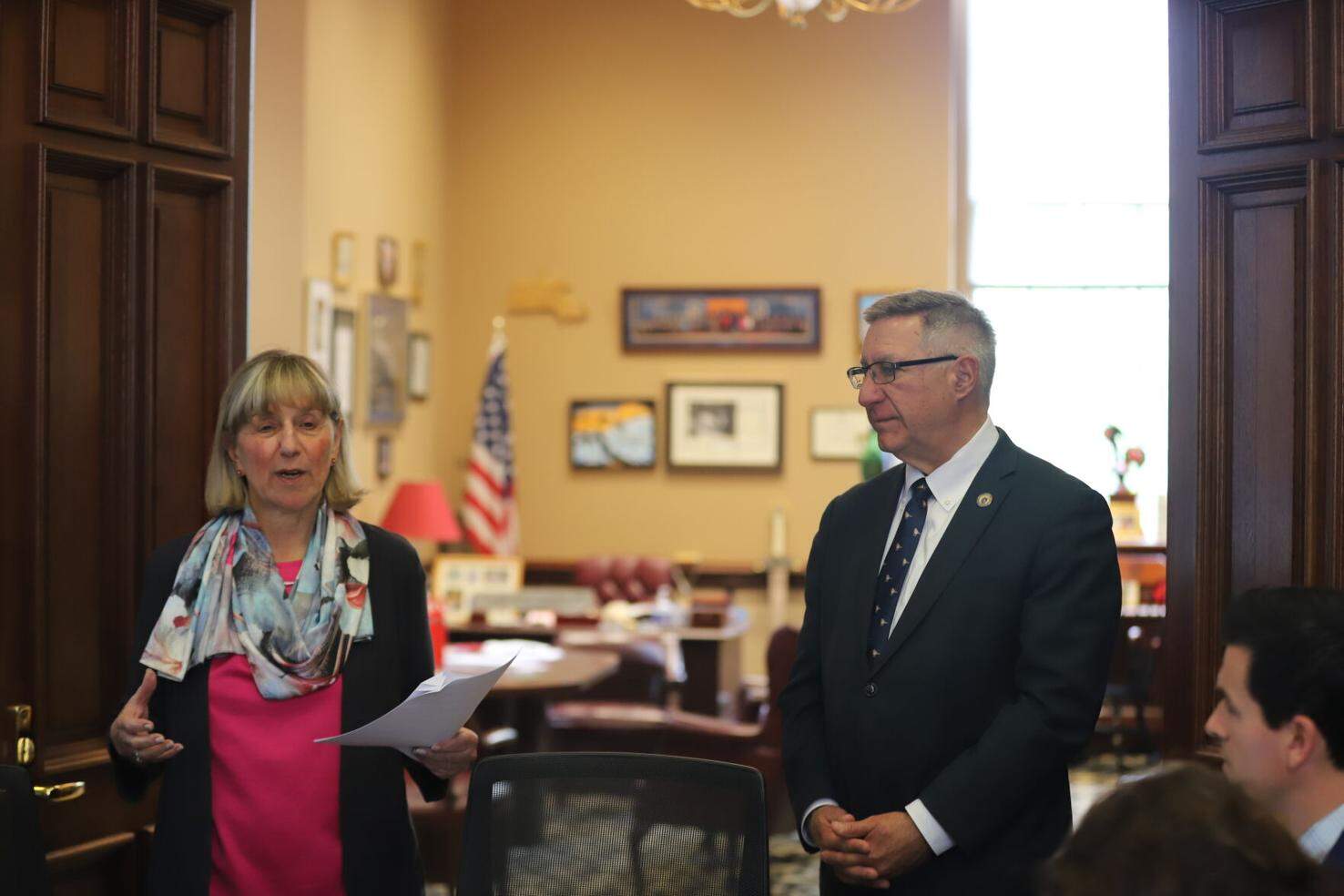
Senate budget writers on Tuesday rolled out a $63.3 billion fiscal year 2027 spending plan that closely tracks the House's approach on the surface, but diverges in quieter ways — from reopening the debate over school funding to advancing housing zoning reforms.
Like the House blueprint unveiled in April, the Senate Ways and Means Committee proposal would increase spending by about 3.6%, relies on the same consensus revenue estimate, and avoids new taxes or fees. It also mirrors the House in several key areas, including completing the final phase of the Student Opportunity Act and closely aligning with Gov. Maura Healey's plan to rein in costs for MassHealth, the most expensive line item in the budget. To do so, both branches have now acceded to her plan to eliminate GLP-1 coverage for MassHealth members.
Senate President Karen Spilka described the committee's proposal as "responsible and future focused" amid economic uncertainty.
With the six-year rollout of the Student Opportunity Act now complete in both chambers' budgets, the Senate is starting to look beyond it.
The committee proposes $7.66 billion for Chapter 70 school aid, matching the House's commitment to fully fund the law and setting minimum per-pupil aid at a historic high of $160. But the Senate Ways and Means budget goes a step further by reviving the Foundation Budget Review Commission, signaling a formal effort to reconsider how education funding is distributed.
This was one of the main issues budget writers heard about during Ways and Means Committee hearings across the state, as educators and town officials pleaded with lawmakers that the current funding formula wasn't working anymore.
"We believe that this is the time to do it," Spilka said. "We're hearing from all of our school districts and folks across the state that we need to take a look at it to continue equity, adequacy and fairness."
That move contrasts with the House approach, where Ways and Means Chair Aaron Michlewitz said lawmakers may be ready to revisit the formula but did not include a mechanism in the budget to do so.
"I think it's an appropriate time now to go back and see if we need to make further changes to the Chapter 70 formula," Michlewitz said last month, while warning that any overhaul would inevitably produce "winners and ... losers."
The Senate Ways and Means budget also directs $652.6 million to the special education circuit breaker, supplemented by $200 million in surtax funds, and boosts regional school transportation reimbursements to 90% with a $114.2 million allocation.
Lawmakers include $20 million for rural school aid — an $8 million increase — even as superintendents continue to press for significantly more to offset enrollment losses and rising costs that have hit smaller districts especially hard.
At the same time, Senate budget writers declined to adopt a House-backed $10 million reserve aimed at helping districts facing enrollment declines tied to federal immigration enforcement.
"We do not create any sort of pothole account like that," Senate Ways and Means Chair Michael Rodrigues said, pointing instead to broader aid streams.
Health care once again represents the largest share of the budget, with MassHealth funded at $22.74 billion, slightly above the House figure. Combined with the broader health and human services budget, those accounts total $33.7 billion — more than half of all state spending proposed in the budget.
Within that framework, the Senate aligns with the House and governor in dropping coverage for GLP-1 drugs for weight loss under MassHealth, reflecting concern about rising costs associated with the medications.
Elsewhere in health and human services, the Senate directs $265.7 million toward food security programs, including $148 million for Department of Transitional Assistance caseworkers, as lawmakers aim to reduce administrative errors that could trigger federal penalties under President Donald Trump's One Big Beautiful Bill law.
The budget also includes $19 million for jail diversion programs, a significant increase over the governor's proposal, to steer individuals with mental health or substance use disorders toward treatment instead of incarceration.
The Senate Ways and Means Committee also aligns closely with the House on a developing effort to overhaul how county sheriffs are funded, adopting a similar structure that breaks appropriations into four distinct line items covering payroll, operations, medication-assisted treatment, and no-cost calls for incarcerated individuals. The approach is designed to bring more transparency and control to a system that has drawn scrutiny after years of significant spending overruns.
"So we pretty much went along with what the House proposed," Rodrigues said, adding that the roughly $800 million allocation is about $53 million higher than last year and roughly $50 million above the governor's initial proposal.
As an enforcement mechanism, the Senate committee recommends setting up an official control board. If sheriffs fail to cooperate with oversight from the Executive Office for Administration and Finance, that board would take over and manage their finances.
The changes come as lawmakers in both branches respond to concerns from the inspector general that the current budgeting process for sheriffs has become "opaque" and "deeply flawed."
The committee adopted the governor's proposed reduction to the Department of Conservation and Recreation, allocating $153.8 million for state parks — an 8.3% cut that has drawn criticism from advocates.
"DCR funds most of its day-to-day functions from the operations account, while the seasonal account pays to staff our forests, parks, campgrounds, beaches, pools, and other DCR facilities during peak use periods," Mass Parks for All Executive Director Doug Pizzi said last month, raising concerns about potential impacts on services.
Rodrigues said the committee followed the administration's lead: "We funded what the governor requested on DCR."
One of the more notable policy shifts in the Senate Ways and Means plan comes through an outside section focused on housing production.
Drawing from legislation filed by Sen. Barry Finegold, the proposal would streamline local permitting and ease certain zoning barriers, an effort to accelerate development in a state where housing supply remains a persistent challenge.
Rodrigues described changes that would freeze zoning rules at the time of application, allow certain nonconforming properties to be modified as of right, and establish clearer timelines for approvals.
"These reforms address persistent obstacles in zoning process and provide developers, homeowners and municipalities with greater certainty," he said, framing the provisions as incremental but practical steps to unlock housing production.
The Senate committee proposes $1.376 billion in unrestricted general government aid, a $53 million increase over fiscal 2026.
"I think the overall theme of this budget really is support for local communities and municipalities," Rodrigues said. "We are very much exceeding our responsibilities and requirements from the Student Opportunity Act, and then we're all in on UGGA."
While Senate leaders highlighted local aid figure and proposed reforms to the formula as a significant step forward, it still falls short of what municipal leaders have said is needed to keep pace with rising costs.
Rodrigues defended the increase in the context of competing demands.
"Every entity, agency, department, always asks for, you know, a lot of money, and we do the best we can," he said, adding that local officials have responded positively to both the increase and the revised distribution formula.
The House included a smaller increase in its proposal, a $10 million increase in local aid.
On the revenue side, the Senate adheres to the consensus forecast, projecting $42.2 billion in baseline collections and $2.7 billion in surtax revenue, for a total of $44.9 billion available for budgeting.
Asked if the committee built any contingency measures into its plan due to a potential ballot question to reduce the income tax rate that could have an $800 million impact on the fiscal year the committee is currently budgeting for, Rodrigues said it did not.
"There are no contingency plans based upon what happens at the ballot," Rodrigues said.
The House also built its budget on the consensus revenue number without an adjustment for the potential ballot question, but leaders warned last month that the measure could force midyear cuts if it passes.
The budget continues to direct surtax revenue primarily toward education, with a roughly 65% / 35% split between education and transportation — nearly identical to the House approach. Lawmakers have noted that supplemental budgets later in the year often shift additional surtax dollars toward transportation.
The Senate also reinforces long-term fiscal commitments, including a $5.1 billion pension contribution, a $1.4 billion sales tax transfer to the MBTA, and $1.3 billion for the Massachusetts School Building Authority.
Debt service — the cost of paying principal and interest on state borrowing — is funded at $2.67 billion, or about 4.2% of the budget, while the Stabilization Fund is projected to reach $8.2 billion by the end of fiscal 2027 with an additional $51 million deposit.
Spilka emphasized the importance of those reserves given broader economic pressures.
"It's not a matter of if the state will go through tough times. It's a matter of when," she said.
A Ways and Means staff member said the rainy day fund represents only 47 days of statewide spending, and therefore should be thought of only as a critical backstop against a future recession.
The Senate will debate the budget in two weeks, beginning May 19, and senators will have their chance to make an argument for any key areas they feel are left out of the committee draft presented Tuesday.
Asked how much room is left for additions via amendments and earmarks, Rodrigues said, "Not much."
Following the debate, negotiations between the chambers will unfold in the weeks ahead, with the bodies aligned on the overall size of the budget but diverging in a few key policy areas. Fiscal year 2027 begins July 1.