Support WBUR
At Harvard, an A could no longer be a grade 'everyone expects'
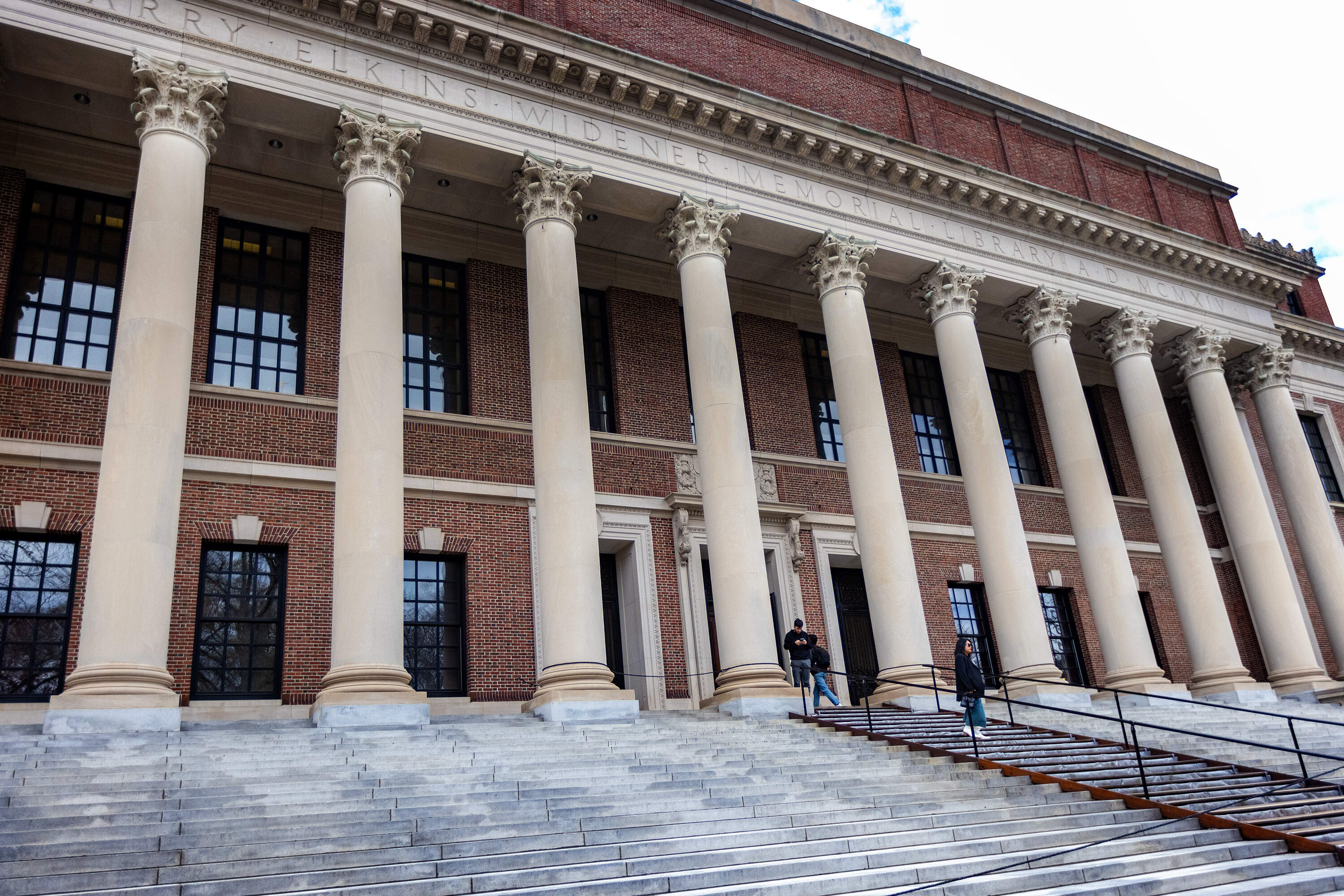
At a time when it's easier than ever to earn an A at Harvard, faculty will vote this week on a measure that would limit how many top grades they can hand out to students in each class.
A's now comprise the majority of grades given at the college. Two decades ago, they comprised only a quarter of all grades.
"The challenges of grade inflation are not limited to Harvard," said government professor Alisha Holland. "This is part of a broader discussion in higher education." And an upwards grade curve has been happening for decades: Median grade point averages at U.S. colleges rose 21% from 1990 to 2020, with a noticeable spike during the Covid-19 pandemic.
Advocates for the Harvard grading cap said grade inflation has shifted the baseline of what a meaningful academic experience at the Ivy League school ought to look like. Students navigating the college's intense and competitive environment will course-shop to seek out an A while professors feel pressured to be more grade-lenient in order to receive a favorable evaluation or not deter students from enrolling in their classes.
They also argue an abundance of A's dilutes the potency of a metric intended to award work of "extraordinary distinction."
There is no A-plus at Harvard. An A is the best grade a student can earn, followed by an A-minus. Professors gave two out of every three graded assignments the gold standard last school year, while 85% of grades landed in the A range. In 2025, about a fifth of all graduating seniors earned a 4.0 GPA.
"We now have a challenge of perfectionism," Holland said. "Many students think that it is possible to maintain a perfect 4.0 GPA. And that means that they aren't taking the types of intellectual risks that a liberal arts education is really intended to promote."
Undergraduate Education Dean Amanda Claybaugh addressed such concerns in an October 2025 report on grading that helped inform the Grade A cap proposal released by a faculty committee in February.
Under the "20 + 4" proposal under consideration, no more than 20% of students per course would receive a pure A, plus an additional four students. That extra four is meant to account for smaller classes, where a 20% cutoff could mean only one or two students earn a top grade. In a class of 100, 24 students could get an A; in a seminar of 10, six could land a top mark.
Overall, A's would account for 34% of all grades under the new formulation, a return to 2011 levels.
The faculty panel said it wants to "restore grades to their role as meaningful indicators of student performance and feedback," while breaking up the clustering, or compression, of top grades, that has caused distinctions like "summa cum laude" to now require multiple decimal placements to award (3.989 in 2025).
Faculty are also being asked to vote on two additional items: implementing an internal percentile ranking system to determine honors and prizes and adding a "Satisfactory-plus" option for the alternate Satisfactory/Not Satisfactory grading scheme.
Holland, who sat on the drafting committee, said the A cap will help institute “uniform and transparent change to grading practices.”
“Part of the proposal is really intended to give students the chance to distinguish themselves through their ordinary coursework,” she said.
But whether the proposal will successfully change academic culture or just create more competition for students is up for debate. Even faculty in favor, like government professor Steven Levitsky, is wary, but he voted to usher it in.
“It’s not a great solution,” he said of the 20+4 cap. “It’s kind of clumsy and arbitrary and takes away some faculty autonomy, but we’ve just gotten to the point where everybody expects an A all the time, and so we need to do something."
Levitsky, who's been teaching at Harvard for 26 years, said he'll see students who get an A-minus on their first paper in his course, "switch from a letter grade to pass/fail because they can’t handle getting an A-minus.” That happens "with frequency," he said.
“I’m hoping we can get to a point where A-minuses are acceptable again,” he said.
Soon after the faculty committee floated its proposal, the Harvard Undergraduate Association surveyed students. Of 800 responses, 85% expressed strong disapproval.
"... we’ve just gotten to the point where everybody expects an A all the time, and so we need to do something."
Steven Levitsky
Hyunsoo Lee, a sophomore economics and neuroscience major who is the academic officer for the association, said the cap will discourage collaboration among classmates if they're competing to be among the top 20% in a class. It could also harm those competing for selective graduate school placements or jobs against other top candidates around the country.
" I'm worried that students will be more competitive in extracurriculars just like they are now," he said. "I'm worried that this A cap will add in another extra layer of stress."
Not all students are opposed. Junior Sofia Mikulasek, a philosophy major, said she hopes it prompts some soul-searching among students that getting an A isn't the end-all-be-all.
“ One of the reasons I like the idea of the grade cap is because it sort of forces people to contend with the idea that, like, an A is not an easy thing and it’s also not a necessary thing," she said.
For a lot of students, she said, getting an A is "very connected to one's self-worth.”
She added she sees grade inflation as "a problem for universities as a whole," because "I think it sort of allows students to continue viewing themselves as being, like, really, really exceptional at everything they try to do.” And that's neither true nor practical, she said, a point she emphasized in an op-ed for the Harvard Crimson.
Harvard isn’t the only selective institution that has experimented with ways to combat grade inflation. In 2004, Princeton imposed a recommended 35% cap on A-range grades, but pulled it in 2014 after reports it exacerbated competitive culture on campus. Wellesley College tried a different tack in 2004, restricting average final grades in certain classes to a B-plus, in an attempt to "deflate grades." That approach raised concerns over whether students would be competitively positioned for grad school. The policy ended 2019.
There's no perfect solution. A Yale faculty committee recently recommended imposing a 3.0 mean GPA or another college-wide standard to address grade inflation.
“Harvard is at the forefront of trying to address grade inflation and in doing so, to restore public trust in universities and ensure that our internally set standards mean something both to faculty and to students," Holland said.
The approximately 800 voting members of Harvard's Faculty of Arts and Sciences, which houses the undergraduate program, are eligible to weigh in, with vote results expected next week. A FAS spokesman said 60% of faculty indicated support for the cap proposal in an "informal poll."
If a majority approve, the 20+4 change would kick in fall 2027.
"I haven't surveyed the faculty but I have lots of friends and colleagues on both sides, and I suspect it's gonna be a pretty close vote," Levitsky said.