Support WBUR
ICA Watershed reopens for the season with industrial-inspired installations
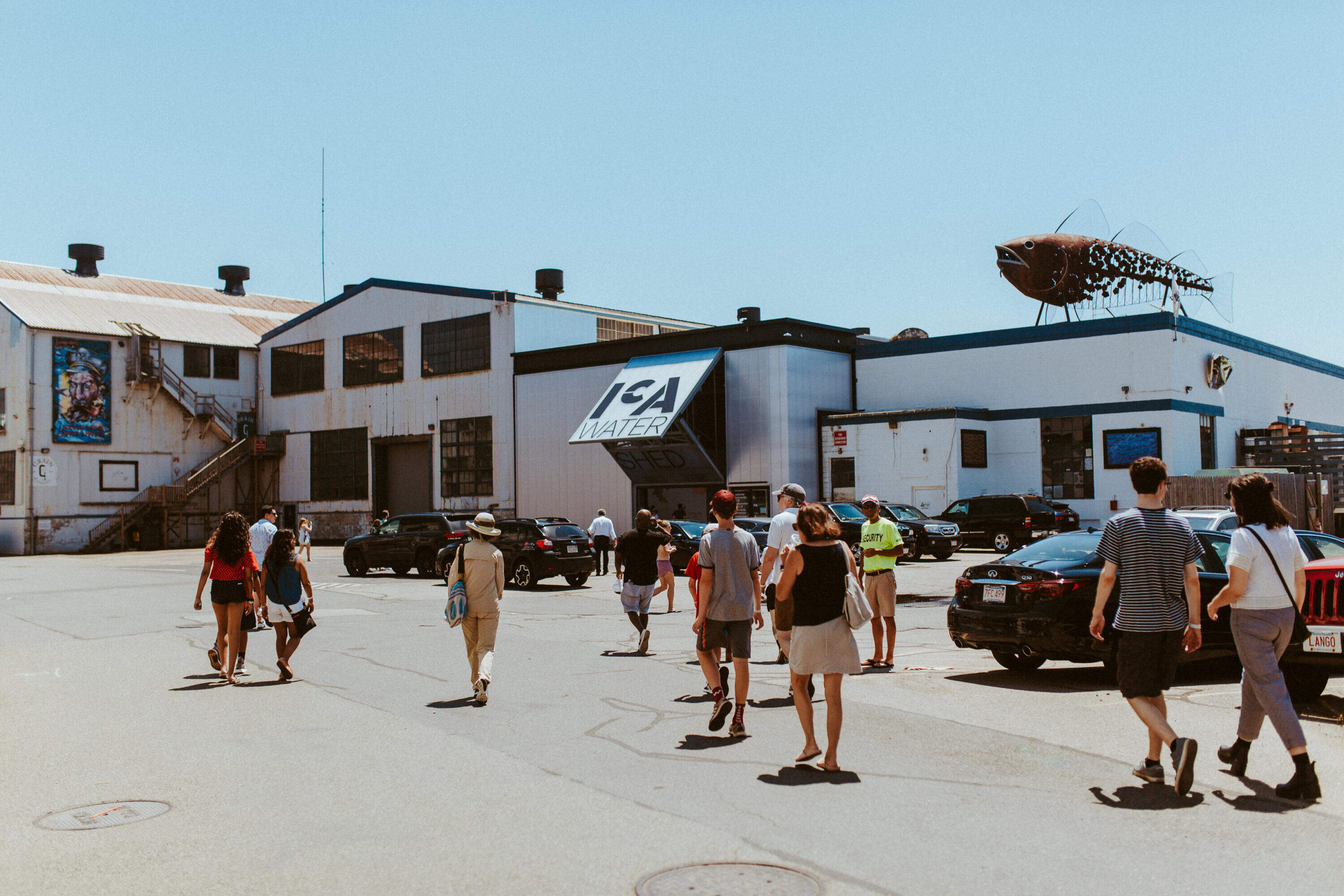
Shrouded in darkness, the two works in “Lucy Raven: Rounds” use light and sound to pierce the immensity of the Institute of Contemporary Art’s Watershed in East Boston.
“ I think the first thing [you see] is really the sense of a monumental scale,” said Ruth Erickson, chief curator and director of curatorial affairs at the ICA.
The opening of the exhibition on Thursday, May 21, marks the start of the 2026 season of the ICA Watershed, and the U.S. premieres of Raven’s “Hardpan” and “Murderers Bar.” The first is a newly co-commissioned work by the ICA and Barbican Centre in London, where it was first shown.
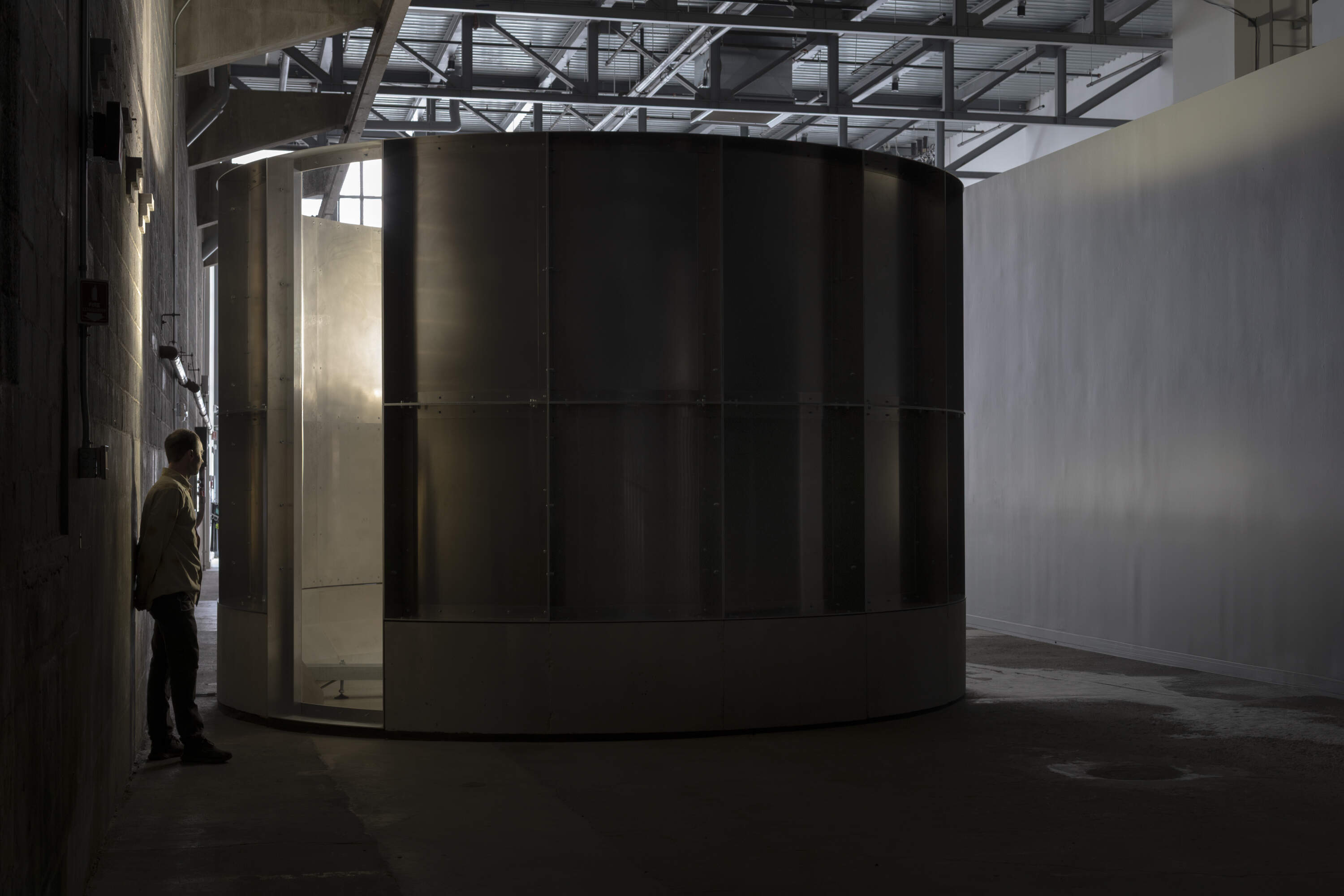
“Hardpan” greets visitors at the front of the exhibition space. The large-scale kinetic light sculpture is reminiscent of a factory machine. Inside the aluminium and cement cylinder, a bright light rotates like a searchlight, illuminating surrounding ceilings and walls through two translucent panels.
“ Lucy Raven is an artist who we have been thinking about for the Watershed really since we first opened it nine years ago,” said Erickson, who planned for Raven’s current exhibition with curatorial assistant Meghan Clare Considine. “So much of her work draws upon histories of industry and our industrial past and present in America.”
“ When first discussing this work being installed here at the Watershed with Ruth, I was really excited about the proximity to the harbor and the maritime history and industry here,” said Raven. The exhibition is the New York-based artist’s first time showing in Boston. Once a former copper pipe and sheet metal factory, the Watershed is a location that ties into her examination of industrial progress and extraction
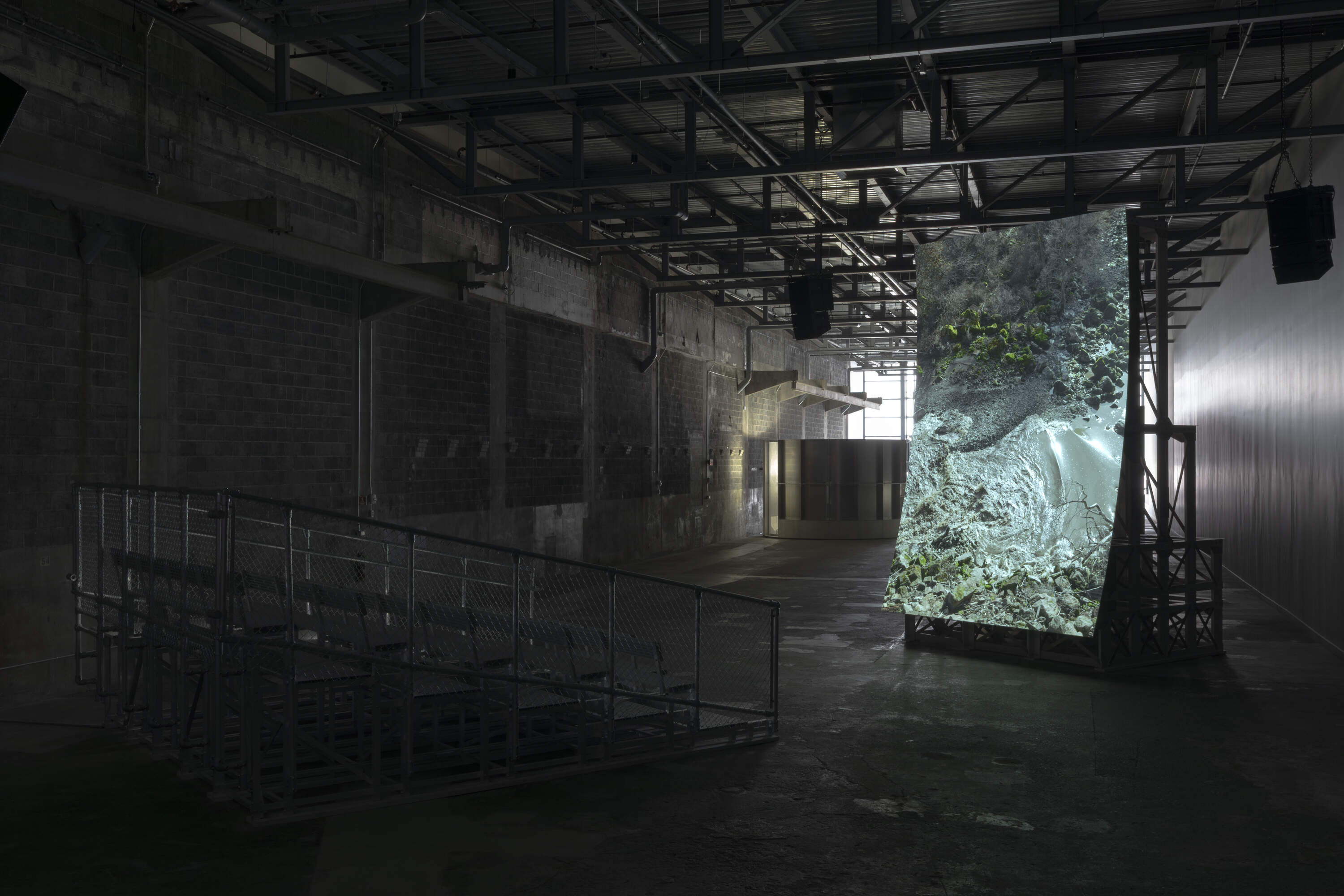
Beyond “Hardpan,” viewers are met by the back of a long, vertical screen at the center of a dark floor. The light from the screen illuminates a set of metal bleachers, and the soundtrack from the film reverberates around the Watershed.
Projected on a curved vertical screen, “Murderers Bar” is a 44-minute film that captures the live detonation of a concrete dam along a Northern California river — the largest dam removal and river restoration project in American history.
The dam was built in 1917 along the Klamath River, disrupting lifeways and the salmon in the river. Following decades of efforts from Indigenous activists to remove the dam, it was demolished in 2024. “Murderers Bar” is the colloquial name of the place where settler violence occurred along the river; it was later renamed “Happy Camp.”
The film, a blend of art and documentary, uses aerial and underwater imaging to track the 200-mile rush of the river as it resumes its journey to the ocean. The cameras then circle back upstream to visit the drained reservoir, revealing the barren landscape that was previously underwater.
“Murderers Bar” is Raven’s final installment in “The Drumfire Series,” a four-part moving image series exploring the use of pressure and force in the American West. The series includes “Ready Mix,” showing how solid rock transforms into concrete, and “Demolition of a Wall (Album 1)” and “(Album 2),” which visualizes shock waves caused by explosive blasts.
“‘The Drumfire’ explores all the ways in which we utilize, draw from, remake, reimagine and try to exert control, and ultimately learn how to let go of control of the land and everything that it provides for us,” said Erickson.
The circular theme of the exhibition title, “Rounds,” is evident throughout: from the cyclic light of “Hardpan,” to the camera moving back and forth along the river in “Murderers Bar,” to the way the river returns to its natural state on a 44-minute loop.
As visitors traverse back and forth across the Boston Harbor, Erickson hopes that they reflect on the waterways that surround them, too.
“It’s incredibly experiential, and I think it's an opportunity to learn and think about our land and our waterways, which are so much a part of Boston's history,” she said. “It's really an opportunity to think about the questions of both how we steward and control those waterways.”
An ongoing hands-on activity in the Harbor Room invites visitors to reflect on their experiences with water. Two gallery talks with Ruth Erickson and Meghan Clare Considine are scheduled for June 7 and Aug. 23.
“Lucy Raven: Rounds” is on view through Sept. 7. While the exhibition is free, the purchase of ICA museum admission includes round-trip water shuttle service to and from the Watershed.
Correction: An earlier version of this story contained a misspelling of Ruth Erickson's last name. We regret the error.