Support WBUR
Boston's Morning Newsletter
How the federal government tracks bus safety — and where the system falls short
Editor's Note: This is an excerpt from WBUR's daily morning newsletter, WBUR Today. If you like what you read and want it in your inbox, sign up here.
Last night's Tony Awards — hosted by the ever-theatrical P!nk — featured a landmark win for "CATS: The Jellicle Ball" costume designer Qween Jean, making her the first openly transgender woman to win a Tony in any category. Click here to read the rest of the results from the awards show.
Now, to more news:
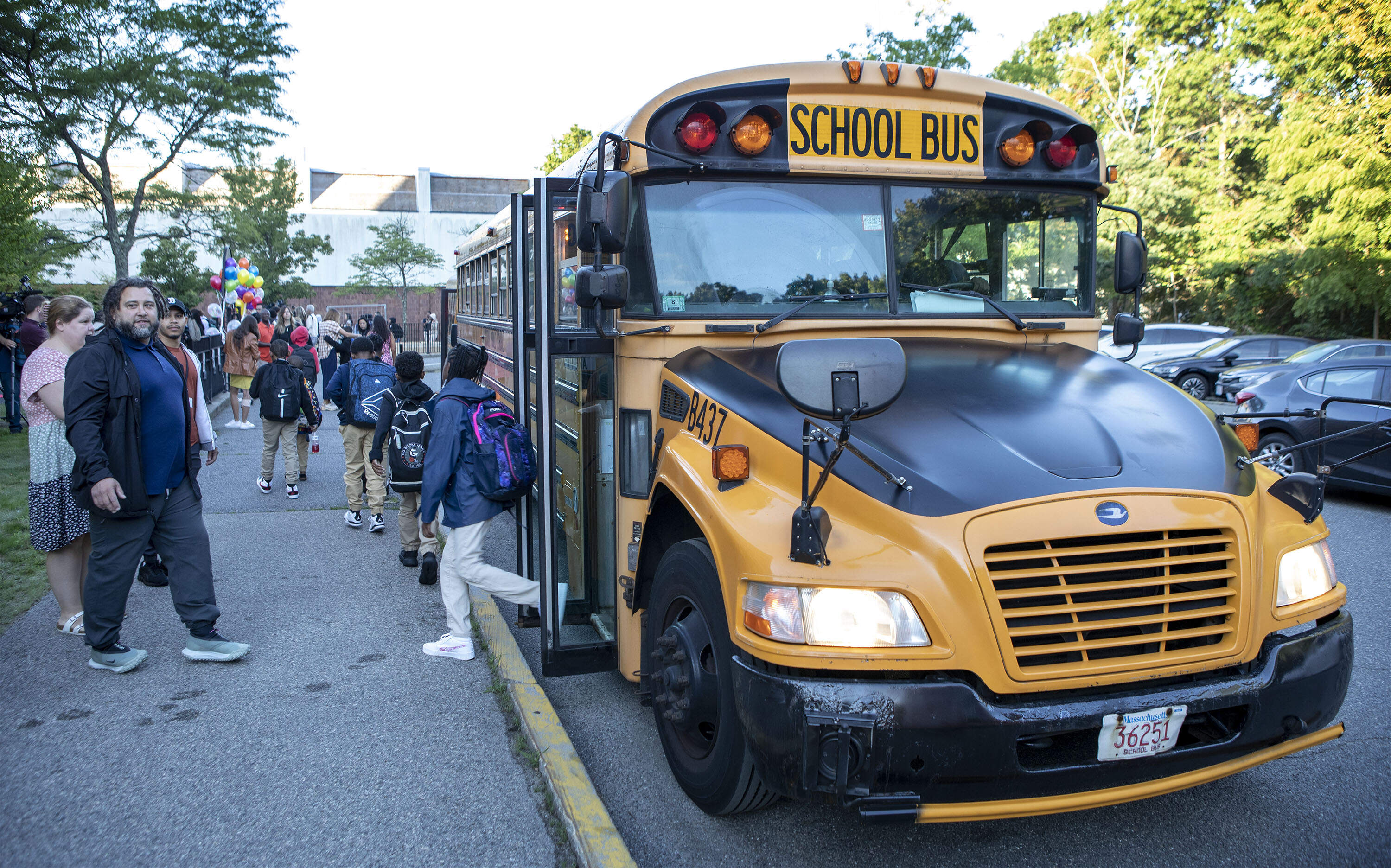
Under the hood: You probably haven’t heard of the Federal Motor Carrier Safety Administration — at least not in the last decade. The little-known agency within the federal Department of Transportation regulates the commercial truck and bus industry, and runs the only public database that tracks crashes by company. The FMCSA can also flex its muscles, such as when it shut down the popular Fung Wah bus between Boston and New York in 2013 over the company’s long list of safety infractions. But in the wake of last year’s tragic Boston school bus crash, WBUR and ProPublica began taking a closer look at FMCSA’s database and found that its process is faulty. The results, as Willoughby reports in this new investigation, is that the FMCSA database only identifies a fraction of a company’s fatal crashes.
- How it works: The FMCSA doesn’t have enough staffing to closely monitor each individual company — so they need some help. Originally, when the tracking system started in the 1980s, that meant companies self-reporting crashes. But that process, perhaps predictably, had shortcomings. So, in 1993, the Department of Transportation turned to local police departments. Basically the way it works now is a local officer fills out a form saying what bus company or carrier was involved in a crash and sends it to state officials, who then pass it along to the FMCSA.
- Where it falls short: Untangling the web of contractors and subsidiaries can be complicated. (It’s on the local police officer to determine what entity “controls” or “directs” the involved bus.) As a result, when it comes to a multinational company like Boston’s school bus contractor, Transdev, their crashes get logged under all sorts of different names and are overlooked when the FMCSA determines their safety rating. Bus companies can voluntarily inform the agency that crashes under other names belong to them, but experts told Willoughby that rarely happens.
- What we found: The FMCSA’s database shows no sign Transdev was involved in the April 2025 school bus crash in Boston that killed 5-year-old Lens Joseph — despite the fact they hired and trained the driver. Furthermore, WBUR and ProPublica found at least 60 fatal Transdev crashes in the last decade, even though the federal database only shows 18 under the company’s name. The fatalities span 16 states, including three incidents that led to criminal charges against the bus drivers. One of them in Massachusetts led to a $1 million payout from the local transit authority. FMCSA didn’t respond to Willoughby’s requests for an interview. Transdev wouldn’t comment on any specific crash and stated it follows federal requirements. Read Willoughby's full story here.
In memoriam: A "celebration of life" for former Massachusetts congressman Barney Frank will begin at 10 a.m. this morning at Faneuil Hall. Frank, who died last month at the age of 86, co-wrote the Dodd-Frank ACT, which overhauled banking regulations amid the 2008 financial crisis.
- Gov. Maura Healey, Boston Mayor Michelle Wu and former House Speaker Nancy Pelosi are among the speakers expected to pay tribute to Frank today. "He was very well liked by members of his party, and also Republicans respected him a lot, but also liked to work with him," Jim Segel, a longtime friend of Frank who is organizing the memorial, told WBUR's Anthony Brooks.
Heads up: Changes to subway and commuter rail train service for the World Cup take effect today. From now through July 12, all subway trains will run extended service hours on match days, and commuter rail trains will run less frequently on several lines serving the South Shore (though most service during the morning and evening commutes will stay the same), according to the MBTA. Here's what to know in the coming days:
- On match days, there will be no Fairmount line service to Readville, and no Franklin/Foxboro line service from Foxboro or between Readville and Windsor Gardens. During weekday matches, shuttle buses will replace Stoughton line service between Canton Junction and Stoughton.
- As the first World Cup games kick off this weekend, there will also be no service on the Needham line on June 13 and 14. (You can use local buses to connect to the Orange or Green line instead.) Additionally, Fall River/New Bedford line trains won't run to or from East Taunton from now through July 12. Only direct trains, going between South Station and Fall River or New Bedford, will run.
- In other service news: This one is for Orange Line riders. Shuttle trains (running on only one track) will replace service between Oak Grove and Wellington tonight and on Tuesday night as crews complete maintenance work. The T says to expect longer-than-usual wait times and allow extra time for travel.
Take a hike: There's a new addition to the Walking City Trails network created by local writer and hiker Miles Howard. The "Boston Boundless Trail" is a 90.9-mile trek (hey!) that weaves through Boston and 12 surrounding communities: Quincy, Milton, Canton, Dedham, Needham, Newton, Watertown, Cambridge, Somerville, Everett, Revere and Winthrop. You can see a map of the path and learn more about the 100+ green spaces it traverses here.
- Behind the scenes: Howard told WBUR's Barbara Moran he got the idea to map out this trail while attempting to hike along the edge of Boston. "It kind of left me with the idea that our borders are a lot more porous than we may realize, and maybe worthy of reimagining in some way," he said. "And I think that walking can be a really interesting means of doing that." Howard plans to host free guided hikes through the end of 2026.
P.S. — As we count down to Boston's World Cup games, don't forget to read our casuals guide to the international teams playing here, with details on the players to watch and off-the-pitch fun facts.