Support WBUR
Bryan Stevenson meets Mass. man freed from prison thanks to 'Just Mercy' attorney's landmark case
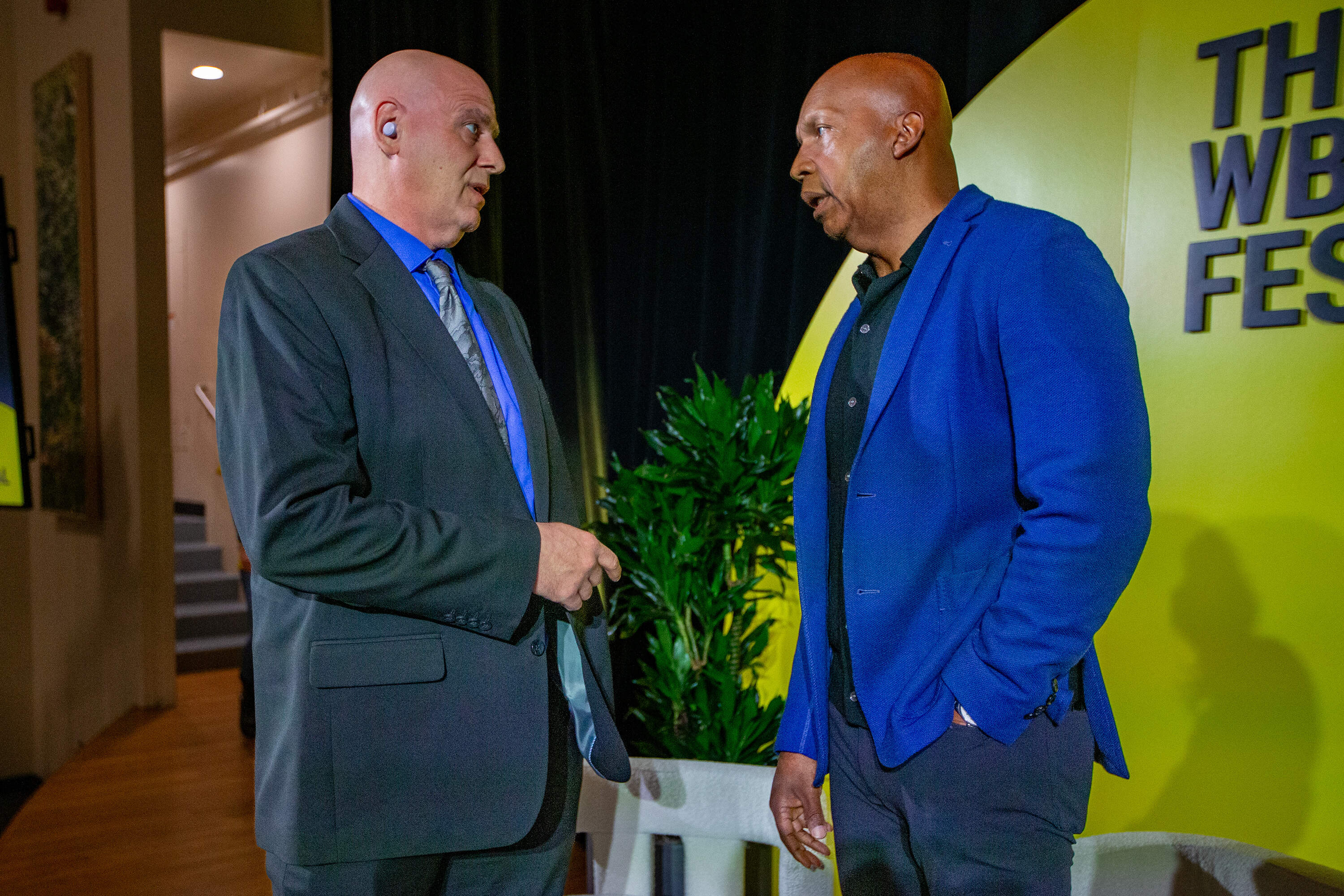
Attorney Bryan Stevenson has spent years fighting for people on death row and juveniles sentenced to life in prison. He won a landmark 2012 victory before the U.S. Supreme Court, which found mandatory life without parole for young criminal offenders is unconstitutional.
Today, he continues that work, as well as the fight to exonerate inmates wrongly put on death row. Founder of the Alabama-based Equal Justice Initiative and a professor at the New York University School of Law, Stevenson also wrote a memoir, "Just Mercy," that became a 2019 Hollywood film.
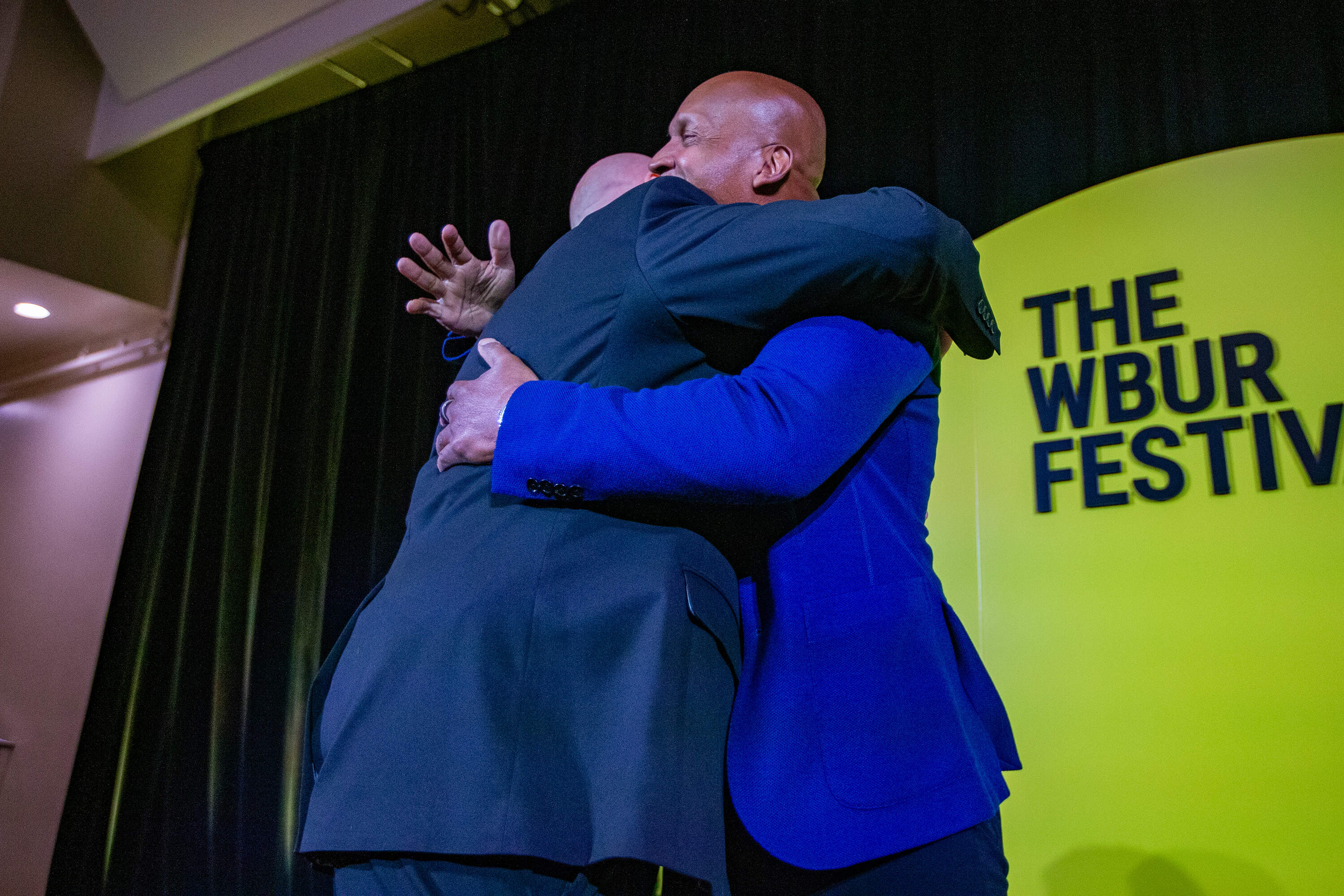
During a visit to Boston ahead of his talk at The WBUR Festival, Stevenson sat down with one of the men who was released from prison because of Stevenson's life work.
"I couldn't be here today if you didn't do what you did," Joe Donovan told Stevenson, as the men embraced.
Donovan, 50, a Cambridge native, once thought he would die in prison. He was 17 years old when he was involved in a confrontation where one of his acquaintances fatally stabbed an MIT student. Donovan was convicted of first-degree murder and sentenced to life in prison without parole.
Because of Miller v. Alabama, the 2012 Supreme Court ruling barring mandatory life without parole sentences for those under 18, Donovan was granted parole in 2014. He'd been incarcerated for more than two decades.
" I want to just say how proud I am — because we opened a door with the legal work that made it possible for people like Joe to get out — but he did the hard work," Stevenson said.
Stevenson added Donovan deserves credit for helping prove that young people deserve second chances, and that success stories are possible in the wake of the Supreme Court decision.
" When we argued this case before the court, I told the court — 'It's a different kind of death sentence,' " Stevenson said to Donovan. "It's death by incarceration instead of death by execution. And to find a way to move forward is no small thing, which is why I think it takes a special person to navigate that despair."
"Where there's life, there's hope," Donovan told him.
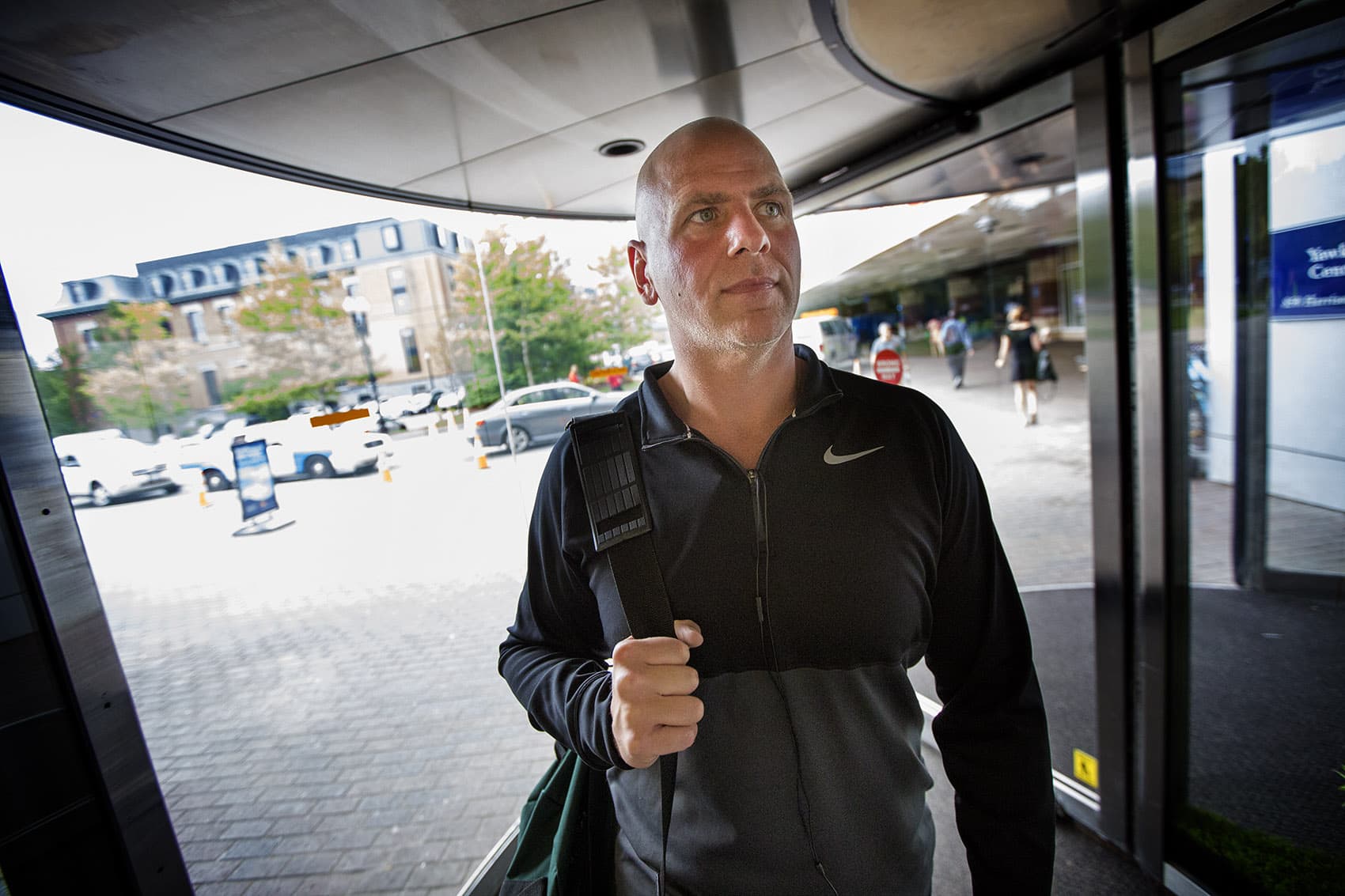
But Donovan said when he was first incarcerated, he had little hope. And he often pretended to be tougher than he really was.
"It's very difficult to just manage life when you're told you're never going to get out of prison," Donovan said. "You're taking everybody's incentive to be any type of good in any way away from them, and then you're putting them in an environment where everybody else's incentives are taken away, too. That's a recipe for disaster."
Donovan was with a group of teens in September 1992 and punched MIT student Yngve Raustein. But another teen, Shon McHugh, was convicted of fatally stabbing Raustein. Because McHugh was 15 at the time and sentenced as a juvenile, he was released after about 10 years. Donovan, then 17, was sentenced as an adult using the so-called felony-murder rule, which allows anyone present during a murder to face the same charges as the actual killer.
Donovan refused a second-degree murder plea deal, so his conviction on first-degree murder charges automatically sent him to prison for life. He said he continues to be haunted by the crime and the pain it caused.
"All the things that would've allowed me to get convicted today, now you can't do it."
Joe Donovan
He also said he's frustrated that his conviction would be unlikely today, because of changes to juvenile sentencing and the felony-murder rule. Massachusetts' highest court narrowed the scope of the felony-murder rule in 2017, but that doesn't apply retroactively to convictions like Donovan's.
"All the things that would've allowed me to get convicted today, now you can't do it," Donovan said.
After the 2012 Supreme Court ruling in Stevenson's case, the Massachusetts Supreme Judicial Court ruled that young offenders like Donovan who were sentenced to life in prison could become eligible for parole. Since then, 47 of the 69 affected juveniles in Massachusetts have received a positive parole vote, according to state public safety officials.
As for Donovan, dozens of people spoke out in support of his parole, including some of Raustein's family members. In 2014, Donovan was granted parole and allowed to live in lower-level correctional facilities for almost two years.
Today, Donovan has an apartment in Boston and has been working as a painter for several years. But he is still fighting — seeking to remove the first-degree murder conviction from his record and not be on parole for the rest of his life. Parole requires Donovan to meet several conditions, including meeting regularly with a parole officer, paying monthly fees and adhering to travel restrictions.
"He might be out of prison, but he's not free," said Donovan's attorney and cousin, Paul Donovan. "Whatever he did that night, he's certainly more than paid his dues and that attitude is supported by the victim's family."
The First Circuit Court of Appeals ruled in December that Donovan's case could go forward. The court found Donovan's release on parole constitutes a different sentence for the 1992 crime so the appeals process can continue.
"One of the things I'm hoping we can do is just point to the success of people like Joe. Just surviving, just being healthy and in the world, and making it day-by-day given what he's gone through, is miraculous."
Bryan Stevenson
Stevenson continues fighting as well, with a focus on laws pertaining to young offenders. He pointed out that 13 states have no minimum age for prosecuting children as adults. Stevenson said he's currently representing a 10-year-old accused of murder and a 13-year-old being held in solitary confinement in an adult prison in Florida.
Stevenson acknowledged the climate has changed since 2012, when lawmakers and policymakers were moving away from the 1990s ideas of young people as "super predators" and charging them as adults. He described the current legal and political climate as "a challenging moment," and said he has "a lot of work to do" to prevent a retreat to criminal justice policies that treat children as adults.
"We're now moving into a new era where I believe that the politics of fear and anger are resurgent," Stevenson said. "One of the things I'm hoping we can do is just point to the success of people like Joe. Just surviving, just being healthy and in the world, and making it day-by-day given what he's gone through, is miraculous."