Support WBUR
Adam Nimoy on growing up the son of Spock
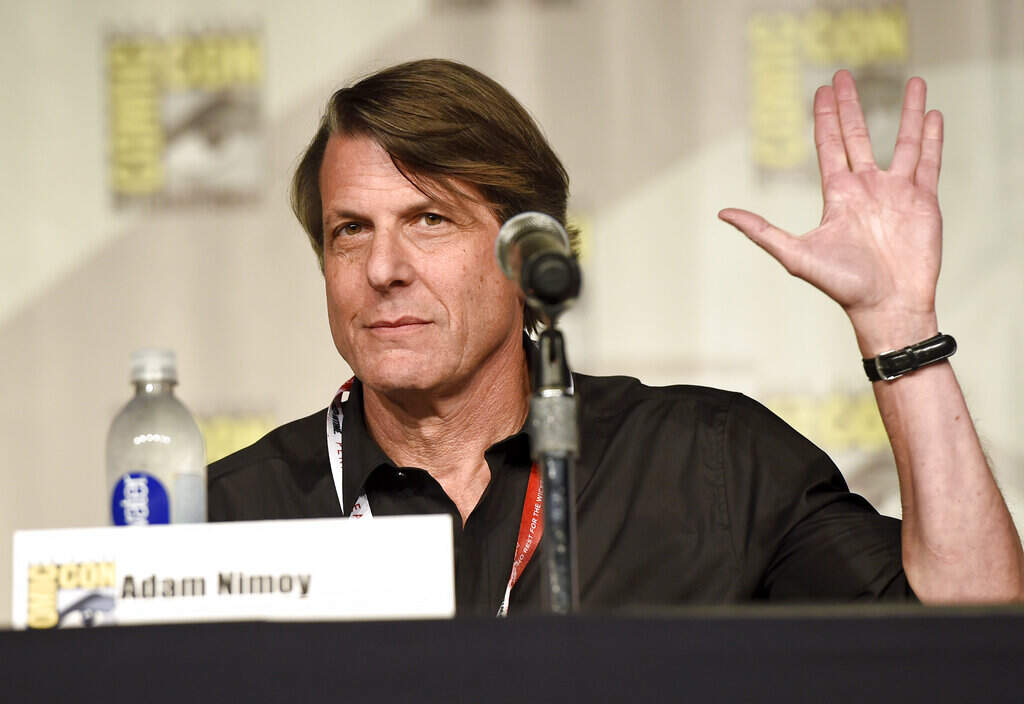
Adam Nimoy's father, Leonard Nimoy, played Star Trek's Mr. Spock, the most famous alien in television history.
In reality, he was a tough, uncompromising father.
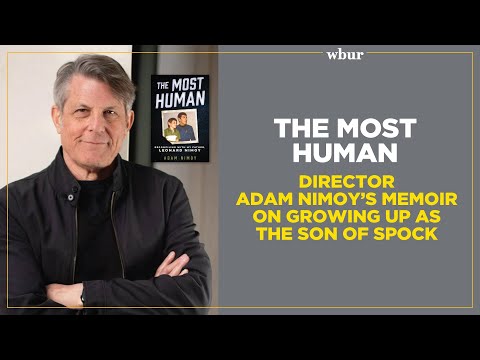
In a conversation live from CitySpace, Nimoy discusses his book “The Most Human: Reconciling with My Father, Leonard Nimoy."
Guest
Adam Nimoy, filmmaker and author of “The Most Human: Reconciling with My Father, Leonard Nimoy."
Transcript
Part I
MEGHNA CHAKRABARTI: Imagine growing up as the son of the most famous alien in the world. That was Adam Nimoy's boyhood. His father, Leonard Nimoy, played the legendary role of Mr. Spock in the original Star Trek series. The role made Leonard Nimoy a global superstar. But off the set, he could be a demanding, tyrannical, and even at times cruel father, as inscrutable and unyielding as the character he played on TV.
Adam Nimoy tells the story of growing up, growing apart, and then back together again with his father in the memoir, The Most Human: Reconciling with my father, Leonard Nimoy. I recently talked with Adam about the book. We were at CitySpace, WBUR's live events venue in Boston. And by the way, you'll hear some specific references to the city in our conversation. Because Leonard Nimoy grew up in Boston, in a neighborhood that's not far from WBUR's studios.
Now, being a lifelong Star Trek fan myself, I took the liberty of beginning the conversation with a story from my own life and how much Mr. Spock was part of my family.
CHAKRABARTI: We watched the original series with my dad. And it was a very major part of my growing up. Star Trek was a very huge part of my family's kind of understanding of the world, even.
And specifically, my father, who would sit cross legged on the couch and lean in and watch and he would just be deeply involved. And his absolute favorite character was Mr. Spock. To the point where, because my dad was a scientist, but he was also an emotional guy. So Spock's duality of being both Vulcan and human, being deeply immersed in the pursuit of a logical existence, marred a little bit by humanity, my father deeply related to that, and he would often tell me, he'd say, daughter, because he didn't call me Meghna, he called me daughter.
When I die, and I come back in my next life, I want to come back as a Vulcan. (LAUGHS)
So my dad actually did pass away a couple of years ago. And I'd like to think that somewhere on Vulcan, in a dimension where it still exists, that was my slam on some of the movies. That he has come back indeed as a Vulcan. And the reason why I wanted to start with that is not only to explain my personal passion and the importance that Star Trek has played in my life.
But to ask you, Adam, you must have heard thousands of equivalent stories. As an adult now, when people share those things with you, does it feel like a gift or a burden, and how does that compare with how it felt when you were growing up?
ADAM NIMOY: Wow that's a broad question. That's a big one to start with.
CHAKRABARTI: Star Trek asks big questions, so I felt like I had to dive in with something profoundly moral and exploratory.
NIMOY: The answer is it's complicated. Things have changed over time. When Star Trek came on the air, I was very excited about the attention my father was getting, and people were interested in Spock.
He was a very popular character. Our lives changed right away. And it was novel, and it was wonderful. The paparazzi were showing up at our house. The 16 Magazine, a fanzine, had accidentally printed our home address as the mailing address for Spock fan mail. So we started getting sacks of mail. And there was just a lot of attention paid to us, and it was novel and really lovely and wonderful and exciting. It was an exciting time.
I was 10 years old. My sister was 11 and a half at the time, and it was really wonderful. The other side is that I had a lot of difficulty relating to my father, because he was so Spock and could be very reserved and introverted, and very obsessed with his career, and it is a fan-based business.
You have to pay attention to the fans and my dad did. I mean on the weekends, he'd spent a lot of time traveling all over the country making personal appearances, meeting with the fans, also generating cash. Which was a big part of his mentality, something he learned here on the streets of Boston. And there was a competitive element with the fans, where I couldn't even be alone with him. Trying to bond with him on father son outings, without the fans wanting a piece of Mr. Spock.
And, but now, it's gone back and forth, and then when I had trouble with my dad off and on, which I talk about honestly in the book, The Most Human, I would have a knockdown drag out argument with my dad. And then I would go to pick up my shirts at the cleaners and the guy would figure out my last name and wax eloquently, as did you, about how much he loves Spock and how Spock changed his life.
And I'm like yadda, yadda, can I just get my shirts? So there was that. And now, with the reconciliation with my dad and his passing, it's lovely, really, to be out with people and being on this tour, and talking about this book, and talking about my life with Leonard. And having, and feeling the afterglow of the goodwill that he's created all over the world.
CHAKRABARTI: So you were ten when all of this begun and it sounds like it was a completely, an overnight change in your family's life. Did you ever get to visit the set?
NIMOY: Yes, so they started shooting the first season in really was late May of '66. I was out of school in the middle of June, and for the next couple of months.
I spent a lot of time on the set. I was just, I was old enough to behave myself, somewhat. And I was interested. Because I loved popular culture, I loved watching TV, I loved all the stuff that my dad had been doing up to that point. And I was very curious about what it was like to be on the set.
And he was willing to take, he brought me with him, I would go with him very early in the morning and watch him in make up, and hang out all day, my mother would come pick me up in the afternoon, and it was really, it's like a Disneyland effect. You're just in this fantasy world and it demystifies things a little bit.
Cause you can see how the Enterprise just set pieces all over the soundstage and then there was Planet from Hell on stage nine. But it was great because one of the things that I really loved doing was trying to remember what scenes they were shooting at the time. Because I would wait for those episodes and go, Oh, yeah, I was there for that. It really felt, I really felt a part of the experience. And although relating to my dad when he was on set was really complicated. Stay out of his way was like the MO.
CHAKRABARTI: Okay. Quickly, this picture from the cover was obviously a day that you were on, where you were on set, what was it like getting the ears put on?
NIMOY: It was difficult because they were oversized. My ears were not quite big enough. It took a lot of, I think they call it the spirit gum. It's some kind of tape, double sided tape that Fred Phillips, the Makeup artist who made up my dad every day for the three years. He was on the series, Freddie Phillips was the guy who made all that happen, all that magic happened. It was this, was a prank. ... Even though the show hadn't even aired. This is July of '66.
It didn't go on the air until September 8th of '66, 58 years ago today. And they were always into how to make Leonard laugh. That was one of the objectives on the set. Bill Shatner, that was one of his objectives, is how to get Leonard out of character. Because my dad had trouble getting in and out of Spock, and it was always, how do you pierce the veil?
And this was one way to do it. They figured while my dad was rehearsing. Somebody, the assistant director came and got me and said, you're going to the makeup trailer. And Fred Phillips cut my hair. He shaved my eyebrows from which they never totally recovered. I don't know if you've noticed.
CHAKRABARTI: (LAUGHS)
NIMOY: And then he put in the eyebrow pencil for the spot. You know, the eyebrows and then he tried to glue these ears on me and I And while they were shooting the scene, I was standing in the turbo lift.
This is one of these moments that, you know, you're never going to forget. Waiting for that turbo lift to open so I could walk out and give my dad a kiss and say, Hi, Daddy. And that was the gag.
CHAKRABARTI: Can you tell me a little bit about how your father saw the role of Spock, or the importance of the role of Spock?
And I ask this because, of course, as everyone here knows, part of the immortality of the original Star Trek was the fact that it presented a future that we all hoped for, right? The diversity of the crew, humanity coming together and exploring space, etc. And I'm wondering if that aspect of the project mattered to your father, especially, him being Jewish.
NIMOY: Yeah, I think one of the reasons why Star Trek has resonated for so many years is because it is a message of hope. Not only are we gonna figure our stuff out on planet Earth, but we're gonna have this United Federation of Planets. There'll be this interplanetary cooperation. The thing about Spock, that in particular, and what you're alluding to, in terms of his character, specifically, is this idea of being the outsider.
I hear this repeatedly when I talk to people, that what has resonated for so many years with people is the fact that Spock is an outsider and it's okay and it's cool. Actually, cool to be outside and my dad was speaking about this. In fact, at the commencement of Boston University in 2012, he was talking about the fact that Spock was the ultimate outsider much like my father was when he grew up in the West End of this city. Because the West End was a bubble of immigrants. It was an immigrant neighborhood of Italians, of Irish, and of these Russian Jews.
My grandparents, they were from Ukraine, but they considered themselves Russian. And my father's whole objective was how can I get out of this bubble and integrate myself with the greater part of American society, something my grandparents knew nothing about, and give the best that I have to offer as an artist, as a creative person.
That's why he left at age 18 and traveled afar, across the country on a three-day train ride, with no support from his parents. They wanted him to go to college and become a professional. They were devastated when he said he wanted to become an actor and go to Hollywood, and they would not help him.
By the same token, my father reminded me repeatedly, and rightfully, that although the Enterprise crew, the core crew on the bridge, was multinational, multiethnic, multi racial, multiracial, the only alien on that bridge crew was Spock. And as such, Spock's objective was very much, his experience was very much like my father's.
When he told his father that he wanted to join, he wanted to go to Starfleet Academy, his dad was appalled because he wanted him to go to the Vulcan Science Academy. So right away there was a parallel in their lives. And Spock's objective was how can he integrate with his human counterparts on the bridge and give the best that he had to offer.
It was that specific. Because that's what, and that's the genius of my father, that's how you bring a character alive, that's how you bring a story alive, you must find some specific personal connection to the role you're playing, the story you're telling, because then it becomes more universal.
Part II
CHAKRABARTI: Earlier, Adam had talked about how Leonard Nimoy was so fully dedicated to embodying Mr. Spock while on the Star Trek set, that it was often hard to get him out of character.
I asked Adam if the same was true at home.
NIMOY: Yeah, look, my father was a very reserved, introspective person to begin with. He was not a warm and fuzzy guy. And he was, that's matter of his upbringing. My grandfather was inscrutable, is the word I use. He was a man of few words, if any.
Mostly my grandmother ran the show, and they were not demonstrative people, my father would say. They were not warm, loving, tender, you know, a kind of parenting people. My mother was that way thankfully, for my sister and myself. My dad was not that way either. So it was very hard to relate to him to begin with.
And my dad was obsessed with survival. From '56 when I was born until '66, it was quite the struggle in the Nimoy household. Family was not a priority to him, and he was just not paying that much attention. When Spock came along, it was the double whammy situation. Not only was, to begin with, he was difficult to get through to and relate to and connect with, but he had so much trouble getting out of character.
When you're living that kind of a character, nine to 10 hours, 10 to 12 hours a day, five days a week. And Spock was such a contained character. And my dad had trouble, really, just getting out of his Spock bag, we used to say. That was a saying in the '60s. He was even more remote, more distant.
Thinking about reading the next script, or thinking about the scenes for the next week, or he wasn't even around because he was making these personal appearances. I had this double whammy with Spock, that now not only am I living with Leonard, I'm living with Leonard and Spock.
Much more difficult.
CHAKRABARTI: Perhaps you already answered this, but someone just asked that Spock himself had a complicated relationship with his father, Sarek. So true. What was Leonard's relationship with his father, and do you think that influenced your relationship with your father?
NIMOY: I had to give him, cut him some slack because of the modeling that he had from his parents.
They were just ... but and I knew they were proud of my dad, even after he was successful. I just knew it. They didn't understand anything about Star Trek, but I never heard them say that they loved him or were proud of him outright. Never. So I think he had, it was a struggle for him, in terms of his own modeling with his parents, for him to figure out, really, what parenting was about in terms of his relationship with me.
CHAKRABARTI: So then talk more about that because again, this is a happening when you're 10, the production of Star Trek goes on for just a mere three seasons, but the impact resonates throughout your whole life, right? Because it never goes away.
It just gets bigger and bigger. How did being unable to get your dad out of the Spock bag have an impact on you in terms of how you saw him?
NIMOY: Stay the hell out of his way, for one thing. You know, I just loved my father and was so proud of what he could accomplish. But being, you know, I was just disconnected to him for many years and if I needed nurturing and support and love, I went to my mother and my maternal grandparents for that.
The problem was that when I became a teenager, and he was done with Star Trek and Mission Impossible, that was five solid years of very heavy TV work, and my dad had some spare time, and he was around the house more, and he was starting to take a look at me in my life. I was 17, I was a pothead, and I was a complete deadhead.
And my dad was pretty heavily into, admittedly, his own alcoholism. It was just a recipe for disaster.
CHAKRABARTI: We have another good question here from the audience. Your father wrote both I Am Not Spock and I Am Spock. How did his struggle with his Spockiness influence his life?
NIMOY: I Am Not Spock was written in the mid 70s, in 1975.
And It was a mistake that he admitted to. My dad was very strong willed, he could be very determined, he could be very pig headed, in fact. And the publishers suggested not entitling it I Am Not Spock. But, and he was taking a very literal approach. People were always coming up to him, and when he was traveling in airports or out in public, and they were, they just identified him as Mr. Spock. Oh, Spock, I love you.
Mothers would introduce him to their children as this is Mr. Spock. I'm not Spock. I don't come from Vulcan. I come from Boston. And he was like literally talking about the fact of that, I'm an artist. I created this character. I love the character, I love Spock, but I'm not him.
People should know that I have my own identity. He's splitting hairs there, and the fans didn't really care about that nuance. What they read from it was, I'm not Spock, I'll never be Spock, I don't like Spock, I'm my own man, stop talking about Spock. And the backlash was immediate. It was vicious, in fact.
It was quite an eye opener for my father. When he decided to write another autobiography, memoir essentially, He decided to make amends for that by entitling it, I am Spock, because the fact of the matter is he loves Spock. He was so grateful what the role had brought him in terms of opportunity.
It was misconception. It was, when he was the last holdout on the Star Trek movie, people thought, Oh, this is because he hates Spock and doesn't want to be a part of Star Trek. Not true. It was because he had this lawsuit against Paramount for merchandising rights after all the syndicated market and all the times they reran that series during the '70s, which made Star Trek such a huge kind of global phenomenon.
It was not the three years on the air, and the actors were paid nothing, no residual. They ran out very quickly, and Paramount's making all this money on merchandising and not paying anybody, including my father. Until they settled the lawsuit, he would not even consider being in one of the feature films.
But everybody else construed that as, oh, he hates Spock, he doesn't want to be in the movie.
CHAKRABARTI: I love the movies. The first four are like amongst my favorite movies of all time. So the line, actually, this is on, from Star Trek 3, when Sarek is on Vulcan. I believe it's from 3. Someone correct me if I'm wrong.
And he's speaking with Vulcan elders. And Sarek says, When it comes to my children, my logic is uncertain. I think that's a paraphrase. It's not the exact words, but it's close. That resonated with my dad profoundly, and I'm wondering if that uncertainty, even in any family relationship, but especially between parent and child, or your case father and son, if that resonates with you.
NIMOY: His logic is uncertain, that's for sure. Yeah, it was definitely challenging, this is interesting ... this is the conundrum about my father. He's a multi-talented artist, he's a renaissance man, he could do anything, he could fix anything, give him a toolbox, he can fix anything, but when it came to parenting, there were a lot of challenges for him.
His logic was definitely uncertain, and these are the kind of things I had to overcome when I had my own kids. And when I had my own kids, it became more apparent to me of what was missing in my relationship from my dad, particularly early on with him. This was the most difficult, this was the issue of my life, really, and the issue of my recovery, is how do you deal with that situation when you have a parent who you just can't relate to and can't get real with.
CHAKRABARTI: Yeah. Our fabulous staff has got the exact quote, My logic is uncertain where my son is concerned. Such a good movie. Talk to me a little bit then about, addiction. You described yourself by the age of 17 as a pothead. How did that happen?
NIMOY: And I guess there were a number of factors.
The thing is about, look, I was very much a loner, a person. I was not popular in school. When you start smoking weed, you have immediate community. Because there are a lot of people in high school who are doing that, who want to party, who want to get high. You know my deadhead community, all of a sudden I had a whole bunch of friends.
And I was enjoying that aspect of it, the problem with addiction is that you, I've spent the next 30 years trying to chase that feeling of fun, of I remember it specifically, in fact. When I got out of, I had a love hate thing with pot while I was in college and went to school Undergraduate at Berkeley. And then I went to Loyola Law School, and I wished I could smoke less and focus more on the things that I had to do.
But I do have a very specific memory of having taken the California State Bar and then I went to the south of Spain with some of my law school buddies. And we're drinking sangria, eating paella, we're on the beaches of Nerja we're enjoying, it's just beautiful women and we're having a great time.
And I was listening to music on the beach and thinking to myself. I just I want to capture this moment I want to remember this moment because it was so wonderful, you know getting high and partying with my friends. The problem with addiction is then you keep trying to chase that moment and recreate that moment in your addiction. And pretty soon, it's just, because it starts off as fun.
Then it's just fun with problems, and then it's just problems. And that's the way my addiction went to the point where I finally figured out after having kids that it was time to lean up my act.
CHAKRABARTI: Can you tell me tell us more about that? Was it the fact of you being responsible for children that motivated you towards sobriety.
NIMOY: Yeah ... I was married for 18 years to my first wife and we're very close now 20 years after we split. But it was a failing marriage. And the way I'd dealt with that was to just stay high all the time. As a way to numb myself, and numbing myself had a little bit to do with my dad too, feeling the loss and the difficulty of dealing with him.
He could be very judgmental, very difficult. This is the thing about these Depression era guys. They have a lot of trouble expressing feelings of love and joy. And just sensitivity and support and pride. But when it comes to anger, resentment, and judgment, my dad was very good expressing some of those feelings.
And dealing with the pain from some of that was maybe a part, and I'm not blaming him, it's just a part of trying to fill a little hole in myself and get that warm and fuzzy feeling that I felt when I was getting high. I was in a failing marriage and trying to do the same thing. I was trying to numb myself from the pain until my kids were teenagers.
And they started to recognize that there was something wrong with dad. That was the clincher. Something's wrong with dad. What was wrong with dad is he's stoned all the time. And when they started to become somewhat aware of that, that's when I hit my bottom and it clicked with me.
OK, I got to get out of this marriage and I got to sober up.
CHAKRABARTI: In the book, you describe your father as being a high functioning alcoholic. What age were you when you first realized that's what he was?
NIMOY: Probably when I was in law school. He was just like me, that's the thing I could see.
I was a high functioning pothead. There's a lot of us, high functioning alcoholics and addicts running around in the world. I think it was probably then that I knew, I knew that he was really deep in his alcoholism, that it was a regular thing with him. And I that every night he was in his little private bar at home fixing a drink, but that the fact of the matter is he never missed a call time and never missed an interview.
And, weirdly enough, I admired that about him. He didn't let his alcoholism get in the way of his professional life. It got in the way of his personal life. Certainly, between me and him. I mean we had a couple of knockdown drag outs, when he had a few drinks and I was probably high. And it's just a horrible combination, that just exacerbated the difficulties between us. But the fact of the matter is I was very much like him. I, you know, I made it through law school.
I managed to pass the bar, and I was stoned pretty much through that whole experience.
CHAKRABARTI: How long had your father been drinking? Do you know?
NIMOY: He said in an interview with none other than Bill Shatner that he started drinking when he was on Star Trek. Because it was the first show that he was on, first series, he was a regular at the time. Cast member on high pressure, how do you decompress? Dealing with problems on the set, dealing with the problematic producers, dealing with Bill Shatner, and some of the conflict they had, a couple of Jewish boys in outer space. A lot of that, my dad said, this is what we do when we become substance abusers.
We use a substance to help deal with some of the issues of the pressures of being on this planet.
CHAKRABARTI: So someone from the audience asks, I am an adult child of an alcoholic and 33 years sober in AA. Was your amends process and reconciliation reciprocated?
NIMOY: Yes. And no, I mean my father never made an amends to me. You know, it's 12 step recovery ... steps eight and nine. You've made a list of people we had harmed and made willing amends to them all. And then nine, make direct amends to such people whenever possible
My father went sober in the mid '90s and he took me with him to an AA meeting. I'd never been to one. I wasn't sober at this point. I'm not even sure why he took me. I mean whether it was him telling me I needed to sober up or him showing me that he was proud of the work he was doing in AA. I don't know, but for the first time and a lot of these 12 step meetings.
We read the 12 steps to remind everybody of the work we need to do in recovery. And when they got to steps eight and nine, which I had never heard before, I was freaking livid, I was livid with him. I was like shaking, I was sweating, because he never made an amends to me.
And what kind of recovery program is this anyway, when you can get away with that? I just, I thought it was a bogus program, frankly. Then I went into recovery myself in 2004, this is probably six years later, six or eight years later after he went into recovery, and that's when I learned that making amends is my job.
That is part of my recovery, and I needed to make one to him. Which I fought, and I resisted and I refused to do. But I was told to do it. And so I did it. You know, I faked it till I made it, we say in the program. And I made an amends to him based on a letter he had written me, about why he thought I was the reason for the problems in our relationship.
He wrote me a six page letter. And it's in the book. It shocked me. He took my inventory, we say. All my character defects, and a friend of mine in recovery said, this is great. Take that letter, go to your dad, make an amends for it. I'm like, are you kidding? That's insane. I'm not gonna do it. He explained to me that the amends was not for my father was for me.
I have my own resentments, my own grudges against my dad. I should apologize for everything in the letter and let go of my own resentments about, and just accept him. One of which was he never made an amends to me and get on with my life. The weird thing was, and my dad was very happy about this experience, by the way, while I was making the amends to him.
He was like very, it was, he had a very satisfying look on his face. And in fact, when he was walking me out of his house, I went to his house to make the amends, he invited me to Shabbat dinner the following Friday night. But the fact is, after that, everything changed with him.
Everything. Because I changed. That is a program of recovery. Acceptance. Radical acceptance with other people. They don't, people don't change. You change. That's the serenity prayer. Grant me the serenity to accept the things I cannot change. Other people and the world. The courage to change the things I can, i.e. me and the wisdom to know the difference.
That is, we say that almost at the end of every meeting. But the fact of the matter is, things changed with my dad. He was willing himself, at that moment, to let go of his own grudges against me. And, when my, as I talk about in the book, when my second wife, Martha, became very sick with cancer, my dad showed up for me, and we call that a living amends.
He was the guy. He was my major source of support was him. He was my go-to guy at any given moment, and that's what we call a living amends.
Part III
CHAKRABARTI: Now, the final part of my conversation with Adam Nimoy. His father, Leonard Nimoy, was Mr. Spock on Star Trek, arguably the most famous alien to ever appear on television. Spock is half Vulcan, half human, half creature of pure logic, half creature struggling with the chaos of the human experience.
Both Nimoy's, father and son, struggled with addiction. With that in mind, I asked Adam if he or his father ever felt a Spock-like duality as they began their journeys into recovery.
NIMOY: Okay. Yes. You touched on a really great issue about recovery. Look, I'm an addict in recovery and I just accept that about myself.
I'm just a regular run of the mill pothead. I thought I was going to be in recovery for a couple of years, dry out after a couple of years and just go back out there and become a normie, right? And I've been modifying that plan every day for the past 20 years. I love the program. I love the meetings, I love recovery, and I don't do it always perfectly.
Because I got to tell you, when people piss me off, my first thought is F you, that is my first thought. But I have tools of recovery. And that's what I felt when I got that letter from my dad. F you. You got a six-page letter, I got a ten-page letter, Leonard and it's coming your way. Recovery for me is trying to gain some emotional maturity over these types of thoughts.
It is very Spockian. Spock has a lot of emotions because he is half human. The Vulcan side is an attempt to maintain himself and control that and get some kind of a grip on it. That is recovery for me, because I don't want to react. This is the whole point, is to keep my mouth from moving when my mind is saying, F you, I'm trying to get to my second thought and my first action.
Those I am responsible for. How do you get to that second thought? And those are where the tools of recovery come in. We have a lot of mantras like count to 10, restrain a pen and tongue, let go and let God. And my all-time favorite, don't just do something, sit there. And that's what I did with that letter.
(AUDIENCE LAUGHS)
NIMOY: And that is what I did with that letter, and I would share this at meetings, anonymously, in 12 step meetings. Most people didn't know I was related to Leonard Nimoy. They don't need to know I'm related to Leonard Nimoy when I share at a 12-step meeting. So a lot of my brothers and sisters from recovery were like, this is great.
You're practicing these principles in all your affairs. That's the whole point of the program. They were very supportive of what I was doing, because I did not react to that letter. I did not write him back. I just tried to let it go. But it was another friend in recovery, my friend Ed, who was a lower companion in high school, and Ed had much more recovery than I did.
He's the guy who said, Oh no, not good enough. This letter is your opportunity to really change your life. Make amends.
CHAKRABARTI: Was it at all made harder for you knowing that your father was also this like godlike hero figure to so many millions of people?
NIMOY: My father warned me very early on when I was 17, he and I had a major knockdown drag out. He sent me a letter, a conciliatory letter. And, which was long forgotten until it magically appeared when I was making this documentary about my dad. And in that letter, he said to me the following. Conflict with him and competition with him was going to be difficult for three reasons.
Number one, he could be very verbal and very loud. Number two, he's just a tough kid from the streets of Boston and you don't mess with him. And number three, he's rich and famous. And that's what I discovered is like, it is really difficult to go toe to toe with a man who was loved by millions of fans all over the world and say to him, I am so sorry.
You are human, you're fallible and you're wrong. That's the tough part.
CHAKRABARTI: So another question from the audience here. Many children say they don't want to repeat the mistakes of their parents. What did you do differently? And what did you find yourself doing exactly like him?
NIMOY: I just love that question. I just love that.
That's just such a trick question. I love that question. Look I was raised very differently. I was, my dad was selling newspapers on the Boston Common, in the dead of winter at age 10. That was my dad's upbringing, completely different upbringing. When I was 10, Star Trek went on the air. I was born in sunny Southern, California, and I'm watching '60s TV, including Star Trek. I'm reading spider man comic books, and I'm listening to the fab four.
That was my life. You know, I loved being a kid in Southern, California. My kids have the same upbringing I had. So right away I could relate to them. And I was also determined like my father to succeed in my career. Initially as an attorney, but I had much more of, I didn't have the desperation Leonard had, because I had more financial well being. He had nothing.
So right away we're dealing with a completely apples and oranges situation. I was just much more involved with parenting my kids. I wanted to, I like to hang out with them, I like the stuff they did. We hung out, watched TV and went surfing with my son and jammed together. And my daughter liked to go to concerts. And, you know, I coached her soccer team.
I mean I took my son out to surfing at 5 o'clock in the morning. I was an idiot enough to get up in the morning at 5 o'clock to take him and his friend surfing. I was helping my daughter with her school papers. I did everything for those kids and yet still they found reasons to hate me.
(AUDIENCE LAUGHS)
NIMOY: It's inevitable. But we had a love connection. That was what was critical. And a lot of the book is, the challenges of my teenage daughter. Oh my God! Teenage girls are, oh geez. Talk about restraint of pen and tongue. It just doesn't factor in. It was really difficult for her.
Particularly when I split from her mom, during the middle school years. We were talking about this as well. Tough period for any kid. It's very challenging. But we did family therapy. I was there. I showed up for them. Even when I split, I was there taking him to school.
My career crashed and burned in TV directing and I needed a job. My first job, get this, was substitute teaching. Because I always wanted to teach, in the Santa Monica Malibu Unified School District so that I could be closer to my kids.
It was just, we had difficulties, but, in the end, we found resolution, because we had a love connection from the very beginning, that simply was not there with my own dad.
CHAKRABARTI: This is another taste of Spock himself, another, yet a moment that embodies the humanity baked into the character as well. So let's watch that.
I cannot dismiss my duties.
Duty? Your duty is to your father.
If I could give the transfusion without loss of time or efficiency, I would. Sarek understands my reason.
I don't. It's not human. Oh, that's not a dirty word. You're human, too. Let that part of you come through. Your father's dying.
Mother, how can you have lived on Vulcan so long, married a Vulcan, raised a son on Vulcan, without understanding what it means to be a Vulcan?
If this is what it means, I don't want to know.
It means to adopt a philosophy, a way of life which is logical and beneficial. We cannot disregard that philosophy merely for personal gain. No matter how important that gain might be.
Nothing is as important as your father's life.
Can you imagine what my father would say if I were to agree, if I were to give up command of this vessel?
Jeopardize hundreds of lives, risk interplanetary war, all for the life of one person.
CHAKRABARTI: Wow, honestly, he's such a spectacular actor and the writing is so good. That also reminded me of a line that he utters in one of the movies, right? The needs of the many outweigh the needs of the one.
NIMOY: You really are a Trekkie, aren't you?
CHAKRABARTI: (LAUGHS) And proudly let me tell you.
NIMOY: A Trekker, I should say.
CHAKRABARTI: I wanted to ask you a couple questions about you, in the book you write about how you mentioned, obviously, frequently, the importance of your father's growing up here in Boston, in the West End. A very different West End than it is now, we should note.
And so in 2013, you and your father took a trip here to film a documentary, right? Leonard Nimoy's Boston, and that was also the same year that he received his honorary degree from BU. And I'm wondering if you could just describe that trip a little bit.
NIMOY: Yeah, the appearance at BU, at the School of Communications, was actually the year before, and he gave a commencement speech to that particular school.
And then he had to make a walk with the procession up to the dais for the general graduation. And it was after that experience, first of all, that experience was amazing. Because he's introduced to the crowd of graduates. There's a couple of, it must be a thousand people out there and giving them the Spock salute. And they're all giving it back to him, and it's just, the trajectory of the man's life as this poor kid from the West End, this immigrant kid. To come back, in such triumph, it's just so empowering.
It is the story of America, this kind of rags to riches story of the land of opportunity, that you can become whatever you set your mind to become. And it was a very satisfying experience. But then, when I went, met up with him afterwards, they had a walk down the track for just not even that far.
He told me he was out of breath and didn't think he was going to make it because he had COPD, chronic obstructive pulmonary disease from 30 years of cigarette smoking. I was shocked when he said that. And that's when, and then the fall. We were thinking about making a documentary together of the following year, actually.
And that's when I decided that we were going to be working together on a project for Star Trek specifically, but that grew out of the fact that before that, this is just after the marathon bombing in Boston, actually, is when I came up with this idea of doing Leonard Nimoy's Boston.
And I called a production company here in Boston. And I asked them, we want to come in, we want to shoot some video on the street of my dad walking from his neighborhood and the various places where he worked. At a card store on Bromfield Street, sold vacuum cleaners on Boylston Street, worked at a camera shop on Beacon Hill. And the guy who owned the production company said we're never going to get permits for that, because the city is basically in lockdown.
And he suggested that we simply show up. And running gun is what we call it. Just go to the location, pull out the video camera and the sound mics and shoot the thing. Interview your dad and let's just keep moving on. And that's what we did, and we were pretty successful at it until we got to the Boston Common.
We got out of the car, me with the camera crew, we were going to shoot just some establishing shots of the Common, where my dad had been selling newspapers. And right away, the cop came up to me right away, and he said, you can't park here. And I said, we're just going to be here for a couple of minutes to do some establishing shots, and I have Leonard Nimoy in the car.
And he says, I'll stand here and make sure no one bothers you.
CHAKRABARTI: (LAUGHS)
NIMOY: Can I meet Mr. Nimoy? I'm like, yeah, sure, come over here. Dad, this is Officer O'Malley, helping us out for the day. It was a great experience for us, for me to bond with my dad, and for my dad to bookend his life and look back at his career.
Because the fact of the matter is, the theme of that documentary is, this city shaped his life. That is a fact. Of growing up on the streets of this city, of hustling, during the Depression and of the opportunities the city gave him. Because they developed these settlement houses in and around the West End. Because the city fathers didn't know what to do with all these kids who were growing up, from immigrant parents and they're all congregating on the street, turning into gangs.
And it's, we've got to do something with these kids. They came up with the idea of settlement houses. West End House, which was just demolished recently. There's a huge structure going up there for Massachusetts General Hospital now. Most of the structures are gone from the West End, but there was West End House where my dad was managing a basketball team, and there was the Peabody House, Elizabeth Peabody was a settlement house.
They taught kids like home economics and science projects and there was a theater at the Peabody Settlement House where my dad was cast as an eight-year-old on the stage. And that's where it began for him. And he was in a number of theater productions there. And then he was seen by a guy named Father John Bond, who ran the drama department at Boston College, who saw my dad in a production.
I think it was awake and sing as a teenager. And offered him a scholarship to come to Boston College for the summer. So my dad wanted to give back. He wanted to pay homage to the city that had molded him into the person he became, which gave him the tools that he needed and the determination and the drive to succeed in Hollywood.
CHAKRABARTI: So here's the last question. It does come from a member of the audience. What do you think is the most important thing you learned from your dad?
NIMOY: The most important thing was passion. Passion was everything to Leonard. Everything. You have to feel a passion about what you do, the work you do in particular.
You have to feel a connection to the work. It was such determination and such feeling and emotion and attachment to make it worthwhile. This is what kept him going through all the trials and tribulations, tribbles of his life in Hollywood. There were a lot of setbacks, or a lot of obstacles in his way, but he was determined to do what he loved to do. And defied his parents, in fact.
They were devastated when he said he wanted to become an actor and go to Hollywood. It was like, telling them he wanted to join the circus, but he was so passionate about what he wanted to do. And this is something, I thought I was passionate about the law. I thought I would be passionate.
You don't know till you get into it, and I was passionate about the intellectual exercise of being in law school. I really enjoy the experience. But practicing law after seven years, I don't feel passion about this. And what really clicked for me was in between jobs as a lawyer, I went out to an acting class with Jeff Corey, who was my dad's acting instructor.
Jeff had a very good career in Hollywood after being blacklisted, which is why he became a teacher. But when he was semi-retired, I went out to his class, three hours. He had a little studio out in Malibu, and it blew my mind. And it triggered something in me that, oh my God, I love storytelling.
I want to be in this. I want to do something creative. That is what I feel passionate about. And that, and everybody, and I say that when I was teaching film school for many years, I would tell those people, they'd always say things to me like, why, Adam, why are you so angry all the time?
And I would say, I'm not angry, I'm passionate. And you need to be passionate because if you want to survive in this industry, you're going to need it. And that is what Leonard was all about.
This program aired on December 23, 2024.