Support WBUR
The legacy of revolution: New Boston Public Library exhibit considers how resistance ages
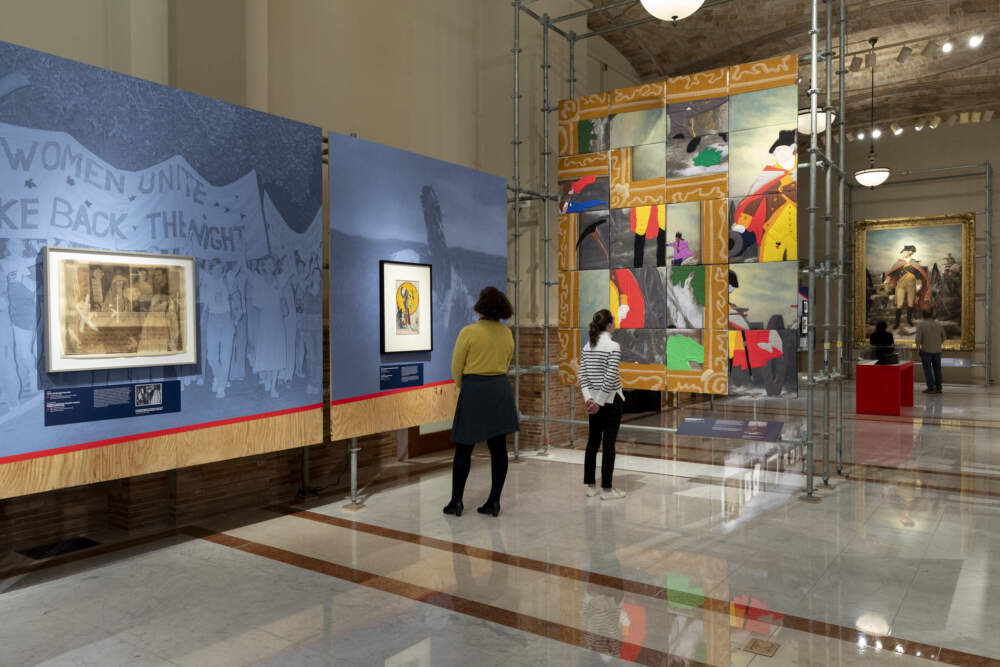
As the nation marks 250 years since the American Revolution, a new Boston Public Library exhibit looks at some local acts of resistance beyond the shot heard around the world.
Called “Revolution! 250 Years of Art & Activism in Boston,” the display features more than 100 objects, paintings and photographs from the library's special collections that document protest in Massachusetts and around the country.
The collection includes works from colonial times, but according to Kristin Parker, lead curator of the arts for the library, it isn't just for history buffs. Through contemporary art, it also aims to compel visitors to think about how celebrated legacies continue — or change — with time.
For example, Parker highlighted that a key part of the exhibit juxtaposes a local artist's modern quilt with an original painting of a victorious George Washington in a revolutionary battle. The pieces tell two distinct, yet connected, stories.
First, the famed 1852 painting, "Washington at Dorchester Heights," by Emanuel Leutze depicts “ a milestone moment" in the war in which, Parker explained, Washington "was able to stop the British without firing a single shot."
Placed near it is "Out of Order, Fortification of Dorchester Heights,” the colorful and rearrangeable quilt created by Michael Thorpe. The Newton artist is biracial and sought to combine in his work his mother's New England quilt-making tradition with the significance of quilt-making in the Black community.
Thorpe's textile explores, according to Parker, how narratives about legacies like Washington's can change over time, depending on who looks at them. Parker said Thorpe is set to switch up his quilt's two-dozen 20-inch panels several times during its six-month run.
Many patrons, Parker said, feel conflicted about "Washington at Dorchester Heights," adding, "they are impressed by it, but they also question it."
“He's a heroic figure, and he was an enslaver," she said. "Both of those things exist. And so, how as a library, how do we interpret that? How do we share the story and the context ... ?”
Open now until April 21, Parker hopes visitors leave the exhibit "with a sense of inspiration," adding that even the setting, as the nation's first free public library, provides a space born from a once "radical idea."