Support WBUR
Tracing the legacy of Rev. Jesse Jackson through the work of Boston's Mel King
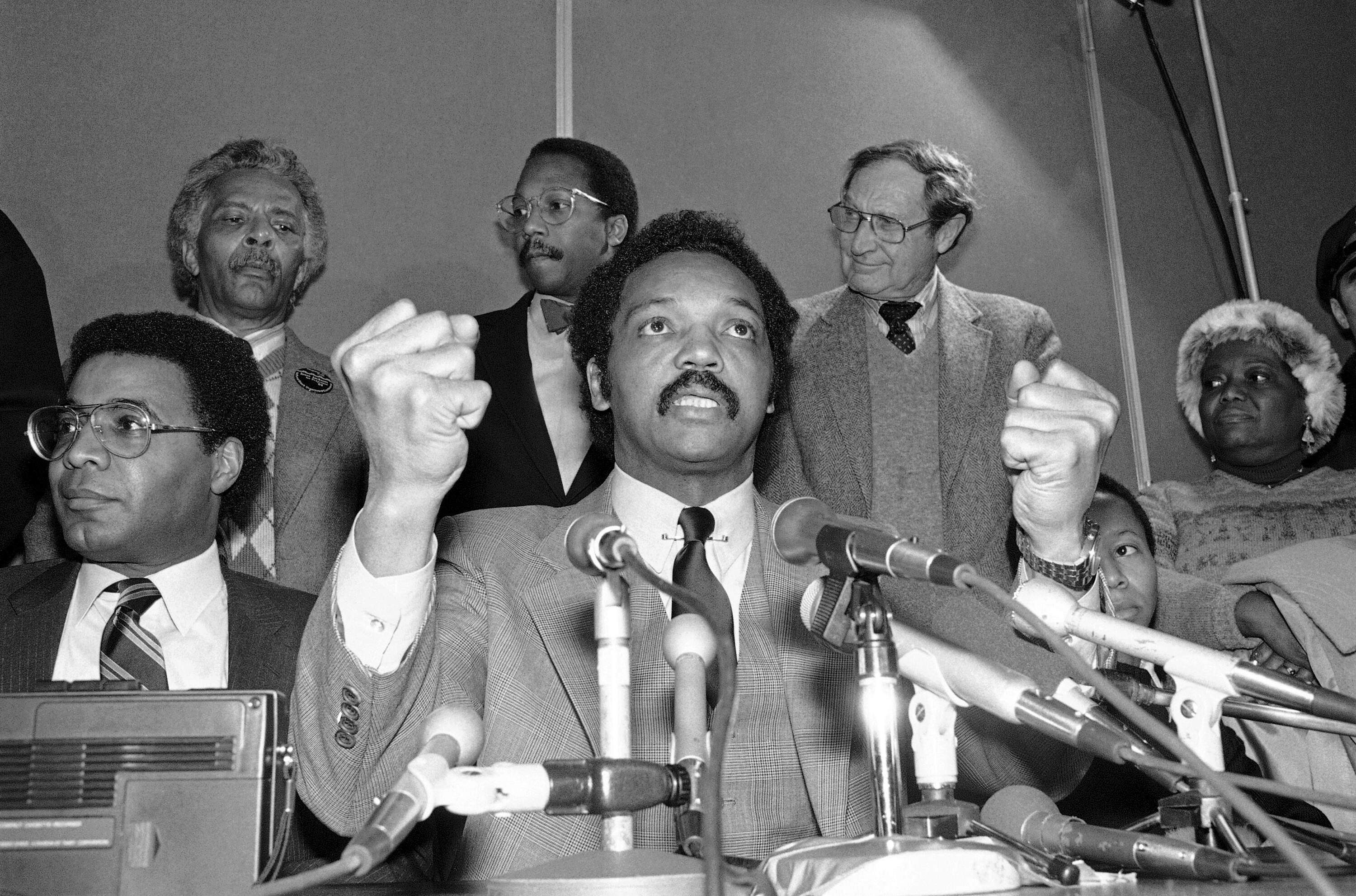
Rev. Jesse Jackson has died at the age of 84, and colleagues in Boston are remembering his impact on the city.
Jackson visited Boston frequently. One of his allies was the late political and community activist Mel King. And the two influenced each other in several ways.
When Mel King ran for mayor in 1983, he did so under the so-called "Rainbow Coalition" — a campaign that aimed to unite voters across demographics. Jackson would use the concept when he ran for president the following year. Jackson later founded the Rainbow PUSH Coalition, an organization still active today.
Michael Curry, a member of the NAACP national board of directors and head of the Massachusetts League of Community Health Centers, joined WBUR's Morning Edition to reflect on Jackson's legacy and his connection to Boston.
Highlights from this interview have been lightly edited for clarity.
Interview Highlights
On Jackson’s wider legacy and Curry’s relationship with him:
“ When I think about his service with Dr. [Martin Luther] King and that period of time in the 1950s and 60s, and the sacrifice, that people are literally sacrificing their lives to make this democracy work for all of us. That he was there with Dr. King when he was assassinated. To his legacy around the Rainbow PUSH Coalition and this whole notion that it's not just about Black folks. It's about bringing people who are marginalized, people who are underserved, together in a movement to deal with social justice issues, to deal with economic disparities, to deal with health disparities. That was visionary. And I think back to Jesse Jackson's conversations with me at a hotel in Washington, D.C. and sharing that history with me. I just feel overly humble right now and honored to have been in his presence.”
On Mel King’s 1983 mayoral run, the creation of his Rainbow Coalition and how it influenced Jackson and the world:
“There's a quote [from Mel King’s 1983 mayoral run] that I remember says, ‘I don't want to give you the impression that I know everything. I want to come here to learn and share. Join our Rainbow Coalition and its research. And we shall help you find solutions.’ That was moving to me, that he was bringing together people who thought that there was a divide between them in terms of their lived experience, in terms of what they wanted, and he brought them under one umbrella, Mel King. And that model of bringing people together would be what Jesse Jackson would take just within the next year into his presidential bid.
“We always say, ‘What does one person mean’? Like, ‘What does one person mean in the arc of history?’ And I think that transfer of this concept of a Rainbow Coalition from Mel King to Jesse Jackson, I would argue … gave birth to [the election of] Barack Obama. So we owe a debt of gratitude to his leadership, his sacrifice, his service.”
On the history of Black leaders in Boston and how King and Jackson contributed to that history:
“ I think Mel's run for mayor and Jesse Jackson's run for president is a message to everyone, which is that for most of this city's history, Boston, most of this state's history, through Deval Patrick, most of this nation's history, we have relegated talent to white men. And shame on us that we didn't believe that women, that people of color could be leaders, could be a visionary, could solve for climate change and economic inequalities, and deal with all the challenges of our time. We left that talent on the table. What Mel King and Jesse Jackson represented was a cracking, if not breaking that glass ceiling by saying, ‘No, we need to be at the table. We need to be in that leadership structure.’ And not only just for Black folks, but for all people in Boston, all Massachusetts residents, all people in the nation.
“And I think that's what his legacy is, that he woke up the consciousness of a nation around inclusion in a way that I think no one else could have done.”
This segment aired on February 17, 2026.