Support WBUR
Cog's Weekly Newsletter
On the streets with Dr. Jim O'Connell
Editor's Note: This essay appeared in Cognoscenti's newsletter of ideas and opinions, delivered weekly on Sundays. To become a subscriber, sign up here.
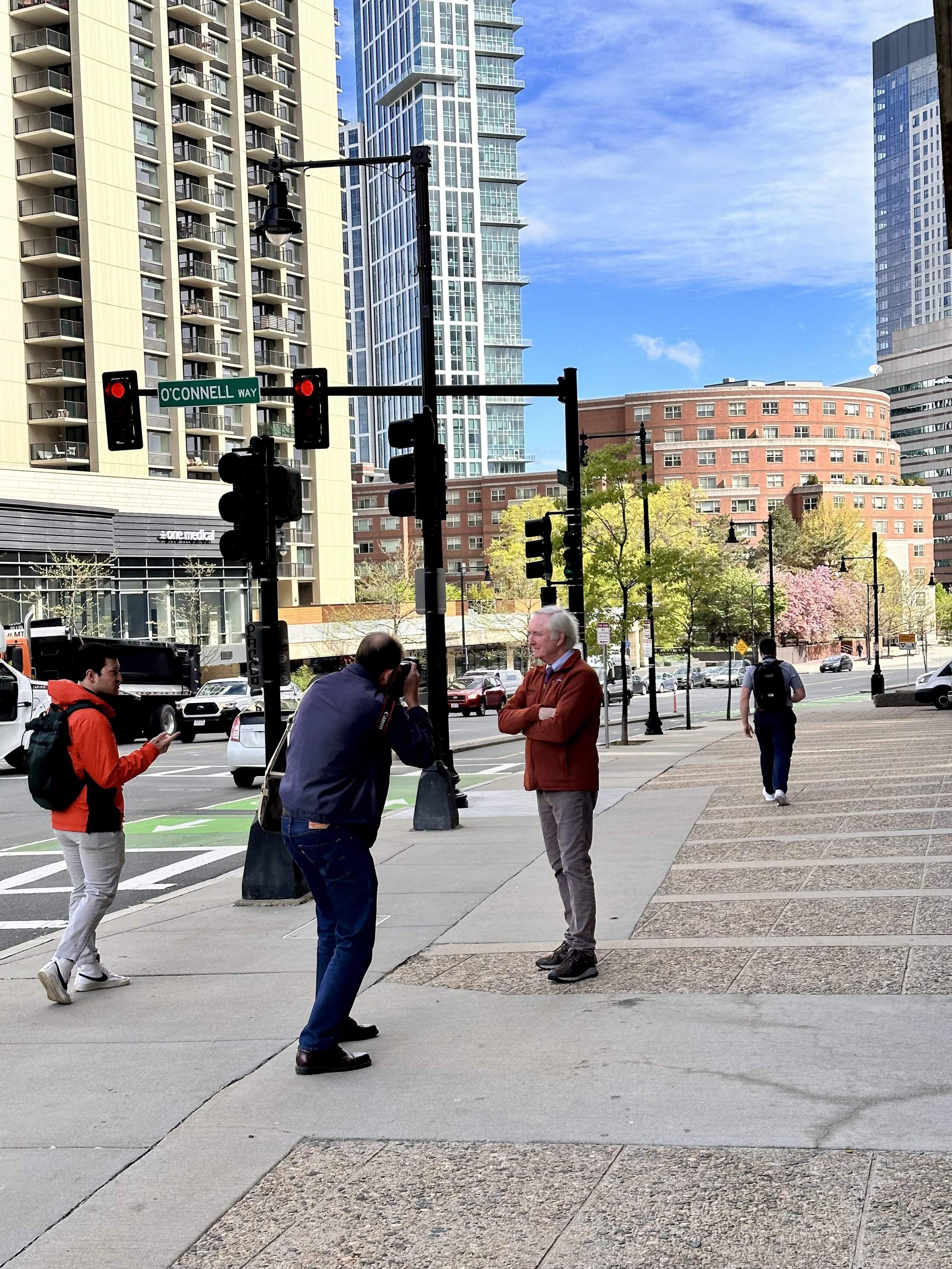
Dr. Jim O’Connell is the kind of person who, if taking up table space at a pastry shop, buys a bag of scones and a coffee because it’s a privilege — and the right thing to do. Or at least that’s what he did when I had the chance to meet him a few weeks ago. I met up with Jim (as he insists on being called) and two of his colleagues at Flour Bakery on Cambridge Street in Boston, just down the street from Mass General Hospital. The plan was to go on street rounds — me with my microphone in tow — to observe Jim interacting with patients experiencing homelessness.
As we sat, munching on pastries, Jim reminded me that there really is no predictable routine or rhythm to his days. He knows when he’ll start work and stop, but has no idea what may happen in between. I got the sense that this fluidity — in his words, “sheer, delightful chaos” — was one of his favorite parts of the job.
If you’ve read “Rough Sleepers” by Tracy Kidder, you’re familiar with Jim's work and ethos. He didn’t start Harvard Medical School until he was 30. Jim was headed for a prestigious fellowship at Memorial Sloan Kettering in New York City, when a mentor at Harvard asked him to please stay in Boston, just for a year, to work as the doctor in a new pilot program for homeless patients. Now, 40 years later, at the age of 76, Jim is still at the Boston Health Care for the Homeless Program — still doing that work.
His warning that the job defies routine held up in our time together. We went looking for folks along the Charles River, under the Longfellow Bridge, but every tent we visited was empty, or the people in them were asleep (and as a general rule, Jim doesn’t wake people during the day). We doubled back down Cambridge Street, and wound our way through the labyrinth that is MGH, en route to North Station. Along the way, I heard him say “How are you?” several times, just the way Kidder mimicked him doing in the audio version of his book.
I got the sense that this fluidity — in his words, “sheer, delightful chaos” — was one of his favorite parts of the job.
Eventually we found our way to BHCHP’s homeless clinic at MGH (the only academic medical center in the country to have an on-site clinic dedicated to the care of unsheltered rough sleepers). Standing in the lobby, the morning ridealong was further sidetracked by lively conversations with Dr. David Munson, the medical director of BHCHP’s street team, and two patients I’ll call Nate and Michael.
Nate told us a harrowing tale about his friend, Josie (also a pseudonym), who was isolated at an apartment in Brockton and in desperate need of full-time care. “There’s nothing in her fridge, not even milk,” he told us. He worried she might fall out of her wheelchair and end up on the floor, helpless for days. I couldn’t help but think how unfair it is that people like Nate, who are living on the streets, are also carrying the burdens of their friends, and lacking in material resources to make a meaningful difference.
Michael, who had experienced a brain injury in an accident, also happened to be a spoken word poet. Jim puffed him up, telling us Michael had performed in Allston. And then Michael, unbidden, gave us a sample:
This is the beginning, or is this the end? Winning, not me.
You said that word. If it was on, it would be sung.
I could cry my eyes out.
But as we speak, my problems always seem to grow into what no one knows.
After 25 minutes in the clinic lobby, we ran out of time to visit North Station; Jim was expected at an event in Back Bay. And my hopes of “getting great tape,” as radio lingo goes, were dashed.
Reading it, I saw a profound relationship between being a keeper of people’s stories and providing care.
At first, this was very troubling (a radio journalist with no good tape). And then I realized the experience of walking around with Jim for a couple of hours was instructive nonetheless.
I’d interviewed Jim over Zoom the week before we met in person. We talked a lot about storytelling; he studied literature in school, and is a lifelong fan of fiction. He's also a writer.
Kidder's “Rough Sleepers” is a New York Times best-seller, but not as many people have read Jim’s 2015 book, “Stories from the Shadows.” He pulled it together from notes written in the early morning hours after returning home from a shift. His writing felt urgent to me, like he was on a critical mission to capture every detail. People’s full names, their living conditions, their diagnoses, their traumas.
Reading it, I saw a profound relationship between being a keeper of people’s stories and providing care. Jim is a receptacle for his patients’ tales and retelling them is perhaps a way to make some sense of all the difficulty and heartache — or at least to make it small enough to hold, and keep moving.
I don’t generally go around quoting French philosophers, but this quote from Jean-Jacques Rousseau, which Kidder used in an interview with my colleagues, resonates: “What wisdom can you find that is greater than kindness?”
That, to me, embodies Jim’s philosophy and approach.