Support WBUR
Commentary
What would trailblazer Alice Marble think about today's US Open?
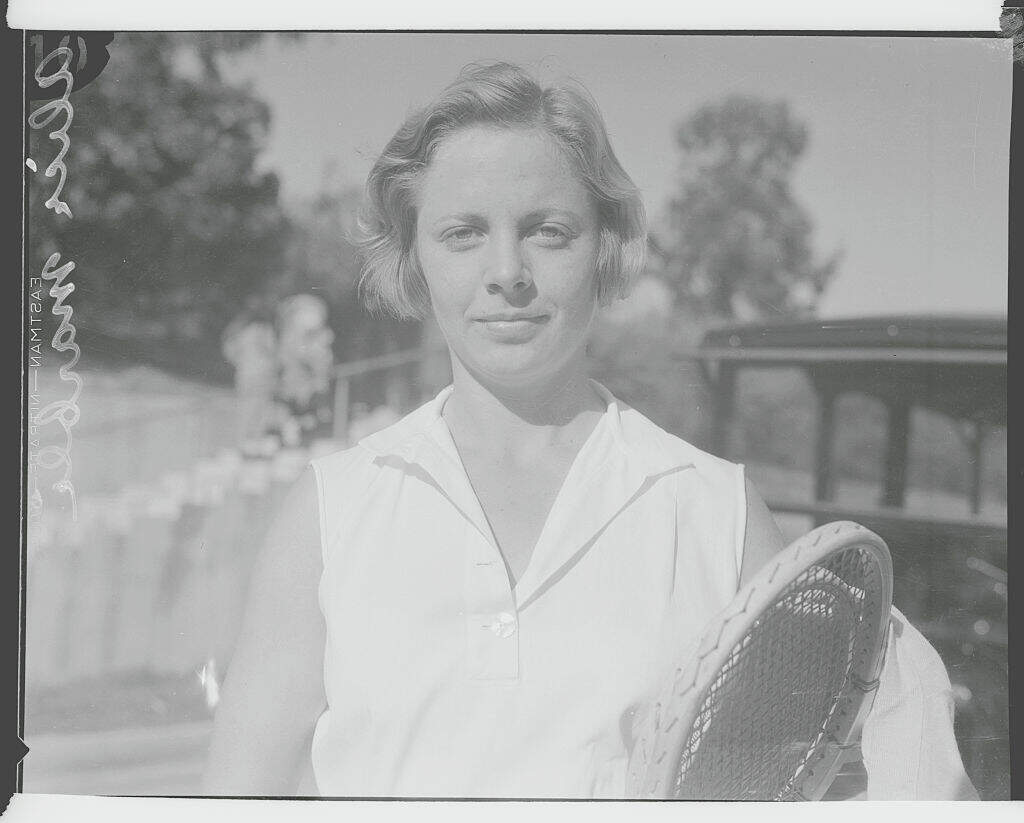
As I tuned in to the U.S. Open in recent days, I had a curious thought. It was inspired by memories of a show that was popular during the early days of TV, called “You are There,” in which actual newsmen interviewed actors playing historical figures. I wondered what would happen if the formula were reversed. What if figures from tennis history could be magically summoned onto today’s stage to share their memories and to give us their impressions of the game today, especially changes we take for granted?
My top recruit is Alice Marble, once internationally known, now mostly forgotten (and forgive me, the subject of my latest book). From a working-class background in San Francisco, Marble lived from 1913 to 1990. Her period of greatest prominence was limited to a few years in the 1930s when she was an “it” girl, famous as a torch singer, clothing designer, pal of movie stars Carole Lombard and Clark Gable, in addition to being a championship tennis player. She won Wimbledon in 1939, in addition to being the U.S. national champion from 1938 to 1940.
Timing was never her strong suit and her career as the best female tennis player in the world ended soon after Hitler invaded Poland in 1939. She contributed to the war effort as a government spokesperson for women’s health and as a guest at many military bases, playing exhibition matches to build morale. After the war, she worked as a commentator, author, inspirational speaker, tennis instructor (including to Billie Jean King), nurse’s aide at a pediatrician’s office (eight years), pool attendant and even had a cameo role in a movie.
I was drawn to write about Marble not despite but because of her obscurity. She was a complicated woman who led a complicated life. Her contributions to the game of tennis, itself a rich source of the vagaries and lessons of history, were two-fold. She changed how the game was played for women with her attack and volley style. No timid clinging to the baseline for her. She owned the entire court. And she changed who could play, when she raised her voice to argue for the inclusion of Black players at the highest levels.
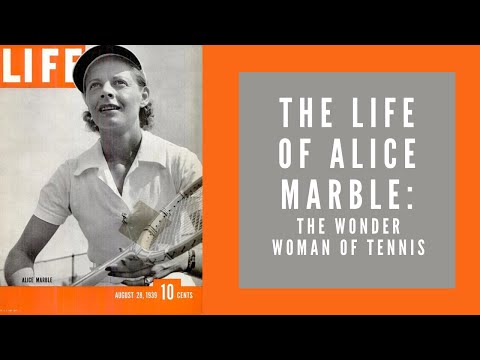
When Marble was coming up, tennis in this country was a mostly East Coast affair, challenged by upstarts like herself from California where public courts were blessedly plentiful. Certainly, she would approve of the current outreach to children across America who do not come from tennis royalty, nor from the kind of family whose finances would make tennis an easy sport to pick up. Marble played her first international tournament in Vancouver when she was 16 in sneakers held together by rubber bands with much of the entrance fee paid for by an anonymous donor.
Marble would likely delight in today’s polyglot roster. In her day in the States, most of the prominent players were WASPS, with names like Wills and Palfrey and Tilden and Budge. On the international circuit, one of her great competitors was a player from Poland, Jadwiga Jedrzejowska, whose name could never be mentioned without someone mangling it with what often seemed to be delight.
Today’s flashy, form-sitting outfits would surely rate her approval. It was once a huge controversy whether to allow women to play tennis in shorts, which she preferred over skirts — “the only sensible costume for modern play” — but didn’t want to be the first woman. “When you’re in tournament play you have to watch what the others do … but with any encouragement I’ll go into shorts in a minute,” she told a reporter in the summer of 1933. Pretty much anything goes these days — body suits, bow, frills, a rainbow of color and material.
No timid clinging to the baseline for her. She owned the entire court.
In Arthur Ashe Stadium there is a sign with a quote from Billie Jean King that greets today’s players: “Pressure is a privilege.” I imagine that would trigger a host of memories for Marble, who could be forgiven if she looked at the sign and shook her head. “Not always,” she might say, recalling that searing July day when she was forced to play four matches, 11 sets, 108 games. By the end of the day, she had lost 12 pounds.
In Marble’s era, there was no prize money for anyone, not even the men. Players depended on wealthy patrons who competed to house the athletes at their mansions as a kind of social capital. The two top players in various tournaments would sometimes be accorded a hotel room. If possessed of a generous frame of mind, they might allow lesser ranked players to share the space, bedding down in the bathtub if need be. The athletes often subsisted on a diet of peanut butter sandwiches and bananas (three for 10 cents.)
Marble always loved the limelight and even when she was in physical decline and living in Palm Desert in California in her later years, she never missed an opportunity to mingle. If Marble were to attend today’s Open, I can see her strolling through the grounds, insisting on a photo next to the statue of Althea Gibson, erected in 2019. She would surely want to be joined by Billie Jean, whom she coached at her home in California in 1959. Though only 16 years of age, Billie Jean observed Marble’s frailty, both physical and mental, but also witnessed her prowess, especially as a teacher. Billie Jean entered Marble’s tutelage ranked number 19 nationally by the USLTA and by the following summer she was number 4.
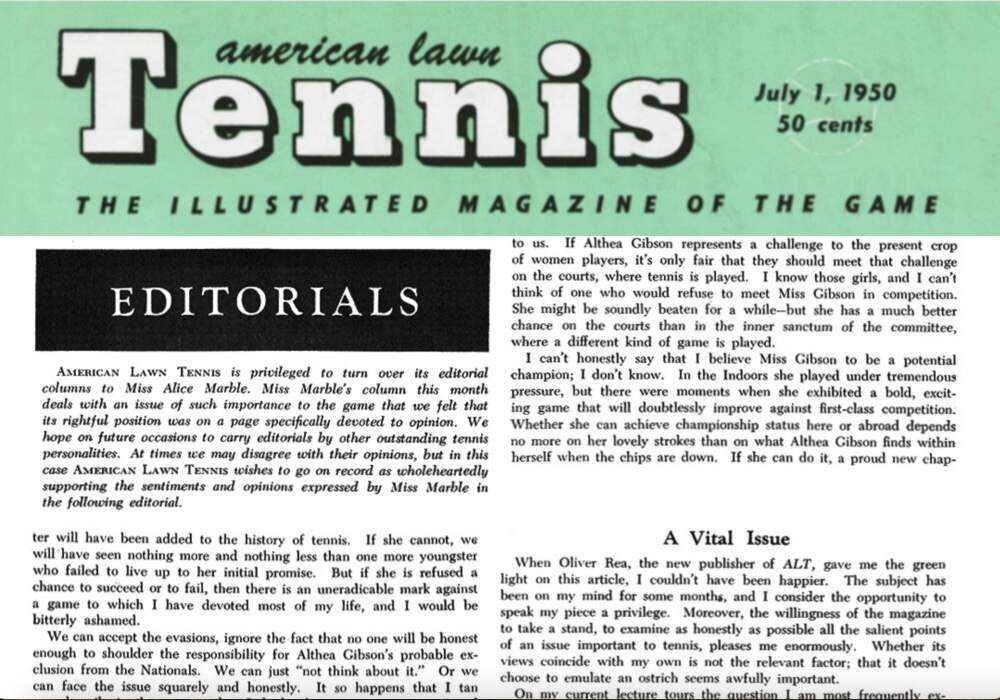
Of all of Marble’s accomplishments on and off the court, the greatest by far was the editorial she wrote in American Lawn Tennis arguing for the inclusion of Althea Gibson in the roster at Forest Hills.
The column amounts to 1,193 words in its entirety. Marble laced into the tennis establishment for setting up a classic can’t win situation: Gibson was welcome to apply to play at Forest Hills, but first she had to win all the tournaments leading up to the Nationals, which were invitational and to which she was not invited. Marble accused the United States Lawn Tennis Association of putting Miss Gibson over a “cunningly-wrought barrel” to which Marble hoped her “one lone opinion” might loosen a few staves.
Marble wrote:
I think it’s time we faced a few facts. If tennis is a game for ladies and gentlemen, it’s also time we acted a little more like gentlepeople and less like sanctimonious hypocrites. If there is anything left in the name of sportsmanship, it’s more than time to display what it means to us. If Althea Gibson represents a challenge to the present crop of women players, it’s only fair that that they should meet that challenge on the courts, where tennis is played.
Marble made it clear she held no special brief for Gibson one way or the other. Marble did not know if Gibson had it in her to be a champion; she didn’t know if she possessed that indispensable elusive quality of athletes who rebound even when the chips are down. Maybe she will turn out to be “one more youngster who failed to live up to her initial promise.” But if Gibson were refused the chance to show her skills on the basis of her skin color, it would be an “uneradicable mark against a game to which I have devoted most of my life, and I would be bitterly ashamed.”
Marble said she believed the inclusion of Black players was only a matter of time. If her own generation did not make the change, perhaps the next generation will follow the example of other sports such as baseball and football and boxing. Eventually it would happen. There was too much talent.
Which leads me to today’s U.S. Open and it many ups and downs with so many top players either eliminated early, withdrawn, or injured. My suspicion is that if Marble were to pick a favorite at tonight’s semifinal, it would be the American, Frances Tiafoe (Big Foe). She'd be thrilled to see him join the roster of athletes of color who have become elite players.
Tiafoe was introduced to the sport because his father was a janitor at a tennis club. He manages to stay positive more consistently than not (for the most part; it would be weird if he didn't have his frustrations and moments of anger, but I can't imagine he'd ever smash his racket in a fit of pique). Other players speak glowingly about him. He is both a gracious winner and loser.