Support WBUR
Commentary
This mayor is an artist
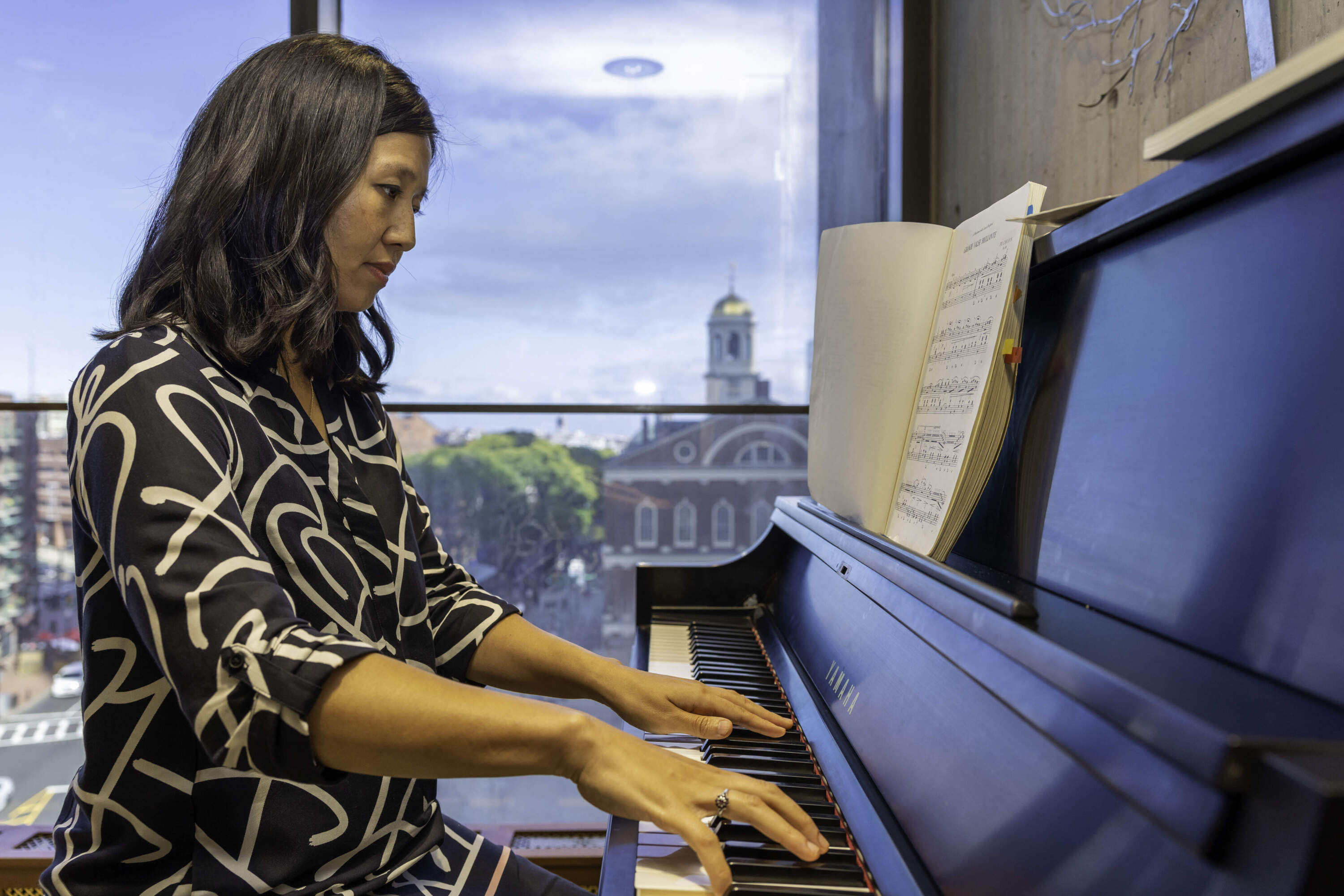
On her first day on the job, the city moved a piano into Mayor Michelle Wu’s office. The shiny black Yamaha upright sits flush against a concrete wall, next to a floor-to-ceiling window that looks out over Congress Street and Faneuil Hall.
“We’ve partnered with students from the North Bennett Street School to make sure it stays tuned up so I can, when I have time, dabble around a little bit,” Mayor Wu says.
Wu started playing the piano when she was 4 years old. As a kid, her first job was actually helping her piano teacher.
When someone came for a lesson, Wu’s teacher had her students do a set of scales and arpeggios to warm up. “She would outsource that to me,” Wu says. “I would be in a separate area running through scales with everyone, then they’d go in to do their main songs and repertoire with her. I remember being pretty small with much older students, helping them with their scales.”
Eventually, when she had more music under her fingers, she played parties for extra cash. “If there was a nice event, someone needed a background piano player, I'd have like two hours of music ready to go,” the mayor says.
Wu, whose third child is due in January, says her pregnant belly is already making it difficult to lean over the piano as much as she would like. “The kicking is also getting quite intense,” she says. “I think she [the baby] likes Gershwin. I can tell.”
That’s Gershwin, as in George Gershwin. This year marks the 100th anniversary of “Rhapsody in Blue,” which Wu was preparing to perform at Symphony Hall with the Boston Pops as part of the Boston Symphony Orchestra’s sixth annual free Concert for the City on the day we met.
When the mayor’s performance was first announced, Boston Pops Conductor Keith Lockhart was quick to tout Wu’s piano chops. “We're not talking Bill Clinton blowing a couple sax chords here,” he told my WBUR colleague Andrea Shea, “we’re talking about thousands of hours of practice that make anybody good enough to be able to sit on stage with an orchestra like the Boston Pops or the BSO.”
People are entire universes, and they're part of constellations of families and communities and neighborhoods.
Mayor Michelle Wu
The mayor has been playing the piano for so long it seems to me like it’s her fifth limb. “When you really get into the flow, brain memory and muscle memory and the keys kind of meld together and it's almost as if you are part of the instrument rather than playing the instrument,” she says.
Like many artists, Wu thinks of the performing arts — as a member of an orchestra or band, dancing, singing, anything really — as a vehicle for expression. When you’re performing, she explains, it’s something that “transcends what any individual person can put words to.”
I’m curious to understand how the mayor’s long study of the piano informs her approach to governing. I want to know if her musicianship changes her approach in some way — if it influences how she talks to people or what she observes.
Wu was a city councilor for eight years before she was elected mayor. And she says that for a long time, she didn’t really see any connection between her love of the piano and her role as a public servant.
But that’s changing. “I think I have really grown in my understanding of how my personal connection to the arts can play a role in my work as an elected official,” Wu says. “More and more as I've stepped into this role of passing laws, making budget allocations, [I’ve realized] that creating programming only matters if and when we are able to support the fullness of our residents’ experiences as human beings. People are entire universes, and they're part of constellations of families and communities and neighborhoods.”
Creating that kind of atmosphere, where residents are supported for being exactly who they are, in all areas of their life — “the Boston for everyone” Wu is so fond of talking about — “does rely on a much more expansive view of what government can do, and what it means to meet the needs of our residents,” she says.
Wu committed to performing at the BSO’s Concert for the City about a month before the concert date. “It was far too little time to prepare,” she says. She realized some professional help and coaching would be useful. But she hadn’t taken a piano lesson in decades — about as long as it’d been since she last played “Rhapsody.” Her team reached out to the Berklee College of Music and Dr. John Paul “JP” McGee, a professor and the assistant chair of the school's piano department, agreed to help.
Wu and McGee met over three weeks, about 30 to 45 minutes per lesson. They worked through the notes, but mostly, Wu says, McGee reminded her what it felt like to be immersed in music, and how invigorating that can be.
“There's this fascinating combination of how to balance the freedom and creativity to be fully present, backed up by so much rigorous, disciplined practice,” she says.
She sees a connection in that effort and its value to her day job, too. Whether her office is unveiling a policy change or engaging with community, planning, research and preparation is key — but so also is improvisation, reading the room and understanding context.
Leaders can be creative, they can be artists, they can be introverted, they can come from any number of lived experiences that we all feel connected to
Mayor Michelle Wu
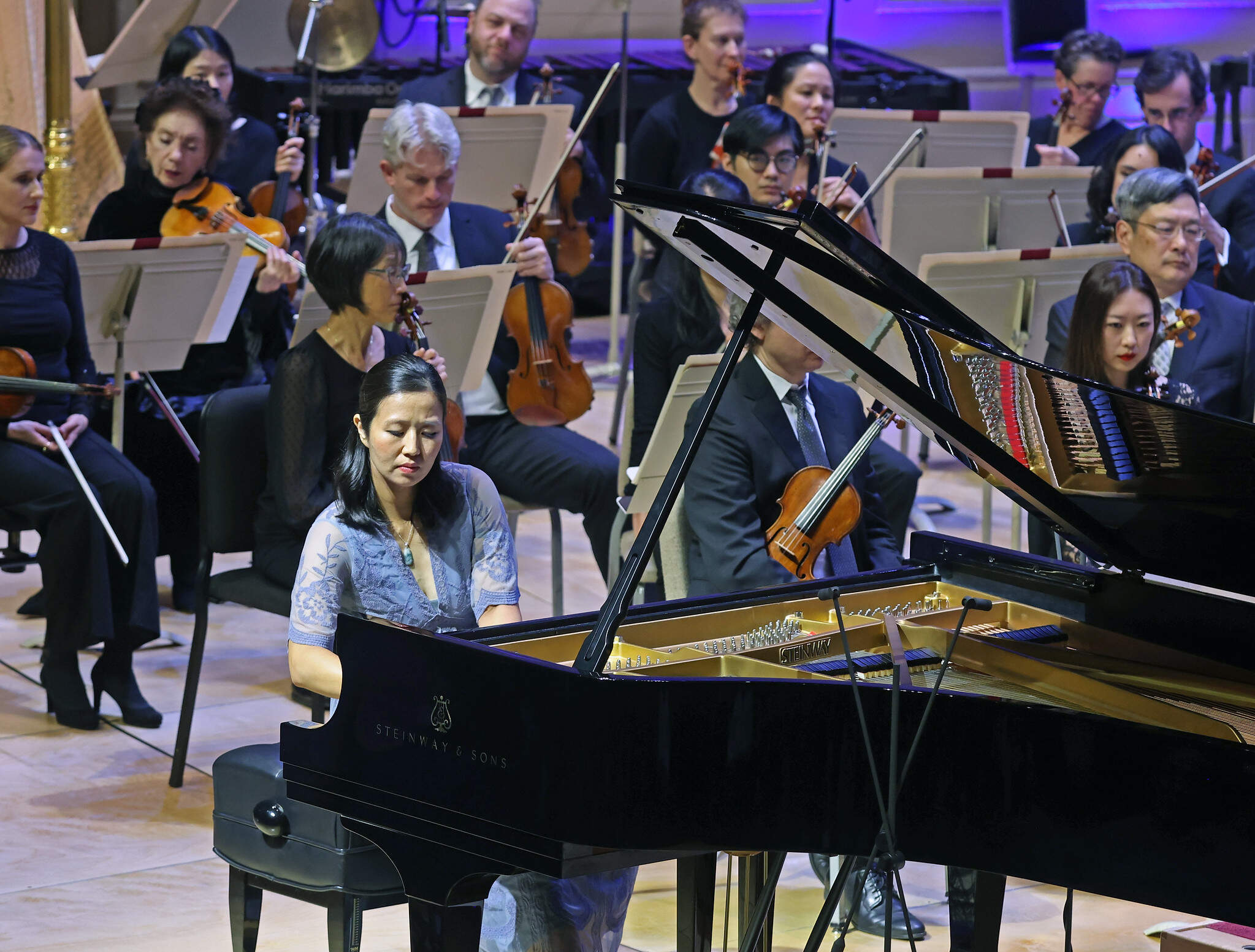
The Concert for the City is a Saturday matinee. I sit next to the mayor in Symphony Hall on Sept. 21, in a reserved balcony section to the right of the stage. She wears a long, blue dress.
During the first half of the program, she claps along to other performers and waves hello to her infant nephew sitting a couple of rows ahead of us. As the program inches closer to her moment on stage, I watch as her hands tap out the trickiest parts of the song across her lap. By now, I’ve heard a lot of “Rhapsody in Blue” — I can imagine what section she’s playing in her head.
After intermission, the mayor goes into a private practice room with a grand piano, just off the Symphony Hall stage. McGee is there, and he helps her run through sections of the piece that have been causing her the most trouble. Then she has some time alone.
Before long, it’s her turn. Lockhart, the conductor, welcomes Wu to the stage. The audience trains their eyes on the mayor. Her family sits on the edge of their seats. Even I hold my breath.
As she makes it through the most technically difficult sections, you can see the hint of a smile on her lips. Her body sways with the music. In that moment, I can’t help but think how brave she is to share this part of herself we don’t usually see.
“I survived!” she exclaims when we talk backstage. When I ask how she feels, she answers simply, “It was amazing.”
In a way, then, she pondered her own sense of relief: “I’m a very introverted person, so piano playing, public speaking, all of this, it takes a little bit of steeling myself.”
Wu gets asked all the time what it means to be a “first” in one way or another — she was the first Asian American to serve on the Boston City Council, the first woman and non-white person elected mayor of Boston — and she sees it as part of her role to demonstrate that leadership can come in all forms. “Leaders can be creative, they can be artists, they can be introverted, they can come from any number of lived experiences that we all feel connected to,” she says.
Fresh off the Symphony Hall stage, she tells me: “I hope it's a statement that everyone should share their passions, everyone can find a way to give their little, gift and love to the community and the world.”
This piece was produced by Cloe Axelson with help from Tania Ralli. It was mixed by Mckayla Varela.
This segment aired on October 11, 2024.