Support WBUR
Commentary
My letter from Jimmy Carter's White House

When former President Jimmy Carter died last month, I went looking for the letter that I received from his White House back when I was in fifth grade and he was in the final year of his presidency. I found it tucked away in my middle desk drawer under other prized possessions — my diary from second grade and the rhinestone earrings I wore to my senior prom. I have held on to this letter through seven more presidents and countless moves, but it’s still in pristine condition — a crisp page of cream-colored letterhead, carefully folded in thirds, the only sign of its age being that it was typed on an actual typewriter.
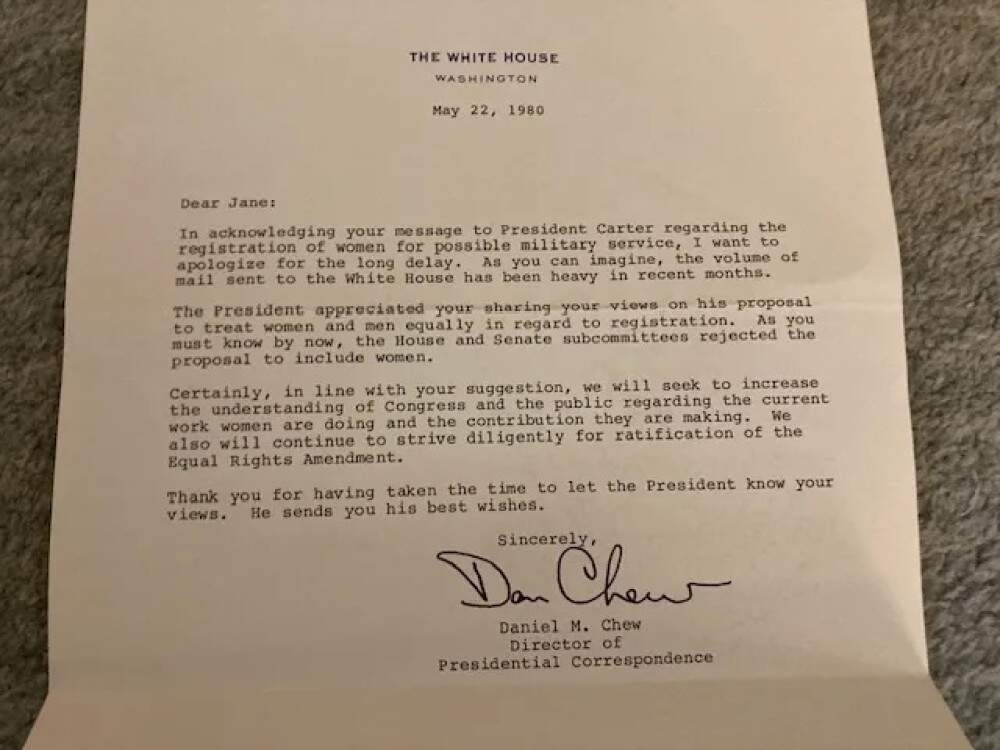
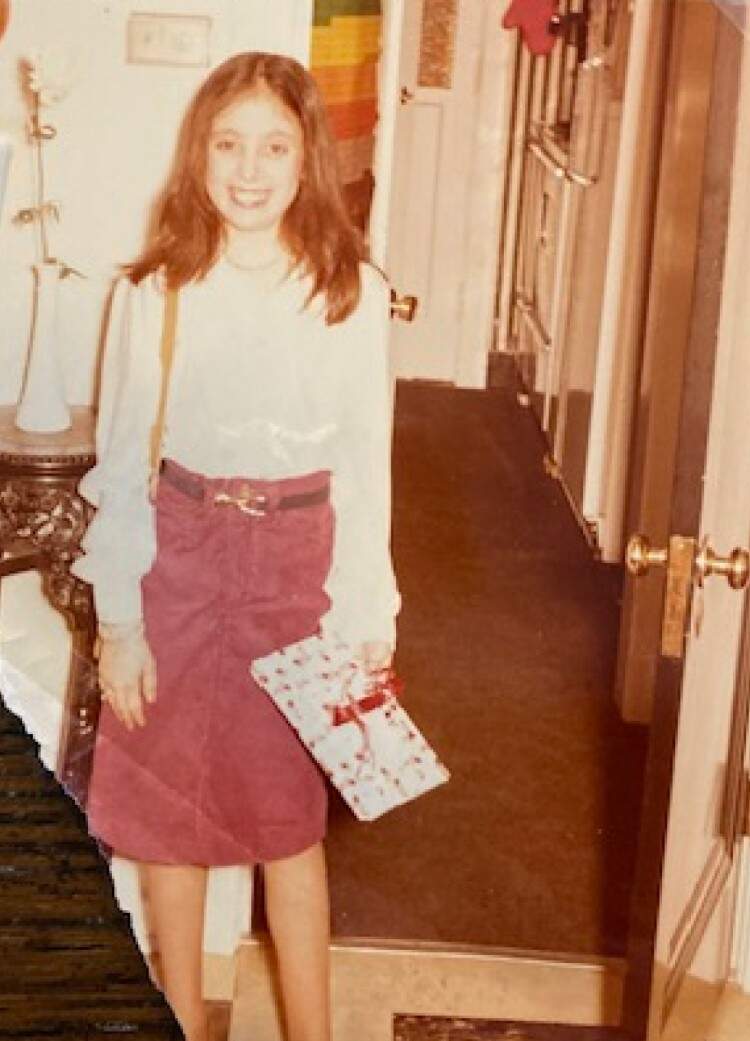
Decades later, I don’t remember what prompted 10-year-old me to write to President Carter to express my support for requiring women to register for the draft. But I do remember how excited I was when I received a response, even though it wasn’t from Carter himself but from his “director of presidential correspondence.” It was enough that it was a personal letter from the White House.
If I’d wanted to share this letter with my friends back when I received it in 1980, I would have had to photocopy it and mail it to people individually. But when I pulled it out of my desk drawer last week, I did what we do so easily in the 21st century: I took out my phone, snapped a photo and posted it on social media — my own “RIP President Carter” post joining a sea of such posts. It only took a few minutes for a Facebook friend to comment. “I bet AI auto respondents could respond to presidential mail much more quickly now,” he wrote.
My friend is correct, of course: Using tools powered by artificial intelligence (AI) can speed up the process of responding to correspondence. Companies are already using AI chatbots to conduct business with customers, albeit with varying degrees of success. And who is to say that the harried staff who handled presidential correspondence in 1980 — my letter begins with an apology for the “long delay” — wouldn’t have appreciated the chance to outsource this work to a chatbot? But while AI agents can respond — as in generate a response — it’s hard to imagine anyone receiving a response from a bot with the excitement I felt about the personal letter I received from the Carter White House.
When I tell my students that back in the days before email, I left school during my free periods every day for a week to see if my college decision letters were in our mailbox, they respond as if I’m telling a story about a hardship — the communication equivalent of, “In my day we had to walk to school uphill both ways.” But I don’t remember waiting for the mail as a nuisance. When I dug out that letter from Jimmy Carter, I remembered the anticipation I felt when I checked the mailbox to see if I had any mail, and the joy I felt when I actually found a letter waiting for me.
But even if my students haven’t experienced that joy of running to the mailbox, they have lived in a world where they could expect that messages they sent into the world would be received and responded to by other humans. And while the experience of corresponding changed in the email era, those feelings of anticipation and joy didn’t disappear for me — they just took on new forms. When I was living in England in the early '90s and my sister showed me how we could chat on a split screen in real time using our email accounts, I felt like Guglielmo Marconi sending wishes from Theodore Roosevelt to King Edward VII. That my sister was there, on the other end of that blinking cursor, was incredible to me.
I may be an outlier in the intensity of my dedication to correspondence — my letter to President Carter was only one of many letters I wrote in a prolific childhood letter-writing career that included letters to 11 pen pals, the casting company for the movie version of “Annie,” asking if could audition, and the editors of Seventeen magazine, asking if they would read my poetry. But I know I’m not alone in valuing the human connections forged when we write to each other, and I’m not alone in worrying about what will happen to those connections as AI agents reshape the way we communicate. We saw evidence of this in the backlash that followed Google’s release of its “Dear Sydney” ad in which a father uses Google’s AI, Gemini, to help his 8-year old daughter write a fan letter to U.S. Olympic track star Sydney McLaughlin-Levrone. Google ultimately pulled the ad after widespread criticism of the idea that something as personal as a fan letter should be outsourced to AI.
Writing to people you don’t know and hearing back from them — whether on paper, by email, or even via text message, allows you to create a connection across barriers. I couldn’t walk up to the White House and ask to speak to President Carter, but I could write down my words with the hope that someone would read them. And when I received a response, my world grew larger. (Donald Chew, director of presidential correspondence, if you’re out there, I want you to know that 14 years after I received your letter, I wrote a master’s thesis about women in the military, and your response to my letter was the first assurance to me that I had something to say on this topic.)
The value of human correspondence isn’t reserved for the person receiving a response — but also for the person whose job it is to respond — to say, I’m here, and I’m paying attention. I grew up to be a person who has been fortunate to read and respond to many letters and emails from strangers, first during a Congressional internship when I answered constituent mail, and later in the fiction department at The Atlantic, where I read manuscript submissions. Imagining the people receiving those messages made me choose my words with intention.

As someone who writes regularly about the impact of AI on writing and learning, I’ve come to anticipate certain responses as inevitable when I raise questions about what we may lose when we outsource writing to AI. I’ve been assured that AI tools are just like calculators, tools that will free up our time from busywork to focus on the important work, tools that will only enhance our human talents and voices, and that those who worry about the price of outsourcing writing to chatbots are simply fearful of technology and not brave enough to embrace it.
But what those arguments leave out are the questions of who decides what’s busywork and what’s important work. Corresponding with strangers when you know they’re out there waiting to hear from you requires empathy and thought, which are qualities often at odds with efficiency. With tools like ChatGPT, words are cheap, but the decision to use these tools will cost us in other ways.
Rereading my letter from President Carter’s White House after all these years reminds me that each choice to automate for the sake of efficiency risks transforming writing from a way of building bridges between strangers to a process that creates another layer of distance between us. President Carter spent his life building bridges, and I’m grateful for the one that letter built from his White House to me.
Follow Cognoscenti on Facebook and Instagram. And sign up for our weekly newsletter.