Support WBUR
Commentary
The two times I saw Bob Dylan
“Theater 14, on the right.”
When my husband John and I showed up at Cinemark Theaters in Hadley to catch the Bob Dylan biopic, “A Complete Unknown,” the usher didn’t even bother to glance at our tickets.
John was disappointed: “I was hoping he would card us to make sure we’re over 65.”
He was eager to see the film in part because he knows the father of actress Monica Barbaro, and he wanted to tell his friend firsthand how great his daughter is as Joan Baez — the Academy of Motion Picture Arts and Sciences agreed when they chose her as one of the five finalists for best supporting actress.
I had my own reasons for wanting to see the film, tangled up in blue.
Bob and I go way back.
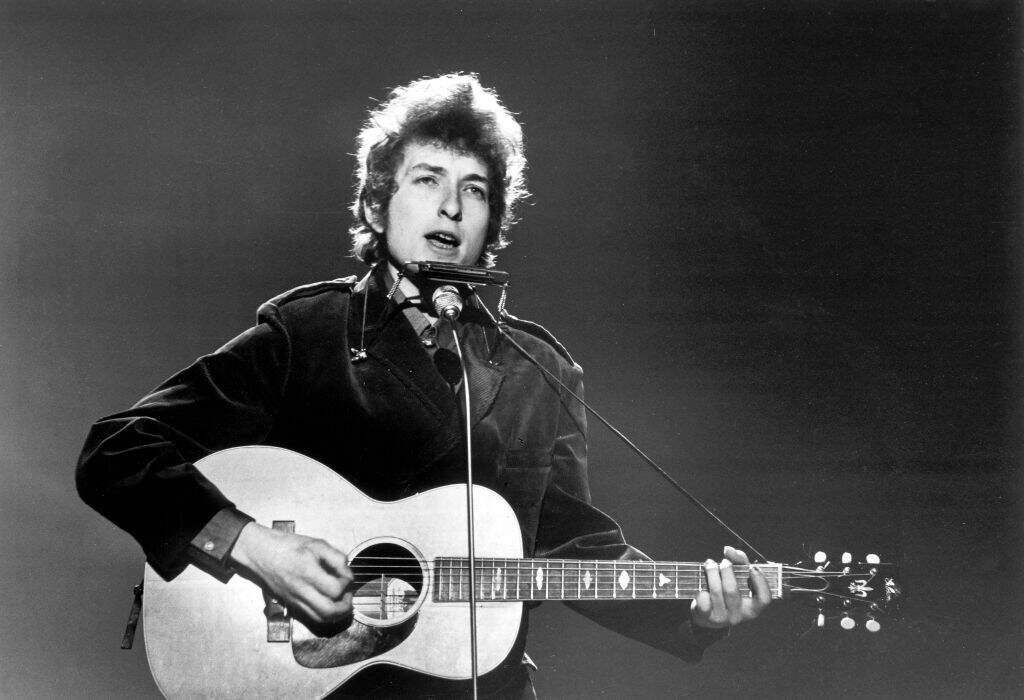
On January 29, 1965, on a similar cold Friday night in the dead of winter, I attended my first Dylan concert at the Municipal Auditorium in Springfield, Mass. Tickets ranged in price from $4.30 to $3.20 to $2.10. The setlist included “Gates of Eden,” “Talkin’ World War III Blues,” and “It’s alright, Ma, (I’m Only Bleeding),” plus “Don’t Think Twice; It’s All Right.”
It was a pivotal time in his life and in mine.
I would soon go to college.
Dylan would soon go electric.
Almost 11 years later, Dylan and I reunited — on December 7, 1975 — this time in New Jersey at a medium security prison, then known as the Clinton Correctional Facility for Women. By then I’d finished college and had a job at newspaper; my assignment that night was to cover the Rolling Thunder Revue, Dylan’s concert tour that included many well-known musicians.
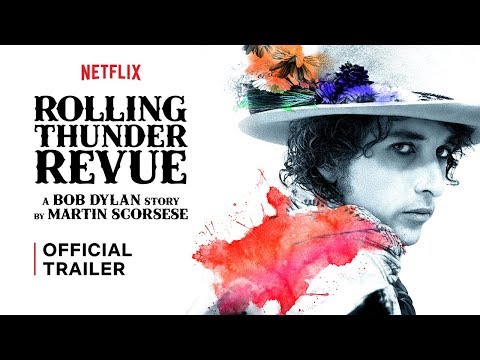
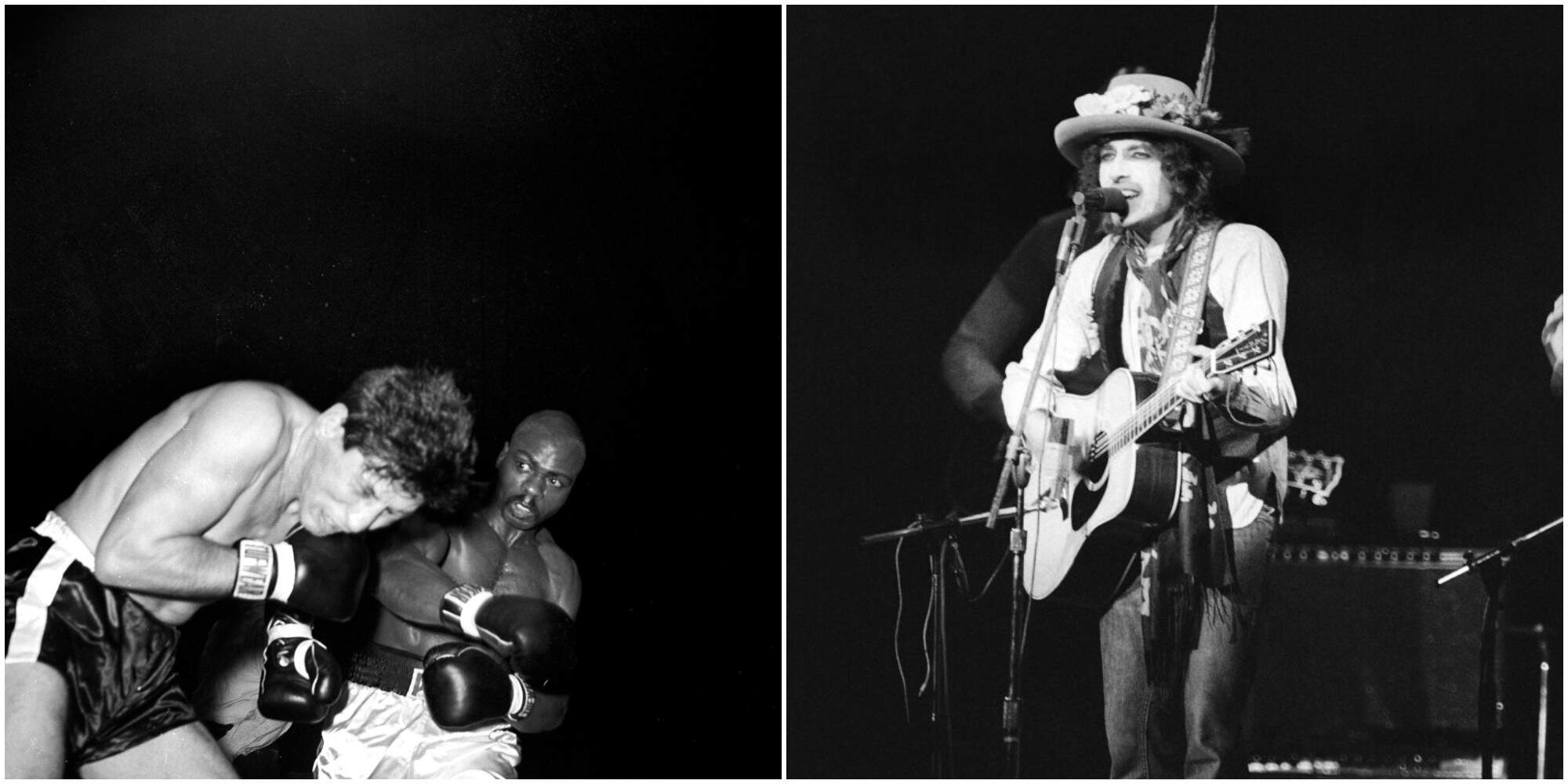
In Springfield, Dylan had been on his own, dressed, as reported by one observer, in a “little brown jacket and blue peg pants,” looking like a child as he strummed his guitar and played a harmonica in front of him on a rack. In New Jersey he wore a hat, two scarves and whiteface. And he no longer travelled light. Candice Bergen, Stephen Stills, Ronnee Blakely and Ramblin’ Jack Elliot crowded the stage at various times. The entourage included 50 roadies.
When I tell people that I heard Dylan perform twice in person, the prison concert is the one they want to hear about. Who could blame them? It had a star-studded cast, including Hurricane Carter, who had been transferred to the prison, with male inmates transferred from other institutions.
The population at Clinton consisted of 200 women and 80 men, but most of them skipped the event, opting not to be in a venue where they might be photographed and filmed. At that show, the media outnumbered the intended audience.
“I’m a poet,” Dylan said to the press by way of introduction, as if that were necessary.
His people shooed me away when I tried to prolong the interview, but he paused and said, “It’s okay. She has the face of an angel.”
I was at the age where just about everyone has the face of an angel, and this sounded like something he’d said 1 million times before, and yet.
I remember one of the questions: “When did you first hear about Hurricane Carter?”
His answer, recorded in my scrapbook of old clips:
“I read Hurricane’s book about a year ago, and you know how you can know somebody for 20 years and know all about them, or you can know them for a little while and know all about them? Well, with Hurricane, I knew that I knew him after the book and that was it.”
Allen Ginsberg, also a poet, joined the tour.
His most famous line is from “Howl”: “I saw the greatest minds of my generation destroyed by madness.” When his recitations on stage went on too long, he gladly accepted a demotion, to baggage handler. He, too, supported Carter’s cause: “I’m from North Jersey and he’s from North Jersey and half the mayors up there have gone to jail for criminal activities…Carter got a bum rap. A phony bust.”
Rubin “Hurricane” Carter and his acquaintance were arrested in 1966 for a triple murder at a bar in Paterson, New Jersey which they said they did not commit. After serving nearly 20 years, the authorities agreed that Carter had been wrongly convicted. Dylan enshrined that story in a ballad called “Hurricane,” more than eight minutes long.

Two singers on the stage in New Jersey that night indicated they were just along for the ride.
Joan Baez said: “I don’t really know anything about the specifics of the [Carter] case. Frankly speaking, career-wise, I joined this concert tour because it was better than singing the college dates I had lined up.”
Joni Mitchell described herself as “apolitical and a media dropout.”
Roberta Flack offered a clearer vision of why her presence there might matter: “I’m here because of a long history of Black people in this country getting incarcerated” unfairly. She admired the correctional facility: “This is a slick place, why the auditorium looks like a high school gymnasium.”
Baez won over the modest crowd that night: “I could thank the authorities for making it easy for me to get in, but I’d rather thank them if they made it easier for you to get out.”
She and Dylan sang a duet of “Blowing in the Wind” followed by “I Shall be Released.” Dylan performed “Hurricane.” For the finale, everyone on stage sang, “Knocking on Heaven’s Door.”
Carter, on track at one time to be the middleweight boxing champion of the world (according to Dylan’s slightly inflated estimate) thanked all “the fighters” who had teamed up to support his innocence including “singers like Joan Baez and Bob Dylan and actors like Ellen Burstyn and Dyan Cannon,” pledging “to out-fight and out-sing and out-dance the critics.”

I look back on the prison concert in New Jersey fondly, but the one in Springfield, 10 years earlier, even more so. Dylan had not yet gone electric, but the audience — a respectable 1400 — was.
Unless you count the Buffy Sainte-Marie album I had purchased with my babysitting money (so I could memorize every achingly egalitarian word in “The Universal Soldier”) nothing about teenage me qualified as cool. I have no idea how I managed to score tickets to a Dylan concert, but I did, along with a couple of friends from my girls’ Catholic high school.
Seated behind us were a bunch of boys whose cuteness, I must say, immediately registered. I froze when in the middle of a song one of the boys said something so daring, so transgressive, so beyond anything I could imagine being uttered openly and with abandon in 1965, it was indelible: “This guy is so great I could be homosexual for him.”
Something was happening, even if we didn’t know what it was.
Revolution was in the air.
Come mothers and fathers
Throughout the land
And don't criticize
What you can't understand
Your sons and your daughters
Are beyond your command
Your old road is
Rapidly agin'.
Please get out of the new one
If you can't lend your hand
For the times they are a-changin’.
The message was so clarion that it makes the review in the Springfield Union the following day — which I unearthed in an internet archive detailing and verifying every one of Dylan’s performances that year — even more striking in its older-generation obtuseness.
Going by initials W.P.M., the critic described Dylan as “a Middle West folksinger … one that doesn’t open his mouth very wide when he sings …He doesn’t have much to say, unfortunately.”
If he predicted anything for Dylan, it was ineffectual future warbling on the sidelines in the middle of nowhere:
Dylan reminds one strongly of the type of youth who is usually sitting around the campfire of the wagon train singing and playing his guitar during a lull before the man and woman start talking of romance under the trees.
A young woman from Longmeadow named Leslie Wernick was having none of it, as evidenced by her letter to the editor printed a few days later.
Did W.P.M. listen to the words? What did he mean that Bobby Dylan didn’t say much?!! Dylan has said more than anyone else has dared today and his style is what puts his message across firmly. W.P.M. really can’t think Bob Dylan is the type to sit around a campfire and sing to a bunch of pioneers. He is listening to us—to Youth—we who are being swept into the messy world that man before us has created. Dylan is saying what we are all trying to say and what WE are listening for.
Did Leslie Wernick have a long life as a rabble rouser and truth teller? I hope so.
After Dylan went electric and he mounted ambitious tours and released copious new songs and won myriad awards, including the Nobel Prize for Literature in 2016, he belonged, and still does, to the world.
On that night in Springfield, he belonged to us.
And that, as another poet liked to say, has made all the difference.
Follow Cog on Facebook and Instagram. And sign up for our newsletter, sent on Sundays. We share stories that remind you we're all part of something bigger.