Support WBUR
Cog's Weekly Newsletter
We are all creative people: 5 questions with Maggie Smith
Editor's Note: This essay appeared in Cog's newsletter, sent every Sunday. We share stories that remind you we're all part of something bigger. Sign up here.
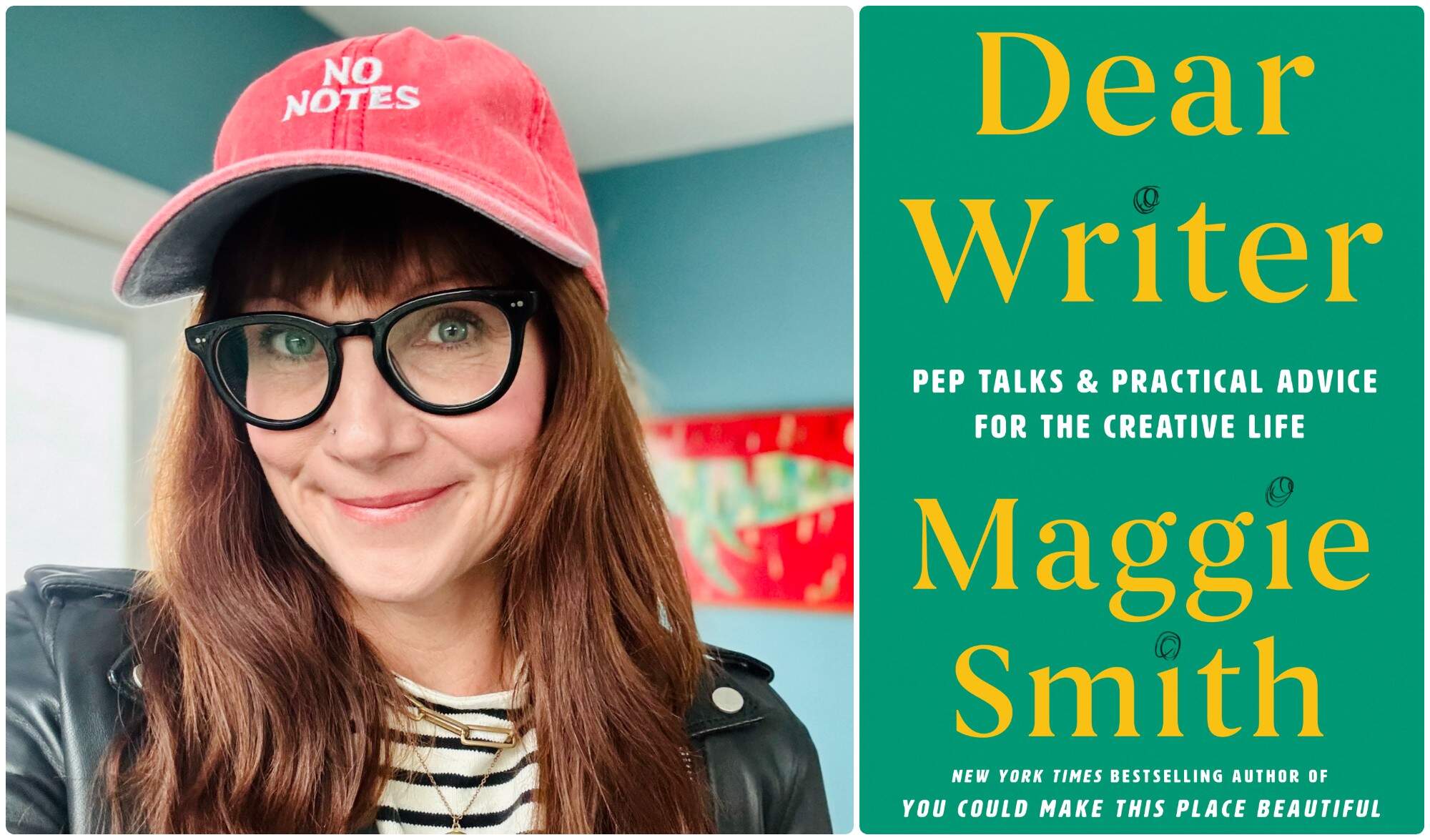
Maggie Smith is probably best known for “Good Bones,” her poem that went viral after a character read a portion of it on “Madam Secretary” and Meryl Streep read it in full on stage at New York’s Lincoln Center. Smith jokes that it’s a “disaster barometer” because it’s widely shared anytime something terrible happens. Public Radio International’s “The World” dubbed it The Official Poem of 2016. It’s her “Free Bird” — the hit she has to play at every show.
But Smith is so much more than this one poem.
She is the author of a New York Times bestselling memoir, “You Could Make This Place Beautiful”; a children’s book, “My Thoughts Have Wings;" five books of poetry and “Keep Moving,” a collection of inspirational quotes and essays for people going through a tough time.
Her latest, out this week, is a craft book, “Dear Writer.” It’s a distillation of her 20 years of editing and teaching (Smith is on the faculty of the Naslund-Mann Graduate School of Writing). Reading the book, which is organized around 10 principles of creativity, feels like getting one-on-one tutoring from Smith. When we spoke earlier this month, she told me that was intentional.
“What people want when they're having trouble with anything — whether it's relationship trouble or writing trouble or trouble with their math homework — what they want is to feel like they're not alone in the problem,” Smith explained. “What people want is a combination of commiseration and encouragement.”
Smith offers plenty of both in our Q&A below. Hear more from Smith on Tuesday, April 1, when Cog hosts Smith in conversation with fellow award-winning poet Saeed Jones, currently an artist-in-residence at Harvard Medical School, at WBUR’s CitySpace. Buy tickets here.
This interview has been edited for length and clarity.
Kate Neale Cooper: You insist that creativity isn’t just about making art. Can you talk about that a little more?
Maggie Smith: “I think the things that are essential for creating are also essential for living. It's funny: Many of the questions I get when I teach or speak or do Q&As after book events are things like, ‘How do you know when something is finished? How do you get the courage to share? How do you try again after rejection or failure?’ All of those questions apply to living a fulfilling life as much as they do to making art. There’s a lot of overlap between making things and just being a person in the world.”
KNC: I love that. It takes a lot of creativity to be a lawyer. It takes a ton of creativity to be a parent. And I think we've somehow created this gatekeeping around art that makes people think creativity is a skill they can’t use elsewhere.
MS: “I totally agree. There are two things there. One is the idea of the artist as someone special and chosen: you're born to paint, born to sculpt, or born to write, and the muse visits you and everything just comes out fully formed and beautiful. And that is a lie, and it makes a creative life seem out of reach for people who don't naturally find themselves drawing or painting or dancing or writing.
“But there's also what you just said, which is that the skills and techniques we use when we make art are also skills and techniques that we use when doing things in our daily lives. Anytime you're problem-solving, it's creative. Frankly, anytime I have to figure out how to get my son to soccer practice and meet a deadline and get dinner on the table, creativity is involved.
“The relationships that we build, the conversations we have – these things are creative. So this idea that some people are creative and other people aren't is a lie. Some people make a living from making art and other people don't, but that doesn't mean they're not creative.”
KNC: People think of creativity as a solitary pursuit. They picture a painter alone in a studio or you, the poet, alone at her desk. But you believe that creativity helps us build community and more connected lives. How so?
MS: “Writing looks solitary, right? But it's not, for a couple of reasons. When I write, I'm having a conversation with a dear friend: my mind. When you write, you're deepening your relationship with yourself and your own imagination. But the other aspect of that is probably, at some point, you're going to hand off that thing you create to someone else.
“You might only share it with one other person. You may be writing something that you really want to share with your daughter or your mom or your best friend or your spouse. Or maybe you are going to submit it to be published. But either way, what you're doing is creating a connection with others, and so it always feels to me like books, poems, and other works of art are community gathering spaces.
“They're places where we go to see how someone else has metabolized their experience and then — even if our experience doesn't perfectly align with theirs — we see ourselves in it and we feel less alone. I think that's really what we go to art for: to feel a little less alone in this strange, beautiful, often heartbreaking human endeavor. To be like, ‘Oh, other people are also experiencing these things, these emotions.’ And so making things allows us to enter that big community conversation. And to be of use to others.”
KNC: In your memoir, you provide this helpful image of nesting dolls and how we’re all carrying these early iterations of ourselves like smaller and smaller nesting dolls inside of us. And then in “Dear Writer,” you talked about trusting the “future you” — your confidence that future Maggie will know how to deal with a poem, to make it better. That's so many Maggies you’re juggling!
MS: “I feel pretty tenderly toward Past Maggie. I'm like, ‘Oh, she did the best she could.’ And I really do trust Future Maggie. I absolutely put things away for a while or think, ‘I've got a year to work on this book and I know it's going to get easier. I'm going to hit a stride. Something's going to crack open for me.’ And I think it gets easier to tell yourself that story when you've done it multiple times.
“When it’s your first column, your first essay, your first book, you have no frame of reference. You don't know that it's going to get easier. It's like getting your heart broken for the first time, and you think you'll never love again. Or having your first kid and wondering how anyone ever copes with two. Having a little bit more life experience gives you the frame of reference to be like, ‘Oh, I've got this.’
“The more that you do, the more knowledge that you have to draw from, and the better frame of reference you have to be like, ‘Oh yeah, this part always sucks, but it doesn't last forever.’ ”
But there's no amount of experience or success that makes it less tough. The experience just helps you accept the toughness.
KNC: You make a lot of jokes about being a firstborn daughter. Do you really think that colors your work?
MS: “I do. But I'm the oldest child, too. So I think there's probably a documentable perfectionism streak in the oldest child — and particularly in girls and women.
“I don't know what part of my personality is because I'm the firstborn daughter or because I live in the Midwest. But what I do know is that I grew up feeling like failure was not an option, and that everything was very high stakes. As an adult, I’ve had to unlearn that, because it's not possible to maintain that attitude as an artist. It's toxic.
“You have to be willing to take risks. You have to be willing to mess up. You have to be willing to even expect failure. You have to be willing to put yourself out there in ways that will make you deeply uncomfortable.
“I feel like my writing is getting better as I get older, because I’m more comfortable in my own skin. And I imagine it will keep getting easier.
“And really there are so few things that are terrifying, right? There is definitely stuff to be afraid of, but writing a bad poem isn't one of them. It just isn't.”