Support WBUR
Commentary
'By Power and Pride': A Minuteman for life
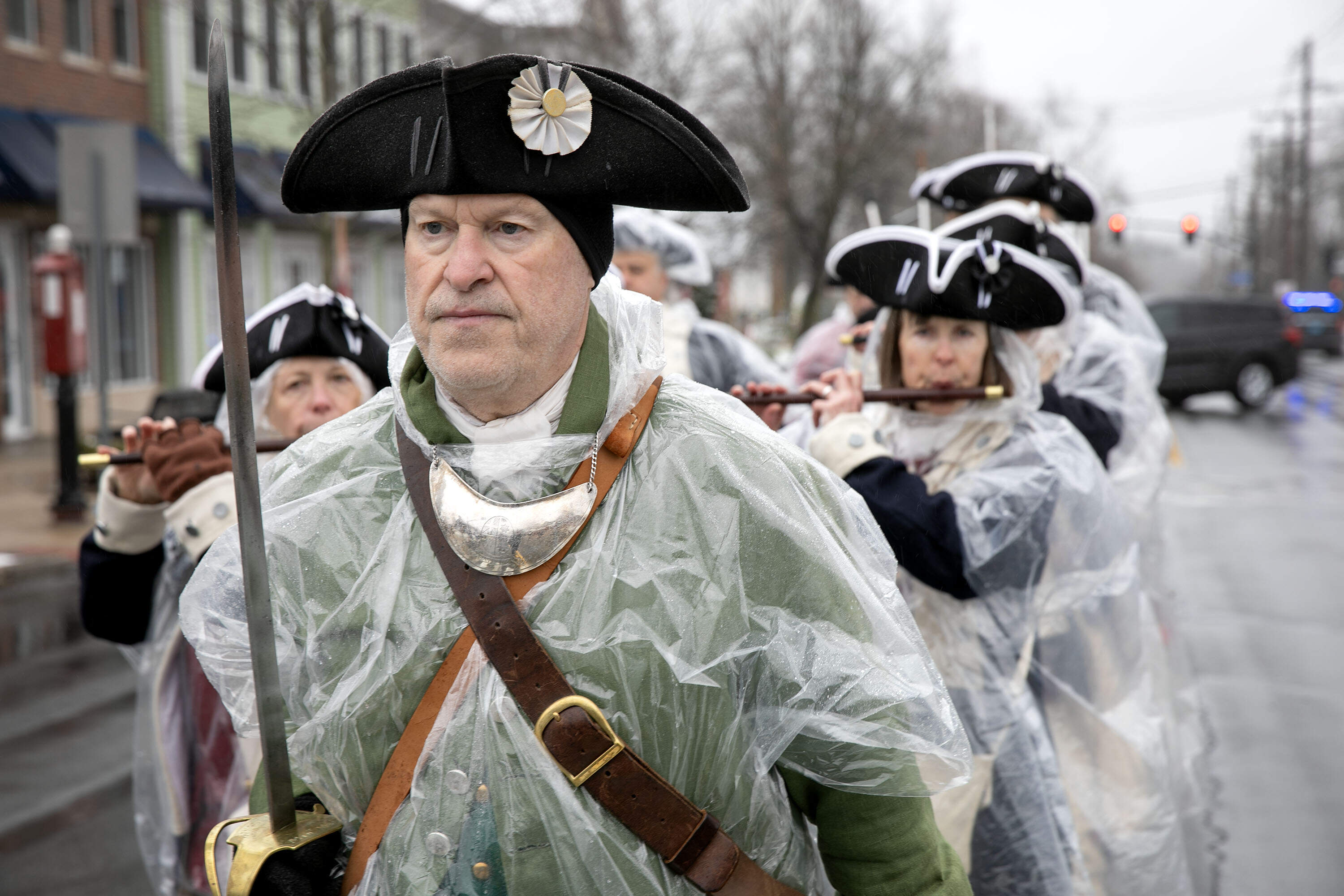
If a cat has nine lives, I bet Carl Sweeney has 11. He is a Renaissance man.
The 69-year-old is a retired educator (for 24 years, he was a beloved custodian at Willard Elementary in Concord, where he also had an alter ego — “Captain Zero, the Math Superhero”); an award-winning golf coach; a veteran of the Massachusetts National Guard; a one-time traffic reporter for WBZ and WRKO; and a poet (more on that later). He’s got three kids and nine grandkids. He’s lost 50 pounds in recent years, drinks protein shakes with flaxseed for breakfast and starts most days at the gym.
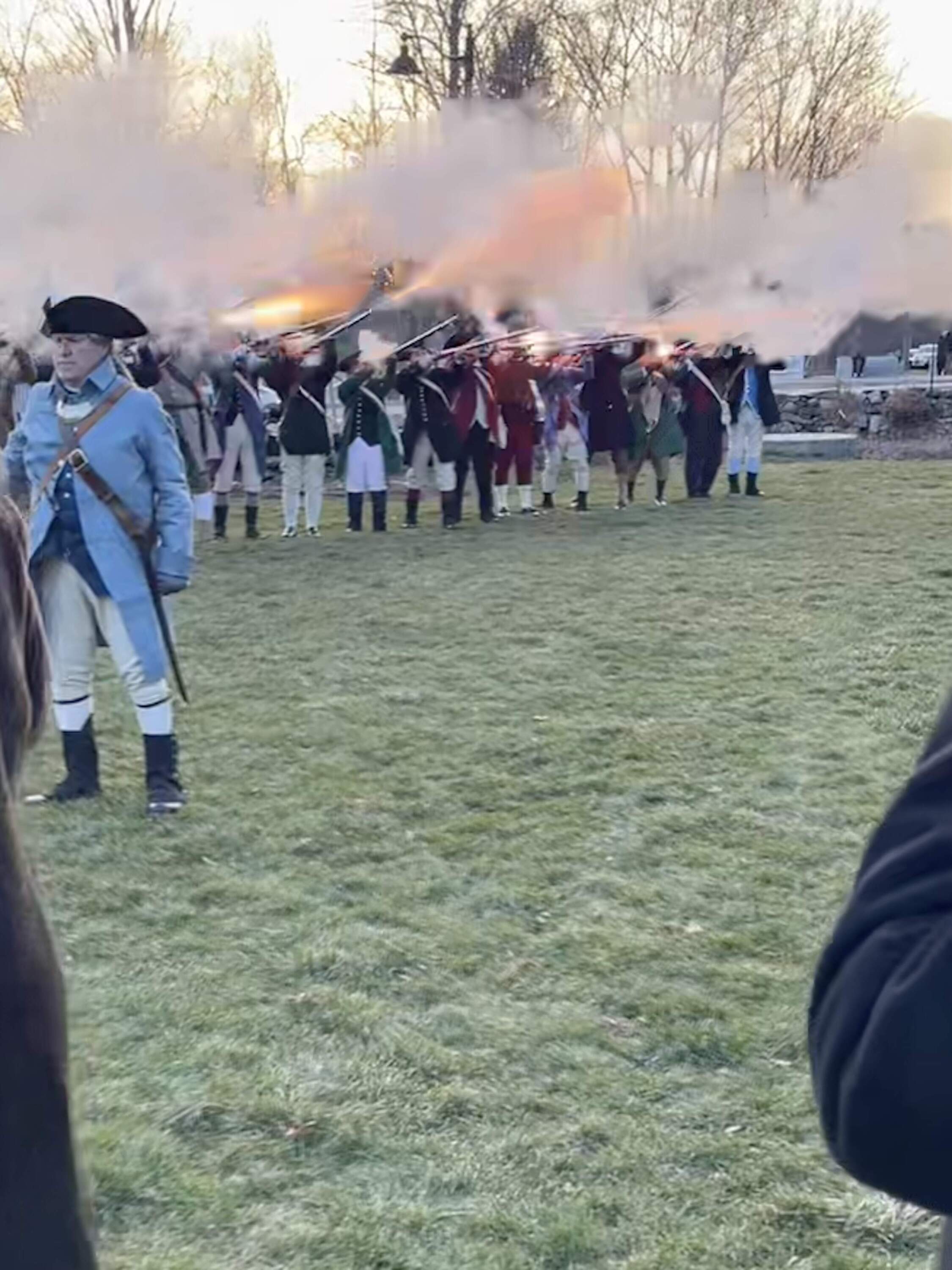
Sweeney is also the captain of the colonial reenactor troupe, the Concord Minute Men. He joined in 1971 and is the longest-serving member of the organization alive today.
“When I die, I'm going to be buried in my Minute Man uniform, and that's the way it's gonna be,” he said.
I spent time with Sweeney in advance of April 19, the 250th anniversary of the battles of Lexington and Concord – and the “shot heard round the world” – that marked the beginning of the Revolutionary War.
Some 100,000 people are expected to attend ceremonies and events in those Boston suburbs this weekend, and the Concord Minute Men will play a big role in the commemorations – from a solemn ceremony at the Old North Bridge, to marching in the town’s parade, to appearances at a colonial encampment, Orchard House and Wright Tavern.
When I decided to do this piece, I thought it would be interesting – and OK, fine, maybe a little entertaining, too. Having grown up in a colonial town (Old Wethersfield, Conn., where George Washington stayed while strategizing his battle plan for Yorktown), colonial reenactors were not new to me: They were in every local parade, my brother played in our local fife and drum corps. But it is a quirky little subculture. Who opts to spend their free time marching around in old-timey woolen garb, carrying a musket and playing the fife or drum?
As it turns out, people who care a whole lot about preserving history.
Sweeney will tell you he’s been enamored with the colonial era his entire life. As a kid growing up in Concord, he lived in the “line of march” of the Sudbury Minutemen. When Sweeney was 12, he saw the Sudbury group marching down the road on April 19 and ran outside, calling to them: “Hey, can you do something for my mom’s birthday?”
As the story goes, they asked her name, fired a musket salute, played Yankee Doodle, tipped their tricorn hats and wished her a happy day. That tradition went on for about 40 years, until his parents moved to Maine.
“ I was blown away by that experience, and I said, I want to do that. I want to be part of that and I want to honor my mom,” he said. “And so, when I turned 16 and was eligible to join, I did.”
Now Sweeney sees his devotion to the Concord Minute Men as a way to give back to the town that raised him.
“This isn’t just textbook knowledge, it’s living knowledge,” he said, “keeping the past alive not only for the present, but for future generations.”
A brief history lesson for those of you feeling rusty (as I was) on Revolutionary War facts.
The first Provincial Congress in the U.S. was formed in Massachusetts – convened in Salem, with John Hancock as chairman – in October 1774, largely in response to the Intolerable Acts enacted by the British earlier that year. The Congress was a form of self-government; it established local militias that essentially every male over the age of 16 was required to join.
Sweeney explained that the colonists were mostly subsistence farmers and blacksmiths, hardly warriors, so if trouble came, they were likely to be out tending their crops or shoeing a horse.
That’s why some members of the local militia were appointed Minutemen, because they could be ready at a minute’s notice.
Sweeney invited me to the Concord Minute Men’s dress rehearsal for the 250th celebration. (Though, interestingly, they were all in modern clothes, not costume.) It was a positively frigid evening in early April, clear skies, brutal wind. The grass was just starting to green, but the trees were still bare.
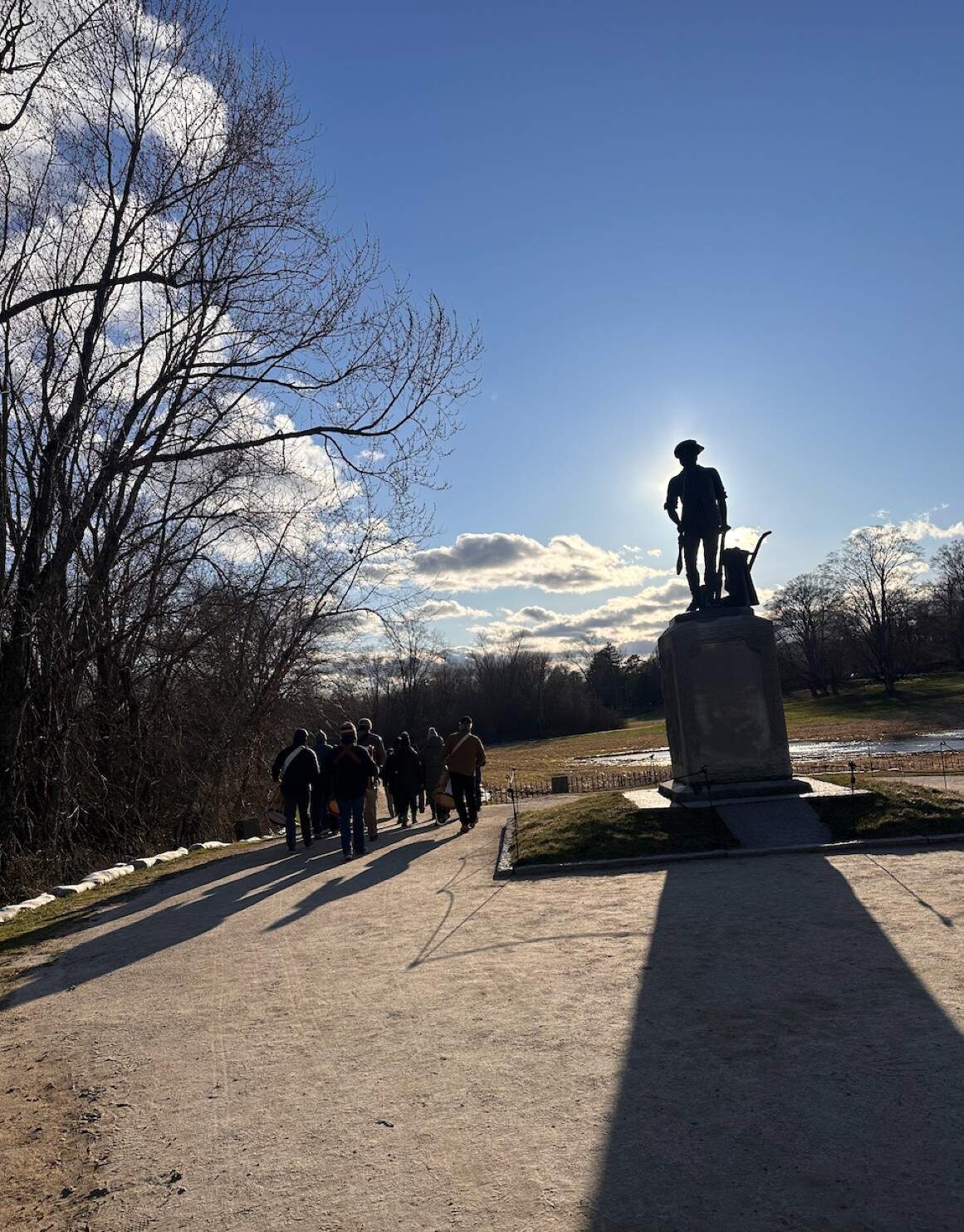
Scott Evans, the group’s fife sergeant, put the music corps through its paces. They marched, slowly, solemnly, past the Minute Man statue, sculpted by Daniel Chester French, across the Old North Bridge, along a paved path up a grassy hill to Buttrick House and back again. As its captain, Sweeney led the group, sword raised in his left hand.
“It’s a very moving experience, the hairs of my neck go up, thinking that this occurred in 1775, and 250 years later we get to do it again,” he said. “I think about everyone who gave of themselves to make this country what it is today.”
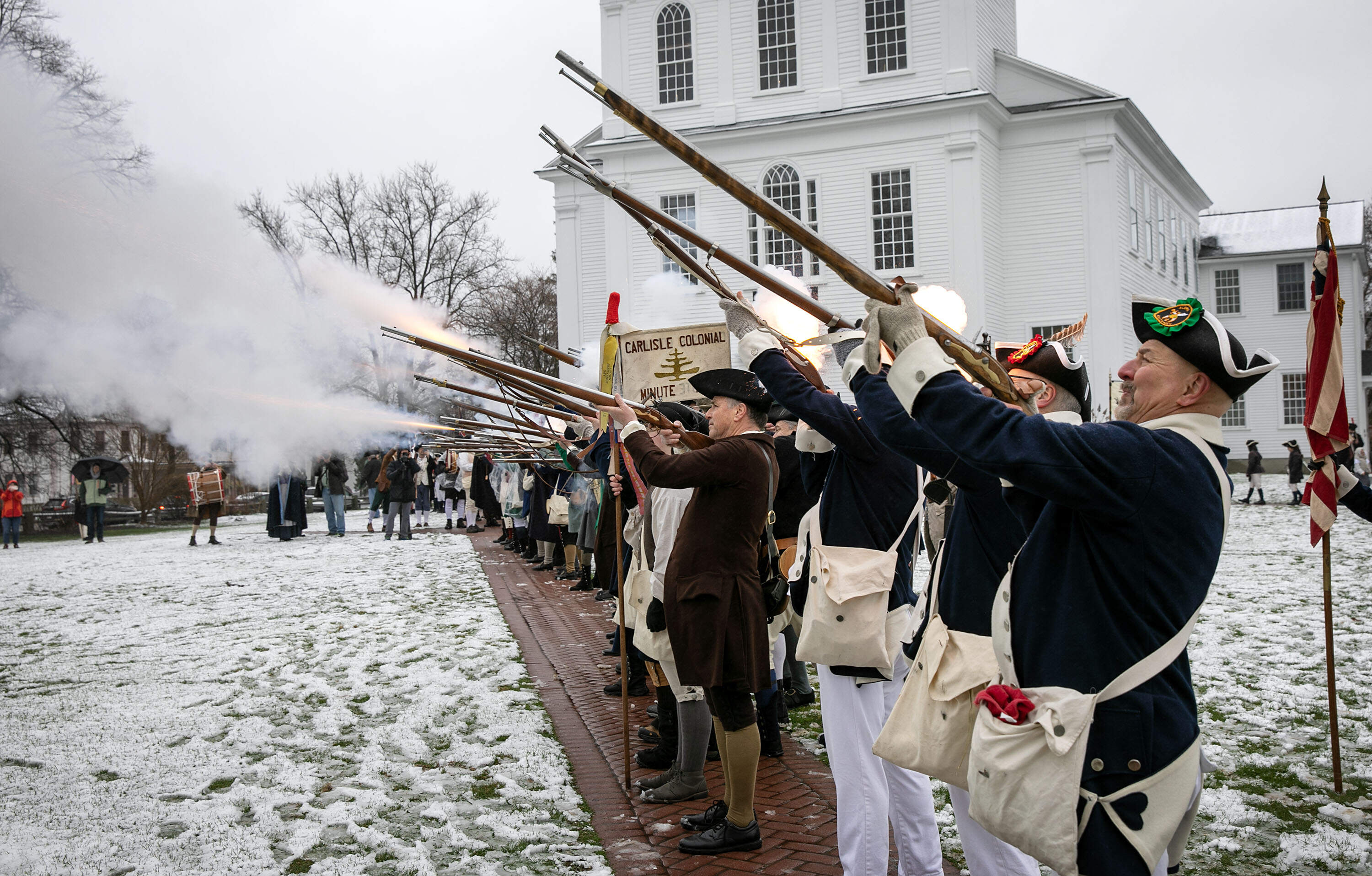
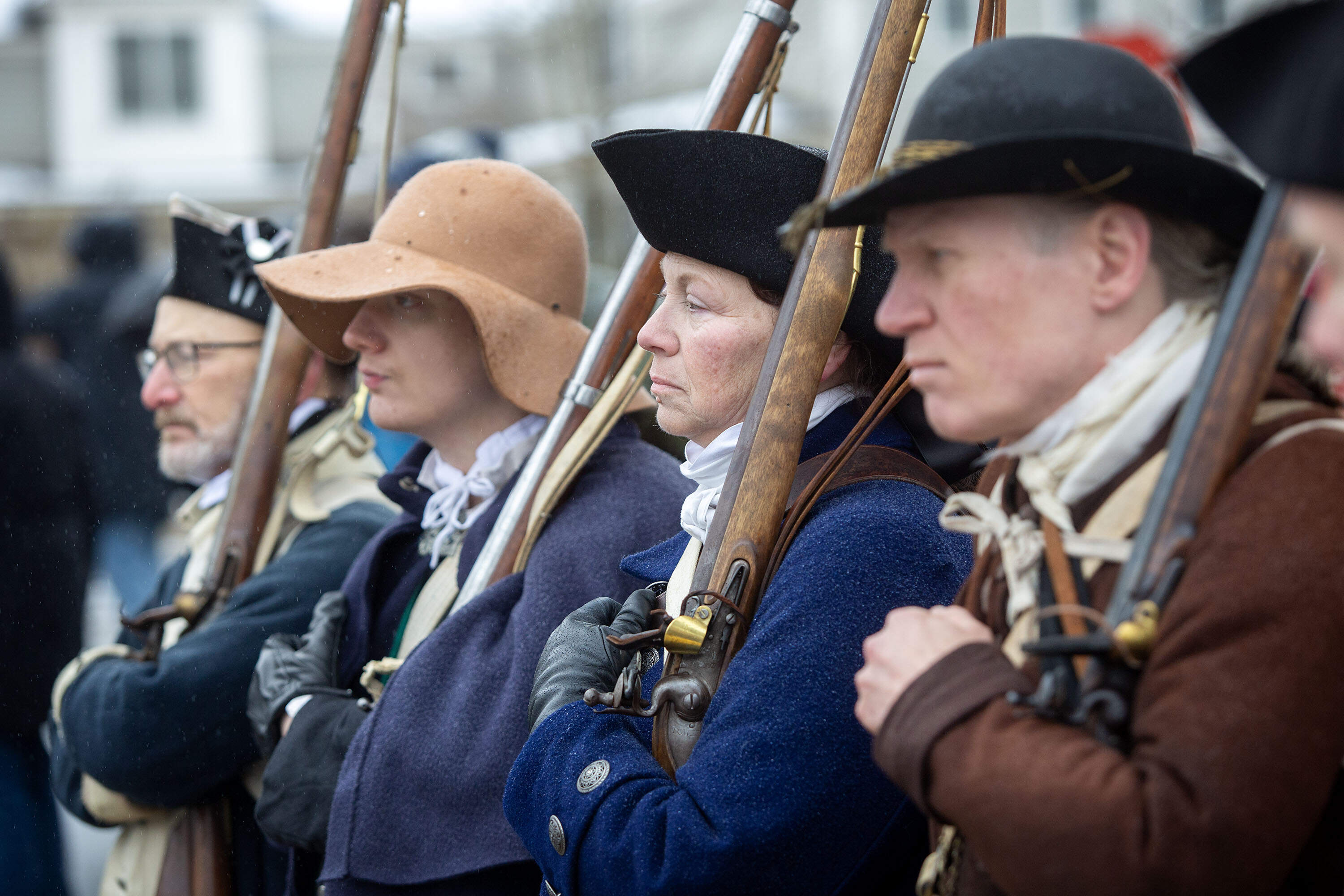
At that same rehearsal, on the grounds of the Old Manse, Doug Ellis, the group’s sergeant major, led the musket men (and women). His crew was in full costume. Each musket weighs 7 to 9 pounds — even more with the bayonet affixed to its barrel.
“Shoulder your firelock!” he bellowed, as he ran them through the 1764 manual of arms, a series of drills for handling firearms in military formation, before they fired a single shot, accompanied by a wisp of blue smoke.
Later that week, I attended the pole capping ceremony in Bedford to see Sweeney in action once again. The ceremony draws Minuteman units from the “Battle Road” towns and beyond — including Concord, Lexington, Carlisle, Acton, Lincoln — who parade from Bedford’s town common to Wilson Park. The Bedford Minutemen carry a 24-foot-long wooden pole, that ultimately one of them shimmies up and affixes a red cap to the top of. (This was once a symbol of rebellion against British rule.)
The most compelling part of that ceremony (brave soul who climbed the pole in 35-degree rain aside) were remarks by the Rev. John Eric Gibbons, who has been the chaplain of the Bedford Minutemen for about 30 years and is the minister emeritus at First Parish Bedford.
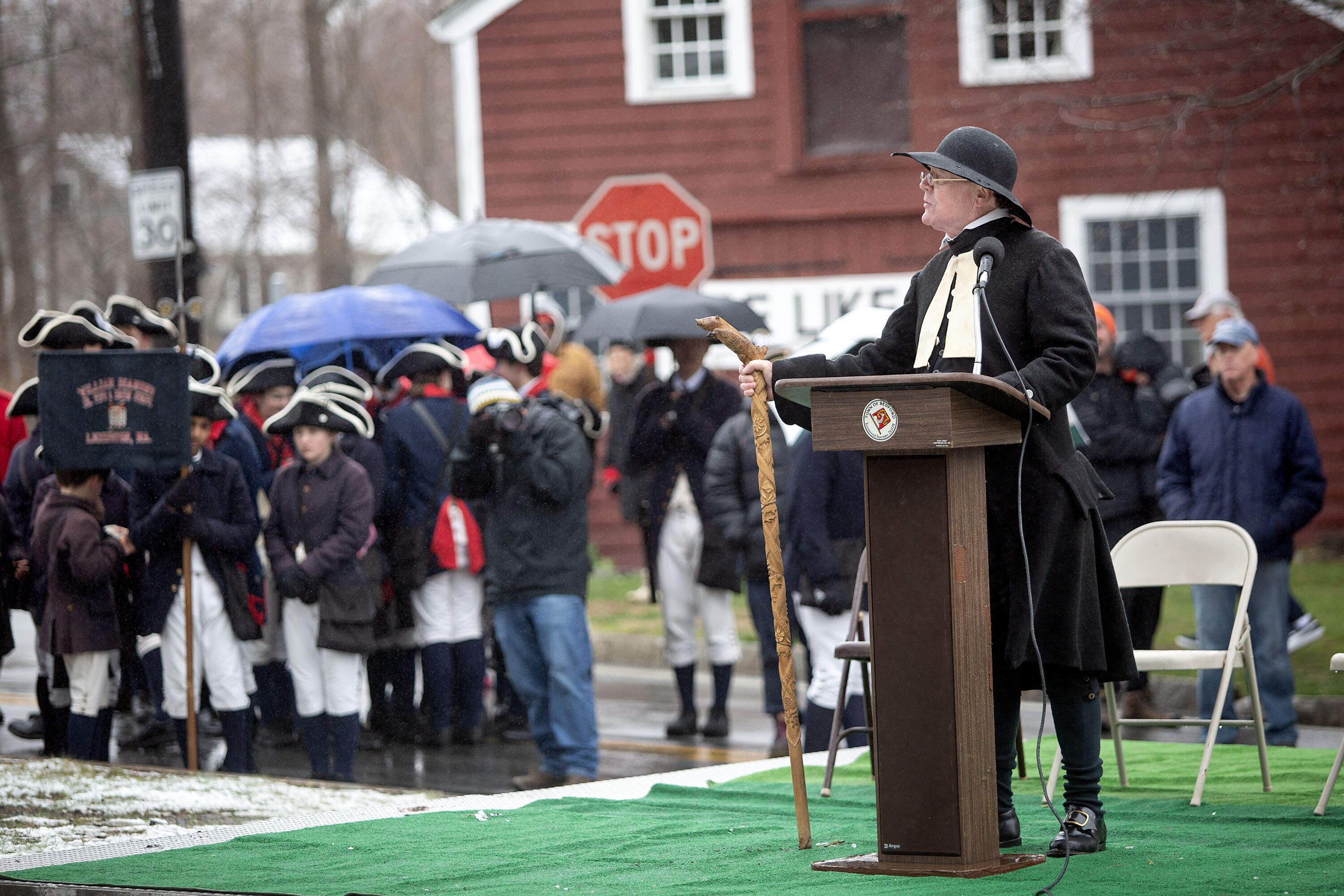
“… Let Facts be submitted to a candid world … ,” he began from the lectern.
“(The King has deprived) us in many cases, of the benefit of Trial by Jury… transporting us beyond Seas to be tried for pretended offenses.
“(The King has obstructed) the Administration of Justice by refusing his Assent to Laws for establishing Judiciary Powers …
“(The King) has excited domestic insurrections among us … protecting those for any (Crimes) which they should commit on the Inhabitants of these States.
“(The King) has imposed taxes on us without our Consent, and (cut) off our Trade with all parts of the world.”
There was a murmur in the assembled crowd: Was Gibbons writing about today’s politics – the tariffs, the pardoning of Jan. 6 insurrectionists, the administration’s refusal to follow a federal judge’s orders – in colonial speak, or was he quoting from history?
I asked him. Gibbons said he didn’t want to deliver remarks that would be considered partisan, but that he did want to recall our nation’s principles and values: “Thus 95% of what I said was verbatim from the Declaration of Independence.”
I happen to live in Concord, and have been watching my little New England town prepare for the massive influx of tourists. After all, it is a tenuous time to be marking 250 years. Since his inauguration, President Trump has moved aggressively to consolidate power, upending the norms of our constitutional system and testing the rule of law.
Sweeney’s been thinking about that, too.
“In today's political climate and society, the 250th couldn't come at a better time to make people realize that it's OK to have different beliefs,” he said. “But you need to talk. You need to speak. And I think our forefathers did that. And when push came to shove, they stood up for their beliefs, and now we have the fruits of their labor.”
But, as I mentioned, he’s also a poet. And to mark the special anniversary this year, he wrote a new one: “By Power & Pride.” It ends:
To wear their cloth, to speak their tongue, to walk the roads from which they sprung. Is
not mere play, nor jest nor game, But honor bound to history’s name.
So in the morning mist we stand, a living link, a leathered hand. Not actors here, but
those who vow, to keep the past alive — somehow!
Follow Cog on Facebook and Instagram. And sign up for our newsletter, sent on Sundays. We share stories that remind you we're all part of something bigger.