Support WBUR
Commentary
A Palestinian bakery in Somerville that always feels like home
I grew up in an Arab household where the concept of أمانة, or amanah, was instilled early and often. The word represents a moral and spiritual duty to act with integrity, loyalty and trust. Amanah carries significant Islamic meaning, but I was taught it also speaks to universal human values.
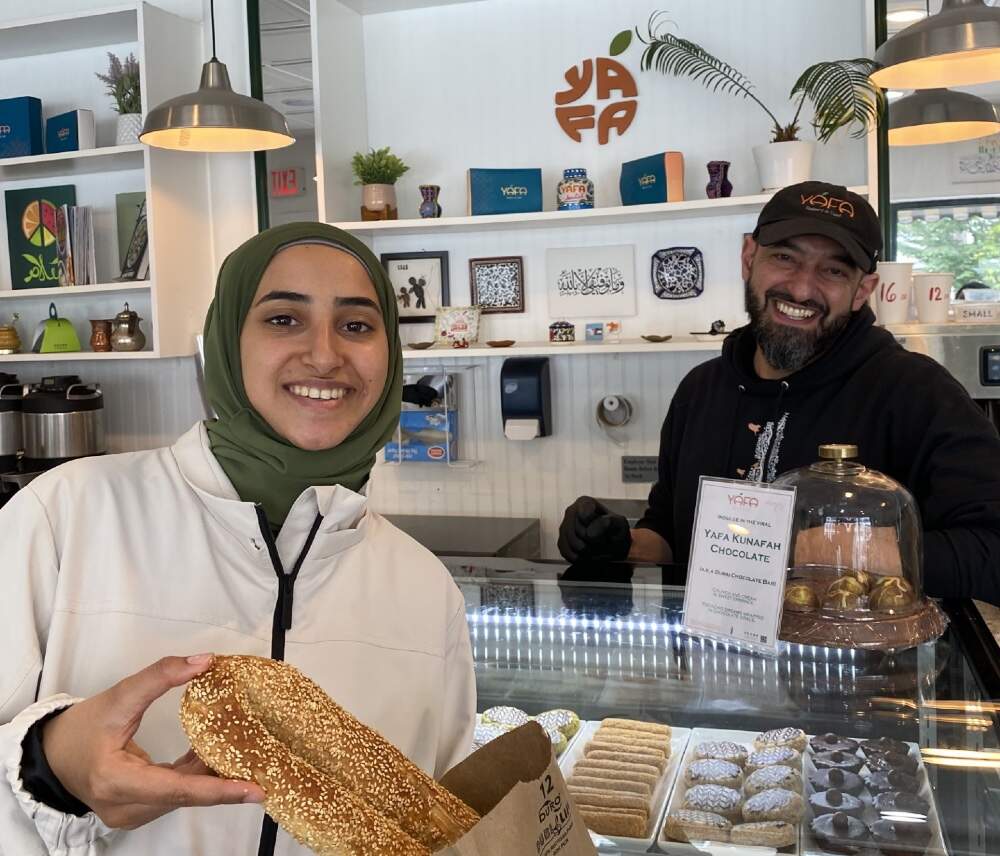
As a Somerville resident, the Palestinian-owned Yafa Bakery & Café quickly became my “third space.” I’d find myself wandering there for a cup of chai or piece of baklawa, but it was the owner, Abdulla Awad, who really brought me back. “You come for the sweets, you keep coming for Abdulla,” a fellow customer told me one weekend, recounting how Abdulla spotted her and her friend $10 for laundry and refused repayment, gifting them fresh bread instead.
As I quickly discovered, Abdulla is not in the business of making acquaintances; he makes friends. I’d pop into Yafa to study, and we’d strike up a conversation about straddling both an Arab heritage and a life in Boston. Abdulla once told me, “The guest is everything to me.” He paused, scratching his salt-and-pepper beard. “Wallahi, I want to show that’s who we are.”
To me, he didn’t even have to say it: The “we” are Palestinians. Whether living under siege in Gaza or running a bakery, this is a people familiar with the dehumanizing narratives surrounding their existence, situated within a broader history of struggle, but made more prominent in the last 18 months. “Kindness is the most crucial word I thought about when creating this space,” Abdulla says. “Spread kindness.” For Abdulla, the amanah he shows his customers is more profound than the delicious desserts and drinks. It is to preserve his heritage and nurture community for all people, in every single interaction, on every single day.
I’d find myself wandering there for a cup of chai or piece of baklawa, but it was the owner, Abdulla Awad, who really brought me back.
Lodged near an unlikely mix of storefronts and a loud main road, Yafa’s surroundings leave much to be desired, but the front door — boasting the slogan “Artfully Delicious” — hints that something unexpected awaits. Smells of pistachio, orange blossom water, zaatar and sesame fill the air. The flavors don’t just span the bakery; they dance across the Levant. Cookbooks like “Falastin” and “The Palestinian Table” line shelves on the walls, nestled between Yafa dessert boxes, plants and Arabic topography prints.
The space evokes the roots of Abdulla’s heritage—Beit Safafa, a historic neighborhood in Jerusalem. This is where Yafa’s culinary journey began, “grounded in generations of family recipes and traditions,” he tells me. “The word ‘Yafa’in Aramaic means ‘beautiful. We use beauty in the details to appreciate the people who take the time to come.”
Each time I am inside Yafa, I picture myself as a guest in a home built from ancient cool stones to block out the scorching sun. The same chai and sweets that Abdulla now offers at Yafa. The afternoon tea fading into early evening. Conversations with my hosts about everything and nothing. I picture this place, where generous warmth, taste, and spirit are inherited, and legacies are defined.
Beit Safafa, a Palestinian village torn between East and West Jerusalem, has made headlines in recent years due to Israeli infrastructure projects, including illegal settlements that annex the neighborhood. In Yafa, Abdulla conjures an image of Beit Safafa that is whole. A tribute to home. “We don’t hide from our heritage,” Abdulla says. “Our [Palestinian] roots are a strong part of who we are, our branding. But it goes back to the community. I just want them to see our roots, how proud we are, and reflect on where they come from.” After all, the majority of Yafa’s clientele “are not Arab,” he tells me. “They’re the John Smiths.”
Abdulla’s generosity manifests in small gestures, like giving a crying child a piece of baklawa or letting customers in the winter wait for their bus indoors. He squirms whenever he hears me call them “customers.” “I don’t like to call them that,” he admits to me. “I call them community members. They are Yafa’s family.” When someone forgets their wallet at home, he tells them, “Don’t worry about it. Please, enjoy it from us.”
Over time, I started paying attention not just to how Abdulla’s practice of amanah was unfolding, but how it was quietly changing me.
This happened with one “community member,” a Jewish man who once commuted a long distance to visit the bakery. He forgot to pay and mailed a check to cover the cost later that week. Nearly a year later, the man reached out when he was doing his taxes. “There’s a check I wrote that hasn’t been cashed. Was this for you?”
“Yes,” Abdulla replied.
The man asked why it hadn’t been cashed.
“It’s a souvenir,” Abdulla told him. “A sign of our shared ethics.’”
Another story Abdulla shared was from one regular, who walked into the store in tears. He sat her down by the window, where she said she had just been laid off. He told me, “What hit me most was when she said, ‘The second I walked into Yafa, I felt like I could reconnect with life again.’ As much as it touched me to hear that Yafa meant something so deep to someone, it also gave me a sense of responsibility. If she felt that way, how many others might too?”
After three years in business, what continues to make Yafa so special is that what might feel sacred elsewhere is the standard here. Over time, I started paying attention not just to how Abdulla’s practice of amanah was unfolding, but how it was quietly changing me.
One weekend morning, I sat alone with my pastries to do some work. Five women clustered at the table next to mine, struggling to find space to place their food, bags and jackets. I offered to share my table with them. Thirty minutes later, we were still talking, passing around the hummus Abdulla had brought over to my table as a quiet gift.
It was a lesson in spreading kindness straight out of Abdulla’s book of amanah: even when we have little, we share. We expect nothing in return. We recognize how gestures ripple beyond any given moment. In Abdulla’s words: “If an act of grace, however small, reminds [people] that there is still goodness in the world—then we’ve done something meaningful.”
Follow Cog on Facebook and Instagram. And sign up for our newsletter, sent on Sundays. We share stories that remind you we're all part of something bigger.