Support WBUR
Essay
AI isn't the end of the essay
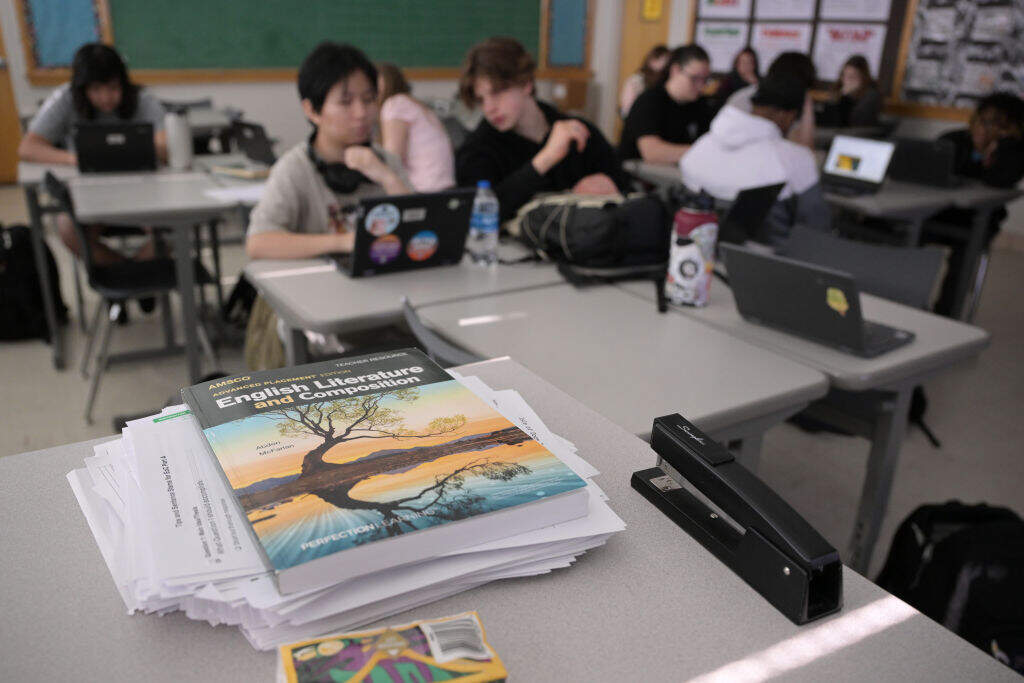
Ban it. That’s the approach most schools are beginning to take on AI. They’re subscribing to AI detection software, ratcheting up the consequences for students and bringing back in-class pencil-and-paper assessments.
But surveillance and threats can only go so far. Moreover, a complete ban on AI suggests to students that at least some part of school is supposed to be a slog—a treadmill of busywork that only ends once your diploma is in hand. Sure, ChatGPT could finish this assignment for you, but we want you to suffer.
It doesn’t have to be this way. In the same way that the advent of the calculator facilitated a shift away from an emphasis on calculation in math education and toward conceptual understanding, educators now need to rethink the aims of school assignments in a world where AI interfaces can instantly produce endless strings of words and explanations. We can no longer simply force students to complete their schoolwork, when AI outputs can earn passable grades.
But convincing students that schoolwork is worth their time is going to take work. Most fundamentally, it entails rethinking the incentives that shape student behavior. And, specifically, it requires addressing the centrality of A-F letter grades in our education system.
In K-12 and higher education, grades don’t merely convey how students did on an assignment. They also produce lasting, high-stakes consequences that reverberate across students’ academic careers and into their lives. The grades students receive on their class assignments and exams add up to course grades, which live permanently on transcripts. Those transcripts, in turn, function as keys that open educational and career opportunities.
For many students, the entire enterprise of going to school is animated by the giving and receiving of these tokens. Learning may occur; in fact, it often does. But it is often merely a byproduct of the quest for grades. No wonder tools like ChatGPT are so enticing.
But what if grades weren’t what students thought most about? What if the secret to “getting ahead” for students involved something more closely tied to meaningful intellectual development?
Consider a typical assignment, when teachers include a scoring rubric, and students do their best to rack up the points necessary to obtain their desired grade. The instructor then evaluates student work, taking care to follow the rubric they designed and award the appropriate number of points. Students get their grades, another column in the gradebook is complete, and the class moves on. Did learning occur? Maybe. Maybe not.
But what if grades weren’t what students thought most about? What if the secret to “getting ahead” for students involved something more closely tied to meaningful intellectual development? Based on our research, we think the key to reducing the centrality of grades and reorienting students towards learning involves three key steps.
First, instructors need to create assignments that are worthy of students’ time, explaining why and how it will benefit them. Currently, students are incentivized to focus only on the exchange value of education — how they can use their credentials to climb the next rung on the proverbial ladder. The key is convincing them of the use-value of knowledge and skill — the importance of actually learning something.
Second, we need to emphasize the process of learning, rather than just the output of it. In the age of AI, most course assignments can be completed by a chatbot. But AI falls short in a place where students can shine — in demonstrating the process of their thinking and explaining the development of their ideas. Such an emphasis not only limits the utility of AI, but also underscores the fundamental value of the learning process.
Third, courses need to offer students multiple opportunities to improve their work. Doing so helps accentuate the importance of learning as a process. But it also reduces the pressure to turn in an assignment that will earn the desired grade. If development is the expectation, then the incentive to rely on AI will be greatly diminished.
What might this look like in practice? Take, for example, one of the most common high school and college tasks: writing an essay. The purpose of such an assignment, despite what students may think, is not the literal production of the essay — work for which they will earn grades, and which might easily be outsourced to AI. Instead, students need to see the value in considering arguments, weighing evidence and developing their own ideas.
The first task for educators is making that use-value clear. Then, teachers might emphasize writing as a process by requiring students to show and explain the development of their thinking; the version history of a Google Doc is one of many ways to do this. Finally, asking students to respond to instructor feedback emphasizes the importance of sharpening and refining their thinking across multiple drafts. It models and facilitates the idea that school is a place for learning, not just amassing credentials.
Educators aren’t wrong that AI threatens to overturn the status quo in K-12 and higher education. But we aren’t going to hold back the tide with prohibitions and threats. By focusing on the fundamental aims of education — and specifically on use, process and improvement — we can minimize the potentially corrupting harm of using AI. Even better, we might actually restore the rightful place of learning in our classrooms.