Support WBUR
Essay
Zen and the art of midlife maintenance
This past summer, as I turned 44, I did so with a shrug. Is there any more boring age to be than 44? If that wasn’t bad enough, being in my mid-40s means I’m a prime candidate for that most maligned of life stages, the midlife crisis.
I don’t think I’m having a midlife crisis — or, I should say, I didn’t. Since turning 40, the closest I’ve felt to that stereotypical rite of passage was when I bought a somewhat impractical car. (It’s a stick shift, a too-bright blue Subaru Impreza — the heart wants what it wants.) Less-than-sensible sedans and a few tattoos since I turned 40 don’t constitute a crisis though, right? It didn’t help matters when, this past summer, I began reading a book titled “Midlife: A Philosophical Guide.” As I pulled the book from my beach bag, I noticed my 12-year-old daughter giving me a savage side-eye. “I’m not having a crisis,” I snapped before she could get a word out. I had just heard an interview with the author — MIT philosophy professor Kieran Setiya — and the book sounded interesting.
Setiya writes in the book’s introduction that his investment in the topic is personal. At the relatively early age of 35, he considered the life he’d built and “felt a disconcerting mixture of nostalgia, regret, catastrophe, emptiness, and fear.” Naturally, he asked, “Was I having a midlife crisis?”
Setiya defines and provides a history of the midlife crisis, tracing its origins – perhaps not as far back as we might think – to a 1965 essay by psychoanalyst Elliott Jaques, titled “Death and the Mid-Life Crisis.” In the essay, Jaques quotes a patient in his mid-30s who surveys his life and says, basically, it’s all downhill from here. Like Jaques’ patient, the stereotypical midlife crisis sufferer is a middle aged man, but in his introduction, Setiya indicates that his intended audience goes beyond the stereotypical; rather, the book is for “anyone coping with the irreversibility of time.”
As I read, I couldn’t help but think: if I’m coping with the irreversibility of time and I’m a middle-aged man … maybe I am having a midlife crisis!
Fortunately, “Midlife” is a self-help book — part of a larger effort by some contemporary philosophers to make philosophy less esoteric and more, well, helpful. And indeed, I have found Setiya’s book insightful as I think through this stage of life. Inherent in the idea of midlife crises are questions of what constitutes a good life, the original domain of philosophy.
For some, midlife crises come on not because of a lack of purpose or meaningful work or problems to solve, but due to the feeling that, as Setiya writes, “something is left out.” Packed into that “something” are all the things we would do if we weren’t attending to problems, difficulties, needs; that is, activities that are not just ameliorative.
Fortunately, “Midlife” is a self-help book — part of a larger effort by some contemporary philosophers to make philosophy less esoteric and more, well, helpful.
Philosophers don’t really have a concise term for “not-just-ameliorative,” Setiya says, so he coined one: “existential value.” Examples of activities with existential value can be anything from the lofty — Aristotle was a big fan of contemplation — to the more mundane: “telling funny stories, listening to pop music, swimming or sailing, playing games with family or friends” are among Setiya’s suggestions.
I know, I know; listening to pop music is one thing, but sailing? Sure, I’ll just slot in a brief voyage at sea between working full time, shuttling the kids around between school and soccer and dance and cross country and friends’ houses, checking in on aging parents, folding endless piles of laundry, making — I mean, ordering — dinner, before finally lying awake in bed worrying about, well, everything.
Still, these days as I come to terms with my mild midlife crisis, I am trying to make time for activities that have existential value and fit in my busy life — reading, writing, taking walks, the occasional attempt at contemplation. There is space, it turns out, for more than I thought.
To this list, I’m adding a new one for my forty-fourth year: working out. On my birthday in July, I decided that by the time I reach 45, I want to be in the best shape of my life. If I were to probe my motivation a bit, it probably has something to do with the creeping awareness of my own mortality — the feeling that, to paraphrase that forebodingly titled essay, it’s all downhill from here. Either that, or I’m just tired of my pants feeling too tight.
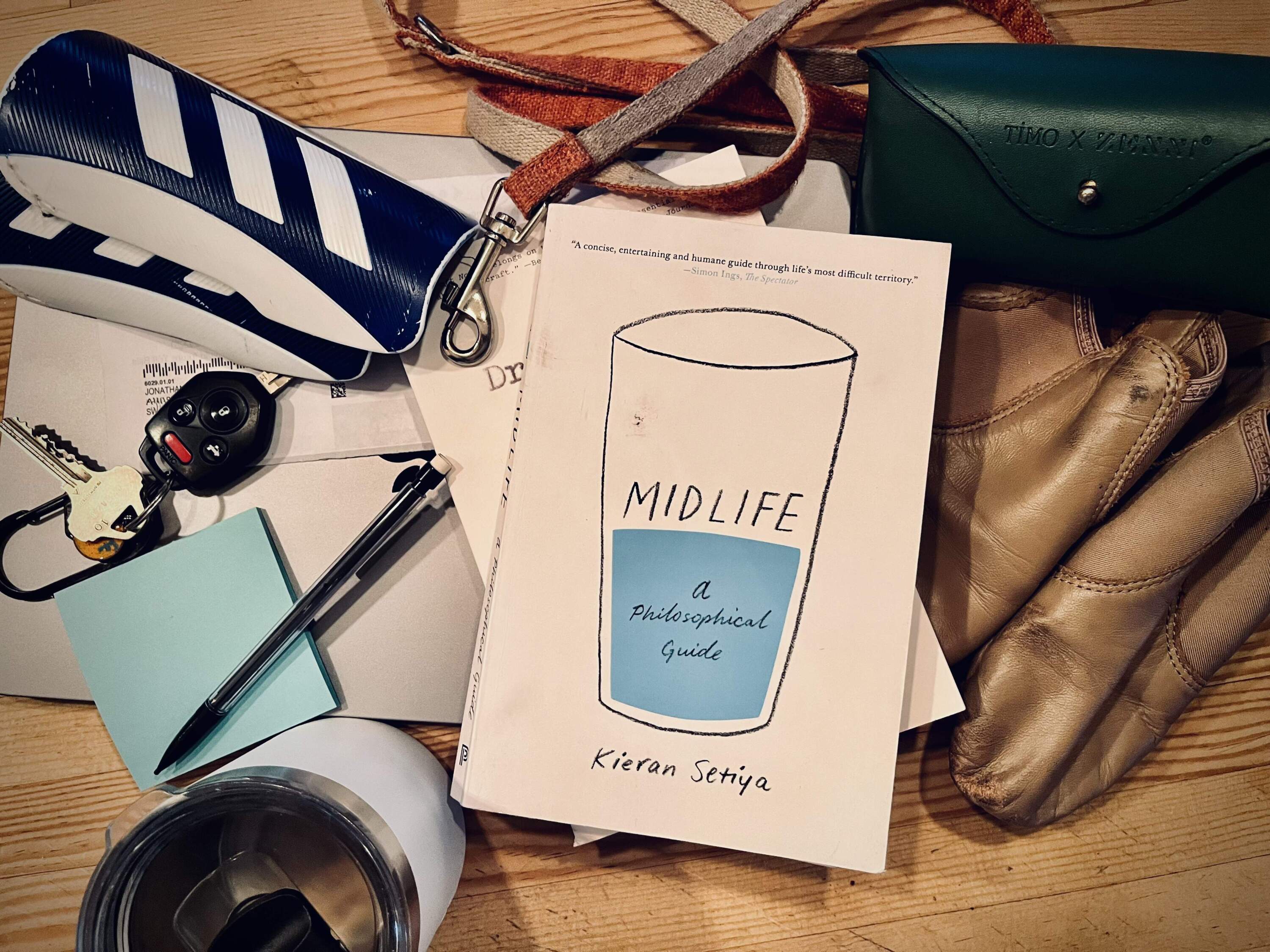
In “Midlife,” Setiya addresses this (mortality, not my pants) and several other familiar feelings that creep up around middle age — nostalgia, regret and relentless striving. So, sure, after reading “Midlife,” I am willing to admit that I, too, am deep in it, but it’s alright. Instead of being in crisis, I’m choosing to see midlife more as an opportunity — to reevaluate, to reaffirm, maybe even to reboot my health.
In this light, my “Fit for 45” project, as my oldest friend has dubbed it, is both ameliorative and not-just-ameliorative. It’s an attempt to spend my time on an undertaking that has both practical and existential value. It’s a continued striving toward the good life, and an attempt to prolong it at the same time.
And, it turns out, a gym membership is much cheaper than a sports car.