Support WBUR
Opinion
First, the Trump administration cut SNAP benefits. Now it wants to stop measuring food insecurity
An old business adage suggests that “what gets measured gets managed.” By that logic, we will no longer "manage" food insecurity in the United States after the Trump administration announced on September 20 plans to cancel the Household Food Security in the United States report, a long-running annual report from the U.S. Department of Agriculture.
The term “food insecurity” captures not just whether households have enough food to eat, but also their ability to eat balanced meals and how often they use common coping strategies when budgets are strained, like buying cheaper, lower-quality food, cutting the size of meals, or skipping meals altogether. Food insecurity was widespread during the COVID-19 pandemic: Millions more families in the U.S. struggled to keep food on the table, and levels have yet to come back down to where they were pre-pandemic. In 2023, nearly 1 in 7 U.S. households were affected by food insecurity. Among children, the picture looks even worse, with rates of food insecurity impacting nearly 1 in 5 kids — a rate nearly one-third higher in 2023 than before the pandemic.
In Massachusetts, where we live and work, the Greater Boston Food Bank estimates that more than 1 in 3 households in the state was food insecure at some point during 2024. If the federal government stops publishing the USDA report, (which has been published during both Republican and Democratic administrations for three decades) and ends the underlying data collection, state and federal policymakers, state agencies, community-based organizations and advocates, and policy researchers may become increasingly reliant on less robust state and local data. Because while state and local data are also important, they may be incomplete and limited in the populations they represent (for example, working adults, or families with school-age children). With these data, we may still be able to see some trees, but not the whole forest, losing sight of national trends and how states and certain groups — rural communities, seniors, Black or Latino families — compare on an apples-to-apples basis.
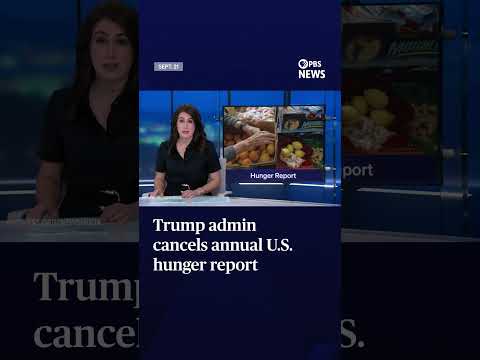
Timothy Synder, historian and author of “On Tyranny,” suggests that “to abandon facts is to abandon freedom.” We seem to be rapidly entering that territory, as key USDA personnel who led the food security survey have been placed on administrative leave as a result of the cancellation of the food security report and the Bureau of Labor Statistics, whose commissioner was recently fired, has postponed key data releases.
Measuring food insecurity over the next few years will be especially critical since the One Big Beautiful Bill Act (OBBBA) included $186 billion in cuts to the Supplemental Nutrition Assistance Program (SNAP), formerly known as food stamps. The Congressional Budget Office projects that this 20% cut in funding will cause about 4 million people — mostly children, seniors, and people with disabilities — to lose their SNAP benefits entirely or receive greatly reduced benefits, putting their health and food security at risk.
We, along with colleagues at the Centers for Disease Control and Prevention and the University of North Carolina at Chapel Hill, recently published new research in “Preventive Medicine” that explored the consequences of cuts to SNAP benefits. We looked at how the rollback of COVID-era emergency allotments impacted food insufficiency, a more narrow measure than food insecurity. Of course our results aren’t a direct proxy for the OBBBA cuts, which are much bigger, but they do help illustrate what we might expect when SNAP — or any other nutritional benefits — shrinks or disappears.

We found that states that ended the SNAP emergency allotments early, i.e., before the end of the pandemic, saw a 22% increase in food insufficiency. And the increase was even higher for households with children. Getting less from SNAP also led about 26% more households to report difficulty affording other necessities, such as housing, utilities or health care.
Many in public health and medicine are concerned about the likely impact of these cuts. Leaders of 582 national, state and local organizations signed a letter calling the cuts “devastating” and urged Congress to pass legislation that, as the American Public Health Association said, would “correct the damage done by the reconciliation legislation [OBBBA] to prevent millions from going hungry.” If these cuts are implemented, there will be downstream impacts on our collective health, particularly for children. SNAP is the nation’s largest child nutrition program. It supports physical and mental health and improves developmental and educational outcomes for the next generation. But the impacts won’t be limited to those who directly experience SNAP benefit cuts. Food insecurity costs all of us, with approximately $237 billion a year in avoidable health care costs and economic burdens to the country.
Stopping the count doesn’t stop the suffering, it just makes it easier to ignore. One of the fundamental roles of government is monitoring the well-being of its population. Failing to do this work is an abdication of our social contract. The costs of food insecurity won’t disappear if we don’t measure it, but we will lose the ability to evaluate our leaders’ choices and craft policies that move us forward.