Support WBUR
Essay
In 'KPop Demon Hunters,' there’s something ‘Golden’ for all of us
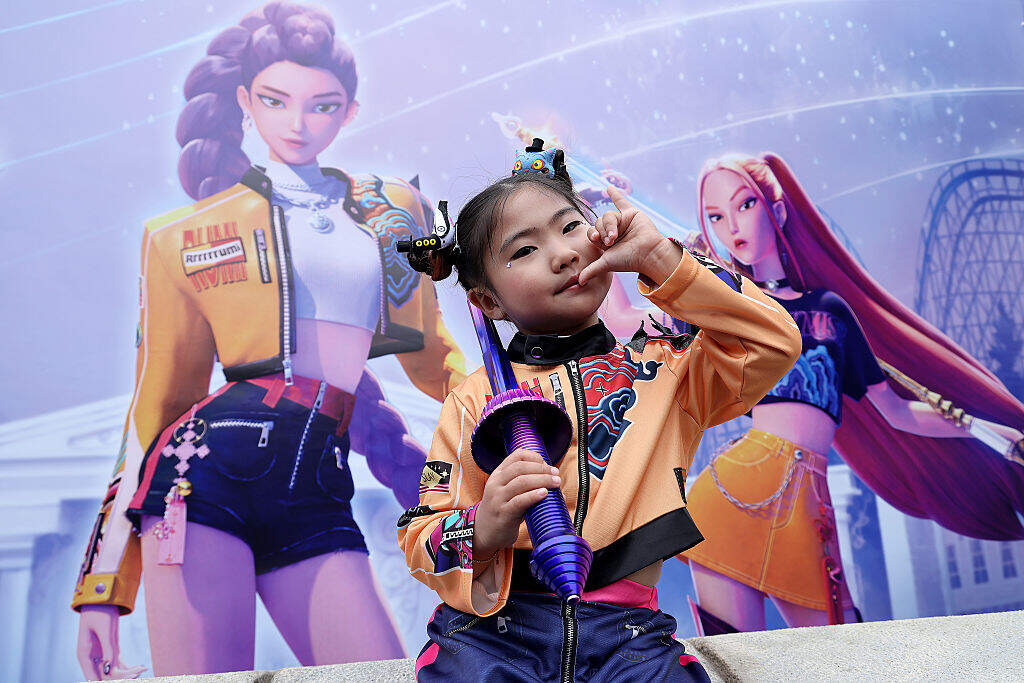
From my Somerville porch, I love to hand out candy and observe the parade of costumes on Halloween. I’ve seen everything ranging from the adorable — Elsas, Minions, T-Rexes and Tube Men — to the inexplicable — a small child in a black cloak and white mask claiming to be “The Purge.” This year, I’m expecting to see a flood of idols and demons from “KPop Demon Hunters” (“KPDH”), Netflix’s most popular film of all time.
Since its release in June, both children and their parents have been replaying this singular movie on loop, the same way I used to rewatch my favorite Sailor Moon VHS as a kid. It boasts over 325 million views to date and continues to top Billboard charts with earworms we never knew we needed.
Despite all the hype, I swiped past this movie on Netflix all summer. I’m neither a parent nor a K-pop fan. Although the premise (female K-pop stars battle against demons disguised as male K-pop idols) featured elements I grew up loving (boy bands and Magical Girl anime), I wasn’t entirely convinced it was made for me until recently, when I finally shrugged and hit play.
Watching it on a Monday night, I thought I was consuming nothing but a fluffy, fun and fantastical escape from my real life. I was still laughing about the corn eyes encounter until Jinu, the demonic boy band leader, gets summoned back into the underworld by his overlord, Gwi-Ma.
By this point in the film, we’ve learned that Rumi, one of the demon hunters, is half-demon herself. She has spent her whole life keeping this a secret from her bandmates and fans by concealing the demon patterns on her skin that signal her lineage. “This means she has shame,” Jinu tells Gwi-Ma. “We can use it to destroy her and the Hunters for good.”

This overt mention of shame unhinged a trapdoor beneath my sofa. In my mind, I dropped into a vinyl chair across from a new mental health provider I had seen earlier that afternoon.
“Over the past two weeks, how often have you experienced the following: Worrying too much about different things? Trouble relaxing? Becoming easily annoyed or irritable?”
I struggled to tally all the specific times I’ve felt anxious, because these feelings had been occurring more frequently than I wanted to admit to myself, let alone to another person.
“Several days…I think?” I told the social worker, although that was probably a conservative estimate.
“How about feeling afraid as if something awful might happen?”
“Oh, every day,” I blurted without thinking. And before she relayed the results of my assessment, which reflected a moderate to severe level of anxiety, I realized that maybe this feeling of unwellness wasn’t something I’d conjured with my imagination, but a very real issue that required care and attention.
I’ve never thought of myself as an anxious person. But since the pandemic hit, I’ve become more susceptible to worry, spiraling and ruminating about all the worst-case scenarios.
“But I still manage to do my work, emails and dishes these days!” I would justify to myself, falsely associating all cases of anxiety with an inability to execute daily functions. However, my days usually ended with an unhealthy engagement with revenge bedtime procrastination, to try to tune out the inner demons that come out at night, telling me, You didn’t get enough done today. Which to me, translates to: You are not enough.
Through language and lyrics that are simple enough to reach our inner child, “KPDH” reminds us of a message we know as adults but struggle to believe: none of us are alone in feeling shame.
My demons are not so different from the ones that stalk the HUNTR/X girls and their fans. Asian Americans seek mental health care at lower rates than other racial groups, so I’ve always sought therapy when I need it, believing I was free from the stigma that impacts so many in our community. But while I did get so far as showing up to my appointment that day, I still struggled to accept that my experience of anxiety is a legitimate condition of unwellness, rather than an inherent flaw or failure of character. I’ve been subconsciously carrying around this internalized shame, and I was so good at pretending to be fine that neither I nor my prior healthcare providers had recognized this struggle with anxiety. I feared being seen as weak and unworthy of acceptance, so I hid my patterns like Rumi did.
Watching Rumi lose her voice and call herself a mistake made my own throat tighten with discomfort. Despite the tropey and predictable plot, this movie surprised me with its magic: its visceral imagery, on-the-nose dialogue and punchy lyrics helped me to more clearly recognize and articulate the shame that fuels my own feelings of unwellness.
The real power of “KPDH” lies not in its stellar animation and heart-pounding songs, but in its willingness to explicitly address the concept of shame. By daring to drop the s-word in its script, KPDH prompts viewers to share how shame shows up in their own lives, through the context of addiction, queerness, neurodivergence, generational trauma or any other experience we’ve been taught to keep quiet. This public discussion of what hurts us feels like a real-life manifestation of the film’s climax, when Rumi, Zoey and Mira harmonize their voices to show us what shattering silence — and breaking through shame — sound like.
Every time I watch that scene, my heart glows with hope for so many things. I hope to find some healing through a new therapy program I’m starting this month. I hope to treat myself with more kindness, like my husband does for me on my bad days, when all I want to do is lie face down on our sofa. When I ask if having anxiety makes me weak, he counters my negative self-talk with grace.
“No,” he says, “But it is okay to have a weakness. You don’t have to be strong all the time.”
I also hope “KPDH” will inspire more meaningful stories about finding solidarity and connection to emerge in mainstream media. We need more models of how to give and accept empathy, an “antidote to shame.” Through language and lyrics that are simple enough to reach our inner child, “KPDH” reminds us of a message we know as adults but struggle to believe: none of us are alone in feeling shame.
So, thank goodness many of us are watching “KPDH” on repeat. I’ve now seen it three times already. And I’m 100% going to watch it again.
In the meantime, I look forward to greeting the hordes of Hunters ready to feast on treats on the most haunted night of the year. It takes a lot of energy to seal the Honmoon! But if we remember that none of us needs to face our demons on our own, just like Rumi, we too can be free.