Support WBUR
Cog's Weekly Newsletter
The winter blues are here again

This essay appeared in Cognoscenti's newsletter of ideas and opinions, delivered weekly on Sundays. To become a subscriber, sign up here.
It happens every year around this time: just after Halloween, before the frenzy of the holiday season begins. I’m sleepy and slow. Can’t concentrate. The little things I normally do to keep myself on track — drink water, work out, get to bed at a reasonable hour, eat vegetables, have a plan-ish for dinner — feel just beyond my grasp.
It’s my first bout of the winter blues, which begins, reliably, the week after we turn the clocks back. (Another bout usually arrives in early-to-mid March when I’m desperate for short sleeves and it won’t stop sleeting.) I’m in my mid-40s; you’d think by now I’d be more prepared! Nope. It sucker punches me every time, and every fall I relearn this lesson.
Seasonal affective disorder (SAD) affects about 5% of American adults, and many more have a milder version of the mood-related disorder, according to the American Psychiatric Association (I’d count myself among that group). SAD was clinically recognized by psychiatrists in the mid-1980s, but the link between the seasons and our moods has been observed for millennia — one article I read on the topic referenced a Chinese text from 300 B.C.
Scientists are still studying the causes of SAD, but they do know it’s related to the lack of natural light and our circadian rhythms, which affect the body’s production of key hormones: melatonin (related to sleep) and serotonin (related to mood). Common symptoms include lethargy, feelings of hopelessness and weight gain. The disorder apparently also affects four times more women than men.
In the early days of this dark month, when it’s suddenly pitch black at 4:50 p.m., I inevitably find myself in a sour mood. I feel bereft watching the last of the bright red leaves drop from my neighbor’s young Japanese maple. I watch very depressing television without really intending to (this is not the time to finally start “The Leftovers,” for example). And a gray 34-degree morning — exceptionally mild by New England winter standards — is enough to send me back to bed.
Early November is a good time to revisit Katherine May — author and patron saint of “wintering.” In May’s telling, winter is not just the cold season: it’s the “active acceptance of sadness.” Instead of willing ourselves to happiness, she suggests that we slow down to hibernate, heal and regroup. (May’s writing is also what inspired me to take up cold plunging, when the pandemic left me feeling as if I couldn’t feel.)
For a busybody like me, this advice does not land easily. My natural impulse is to get moving! Be tough! Launch into action! Part of me worries that if I slow down too much, inertia will take over and keep me stuck. I’d like to say that I’ve learned my lesson this November –-- that I have (at last) taken Katherine May to heart, and given myself over, temporarily, to the quiet of the dark. Alas, I’m not that evolved. At least not yet.
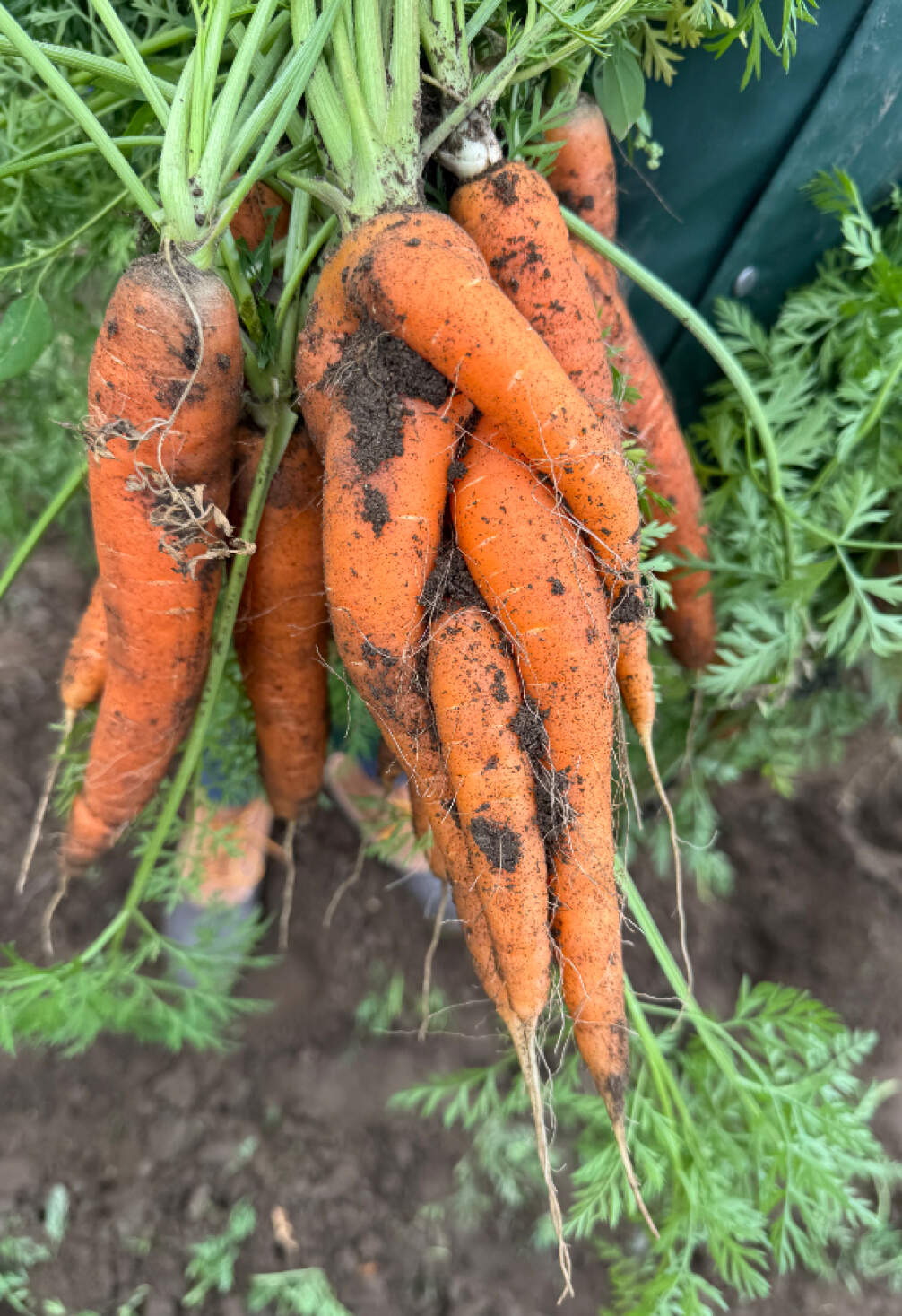
But I am making progress. I’m trying to take more careful notice of what makes me feel better. I pulled out my “HappyLight” this week and set it up next to the desk in my office. My family thinks the 10,000 lux lamp is ridiculous, but the science says it helps. I attended Siena Farm’s annual carrot pull last weekend, which is exactly what it sounds like: you harvest carrots, straight out of the earth, alongside hundreds of other people. Getting my hands dirty, paired with the repetitive, physical nature of the task, was therapeutic. I also took my kids to TJ Maxx and giggled as they put on an impromptu fashion show in the dressing room. Clothes shopping isn’t my favorite, but watching them banter and strut under the fluorescent lighting was a balm. I suppose all these things signal a change in season, in their own way.
I just read “Instead of Depression” by the poet Andrea Gibson, who died earlier this fall. She, like May, suggests a reframe:
try calling it hibernation. Imagine the darkness is a cave
in which you will be nurtured
by doing absolutely nothing.
Hibernating animals don’t even dream. It’s okay if you can’t imagine
Spring. Sleep through the alarm
In our age of non-stop information, production, connection – and news – there is something intriguing about “being nurtured by doing absolutely nothing.” I know, I know: maybe I'll try it.