Support WBUR
Commentary
Resilience is no substitute for justice
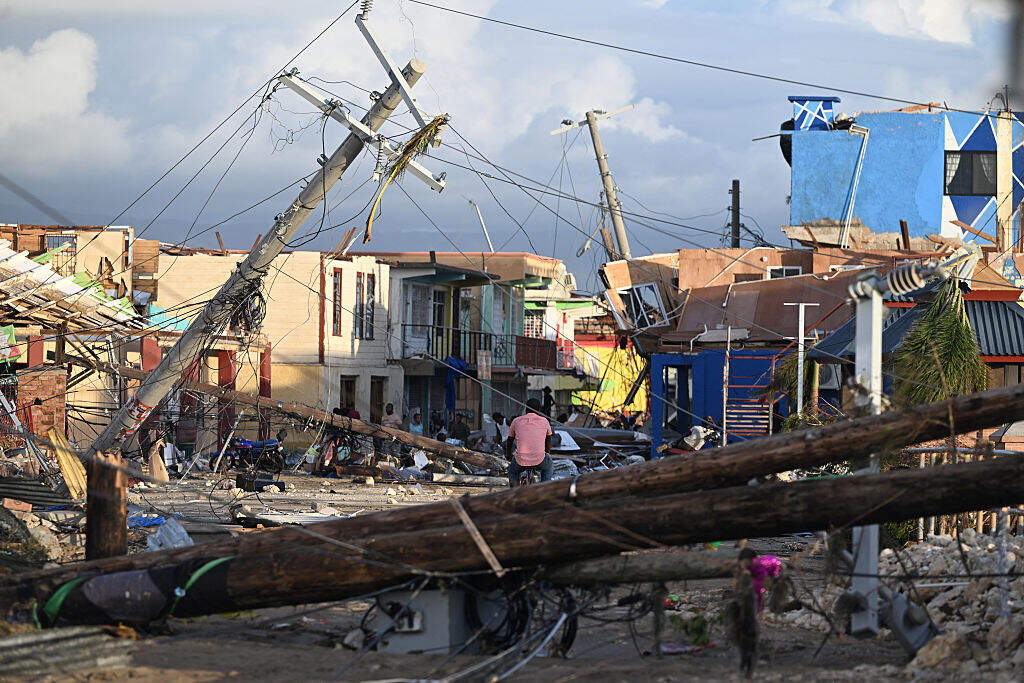
As Hurricane Melissa tore through Jamaica at the end of October, headlines praised the country’s resilience. Images of flooded streets and uprooted homes were paired with the familiar refrain: Jamaicans are strong; they will rebuild.
But resilience to what — and for how long? How many times must the same communities be expected to “bounce back” from storms made deadlier by climate change, and from structural inequities that keep them poor?
During my two decades of work at the United Nations, I watched the word resilience lose its meaning. A word that once described solidarity and shared responsibility has become a way to shift the burden onto the poor and abridge their human rights.
Health, for example, is not a privilege to be earned through perseverance. It is a right, recognized in the Universal Declaration of Human Rights and made binding through the International Covenant on Economic, Social and Cultural Rights (ICESCR). Article 12 of that Covenant was later interpreted by the UN Committee designed to interpret it, to include the social determinants of health — the conditions in which people are born, live, work and age.
These are not aspirations; they are legal obligations. Yet those obligations are routinely ignored.
What can be done? International law has weak accountability systems but one avenue for redress is through the Optional Protocol to the ICESCR, which allows individuals (from countries that ratified it) to bring complaints to the UN Committee in Geneva. While its rulings aren’t legally binding, they can change policies. In Spain, a 2020 case prompted stronger housing protections after an eviction of a mother and her six children was found to violate the right to adequate shelter.
International law offers one path to accountability. But we can also make changes within the development sector, comprised of government donors, NGOs and foundations. Perhaps unwittingly, the sector’s growing embrace of “resilience” began to take on a meaning far from what was originally intended. Indeed, it subtly redirected attention away from governments as duty bearers, making it easier for donors to fund a patchwork of NGO projects rather than invest in the public systems that genuine resilience requires.
The modern story of “resilience” in the development sector began after the 2004 Indian Ocean tsunami, when I was working at the United Nations with former President Bill Clinton, who was then the UN Special Envoy for Tsunami Recovery. We coined the term “build back better” to encourage governments and donors in countries including Indonesia, Sri Lanka, India and Thailand to rebuild public institutions to be stronger and fairer, so people would be better protected the next time disaster struck. “Build back better” was a call to invest in states as duty bearers — not to romanticize survival.
In celebrating the resilience of the poor ... development professionals often began to romanticize survival itself, to praise endurance rather than demand change.
But over time its meaning was hollowed out. By the time of the 2010 earthquake in Haiti, “build back better” had become a slogan. The focus shifted from rebuilding systems to measuring how much suffering individuals could endure. Entire bureaucracies in donor governments were created to assess how “adaptive” a community might be — as if resilience were a technical metric. They measured how many houses were built, tents distributed, families moved out of camps; or how quickly the Haitian population bounced back. What these measures never asked was whether health systems were stronger, inequality narrower, or rights fulfilled. The actual resilience of the Haitian health system was left untouched and unmeasured.
In celebrating the resilience of the poor — of people who had suffered unimaginable loss — development professionals often began to romanticize survival itself, to praise endurance rather than demand change.
We saw this again during the COVID-19 pandemic. Infection and death traced the same lines that long predated the virus. In a recent analysis I co-authored in The Lancet, we showed how less than 9% of the $170.9 billion in global pandemic aid reached governments in poor countries in the form of grants. Most of that funding flowed in the form of loans — reinforcing dependence instead of building capacity.
At the FXB Center for Health and Human Rights, our mission is to examine the structures that make people ill. We study the intersection of health and human rights because no one should have to beg for the right to health. These rights are guaranteed under international law.
And yet today, as hospitals and schools lie in ruins in Gaza, and as children in Sudan flee violence with little more than what they can carry, the world again reaches for the language of resilience. We marvel — rightly — at the heroism of doctors in Gaza operating by torchlight, and of families in Sudan walking for days to keep their children safe. Their strength is real, their courage extraordinary. But it cannot end there. The lesson cannot be that we need more of this endurance — it must be that we need far less of what brought them to this point in the first place.
If we truly believe in the rights we have already signed on to, resilience cannot be the end goal. Our task is not to make vulnerable populations more adaptable to injustice, but to make the powerful more accountable for it.
Resilience was never meant to replace justice. And the right to health should never depend on how much suffering people can endure — in Jamaica, in Gaza, Sudan, or anywhere else.
The views expressed by the author do not represent the views of Harvard University, her employer.