Support WBUR
Essay
When reality felt broken, I turned to Tarot cards
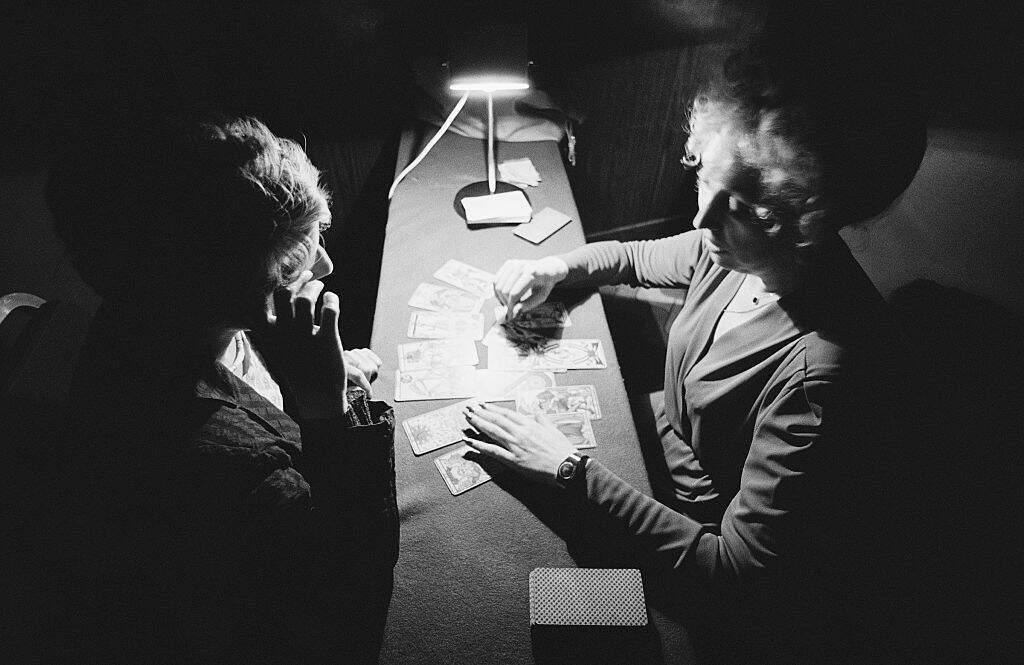
This past summer, I wound up in a Tarot reader’s tent at a seaside town fair. She asked me to shuffle her deck, and then she spread the cards out in a semi-circle. I closed my eyes and, as instructed, let my hands float, landing on the cards that beckoned to me. I was drawn to this, my first professional Tarot reading because my life felt topsy-turvy. My mother had just received a hard health diagnosis and President Trump 2.0’s America meant non-stop political crises. I was well into middle age and looking for a distraction.
The reader asked me what I wanted to know. So I queried the cards: “When will I — we — know stability again?” Together, the young woman and I pulled the Seven of Pentacles card. The reader told me it signified the value of my dependence on community, among other augurs. We pulled other cards, too.
After our reading, I went on a Tarot tear, meeting with five different readers over the course of a few weeks.
I see Tarot, much like New Year’s resolutions, as part of something I call "wish culture.” What I mean by that phrase is how we express a desire out loud for things to happen or to change, and, as a result, it becomes possible for the first time. “Wish culture” includes wishing wells, runes and spells, for sure, but for me it also pertains to idealistic political tendencies — the seemingly quixotic mayoral campaign of Zohran Mamdani and unexpected hyperlocal efforts like the Chicago cyclists who protected tamale vendors from ICE by buying out their stock each morning (thus sending them home early).
Wish culture or no, Tarot has not been of interest to me until now. I’m far from spiritual; If I believe in anything, it’s the Criterion Collection.
But this year, reality itself felt broken. For months, I had been at hospital appointments with my mom, and any time I turned toward the headlines — which I couldn’t avoid because I run a media nonprofit — I was consternated anew. I needed to be lifted out of this quagmire.
I’m far from spiritual; If I believe in anything, it’s the Criterion Collection.
Tarot was one of many coping mechanisms I turned to as a harmless distraction that also offered the promise of occasional wisdom.
The pain and desperation I felt is part of why I think Tarot, spells, energy work and even vision boards have become particularly seductive at this point in history. According to a 2025 Pew survey, 30% of U.S. adults say they consult astrology or a horoscope, Tarot cards or a fortune teller at least once a year. In the U.S., searches for the phrase “Tarot cards” increased by more than 30% during the pandemic. This could just be a result of hours spent indoors or within dull pandemic pods. On a deeper level, though, I see the increased interest in Tarot as reflective of us trying to handle a new level of personal danger — danger posed by a global pandemic, by National Guard troops descending on our cities. We seek predictive readings as a way out of our sense of uncertainty.
The rise of Tarot also seems directly linked to the sense many of us have that we have less control over our own lives than we used to. Suzanne Schneider, a historian at the Brooklyn Institute, who studies economic risk and its relationship to the occult, says that it’s no surprise that today’s “vast inequality and the growth of authoritarianism, has bred a resurgence of astrology and Tarot as cultural practices.”
In my Tarot phase, I was definitely seeking a sense of active and even pleasurable engagement with a new degree of uncertainty. Along the way, I received a reading from, among others, Daniel Felsenfeld, who pulled cards for me from the Crowley Thoth Tarot over coffee in his kitchen.
Another reader, Mikaela Renquist, a friend of a friend who is a climate policy analyst by day, greeted me with a round “Mother” deck and did my reading outside on the day of the autumn equinox, with bees circling us.
Selah Saterstrom, a professional Tarot reader and former academic administrator, whom I was referred to by my poet friends, read my cards virtually and asynchronously. Her sonorous voice emanated from my computer, a surprisingly affecting recording of a Tarot reading that was 1 hour and 20 minutes long. I listened to it in the dark in my bedroom. Tears welled in the corners of my eyes, without my understanding why. “Will I be able to find modes of survival and recovery?” I had asked. She repeated my question in her Southern twang. “Yes, you will. Spirit is now talking about the most important word in our vocabulary: The word ‘anyway.’”
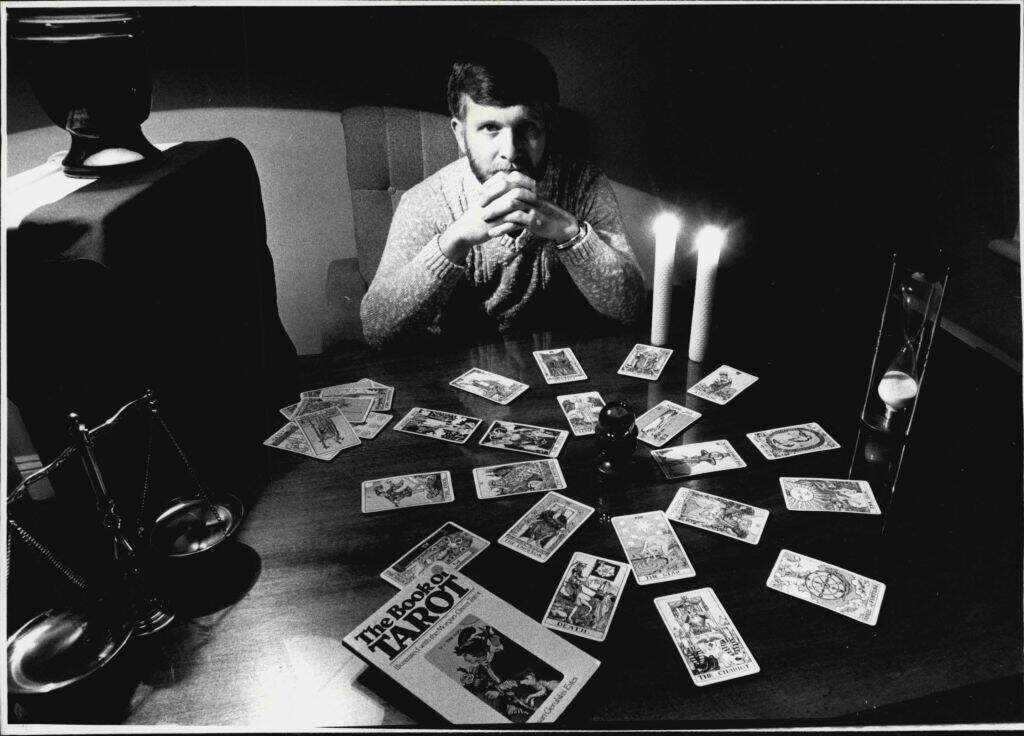
I think these readings made me feel better because these friends and strangers focused on my queries, as if they were a work of art or a puzzle. Together, we created a story about my present and future. That story was as much a product of happenstance as it was of my own efforts to perform well and mold reality to my will. It gave me a sense of relief. I was able to talk about my constant sense of uncertainty as well as my pre-grief for my mom without using the too-familiar tropes of talk therapy.
Of course, I’m not the first person to find comfort in the cards. Tarot has provided this kind of relief for generations. It was popularized in late 18th-century France. Today, there's Tarot TikTok and Instagram, including the profane topless Tarot and the liberatory Queer Tarot. And there are many niche decks for sale from your average, un-witchy e-tailer.
On a more high-brow track, the Warburg Institute, a museum and library in London, mounted a sizable exhibit of a collection of Tarot cards across the centuries called “Tarot — Origins & Afterlives” in 2025. And New York University hosted a sold-out Occult Humanities Conference. As Tarot reader and poet Timothy Liu has explained, “In the post-truth world, anything could be completely fake or false, so why not turn to an occult system?”
Of course, I know that any lasting sense of progress or comfort will require far more than an occult-curious pastime.
Still, I’ll keep asking professionals and amateurs to pull the cards for me, keeping in mind Tarot reader and writer Cat Tyc’s warning that the cards get tired if you repeat the same questions too often.
That’s okay. Just one more strong query of the cards — a wish said out loud — may be what I need to start the new year.