Support WBUR
Opinion
Echoes of the 1850s in Minnesota
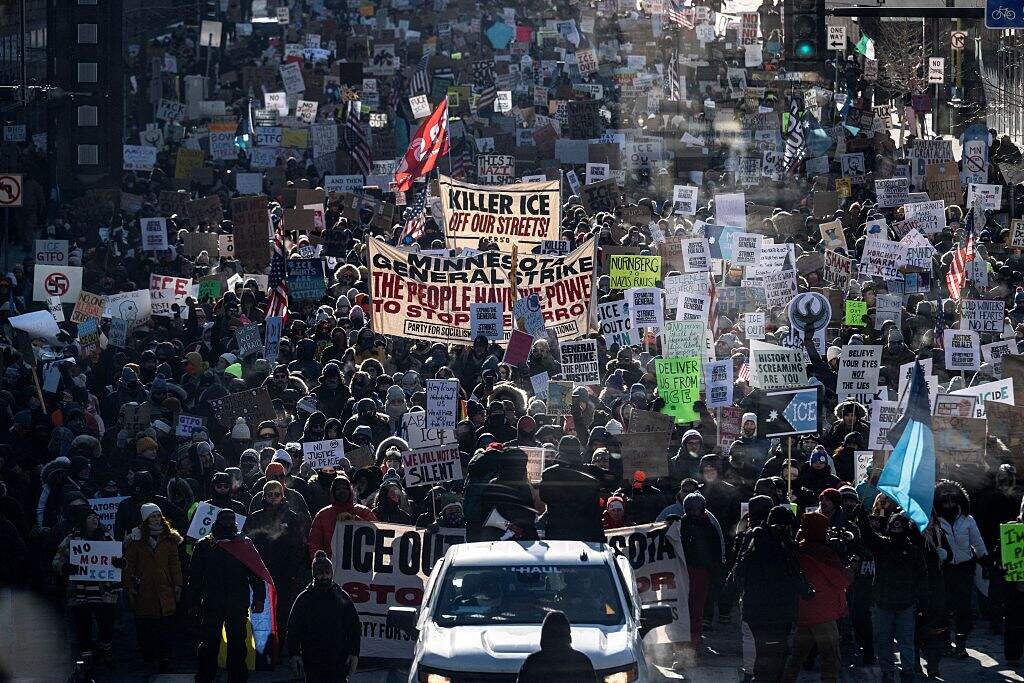
My former colleague at the National Parks of Boston liked to paraphrase Mark Twain: “History doesn’t repeat itself, but it sure does rhyme.” The ongoing conflict between the Trump administration (specifically U.S. Immigration and Customs Enforcement and U.S. Border Patrol) and protestors in Minnesota, very much rhymes with a similarly charged conflict in the 1850s.
The federal presence in Minnesota is part of the administration’s immigration enforcement surge. In it, I see similarities to the Fugitive Slave Act, legislation passed into law in 1850, which empowered U.S. Marshals, bounty hunters, slave catchers — even ordinary citizens — to detain formerly enslaved people, or anyone suspected of being a fugitive slave, and send them back to bondage without due process. Anyone who refused to assist or stood in the way of an arrest could be fined up to $1,000 and receive a six-month imprisonment. The law incentivized judges to return freedom seekers to slavery: for each person arrested, determined to be a fugitive and re-enslaved, judges were paid $10; for each person who was not determined a fugitive, and allowed to remain free, they were paid $5.
The Fugitive Slave Act and the Trump administration’s immigration policies are different of course, but the outcomes of these federal actions – in terms of the pushback and protest they inspired in the American people — are remarkably similar.
The federal government is now detaining thousands of people suspected of being undocumented immigrants without due process by relying on a 1798 law, Alien Enemies Act. There has been substantial public protest. In Minnesota, federal law enforcement agents have shot three people who protested federal invention, killing two. And, like in the 1850s, when the Boston Vigilance Committee organized against the slave interests, Minnesotans have organized to resist state-sponsored violence inflicted on legal residents and peaceful protestors, and to remind residents of their constitutional rights.
The 19th-century case of Anthony Burns is illustrative. As a ranger at Boston African American National Historic Site, my fellow rangers and I often share the stories of Anthony Burns (and other freedom seekers) with visitors.
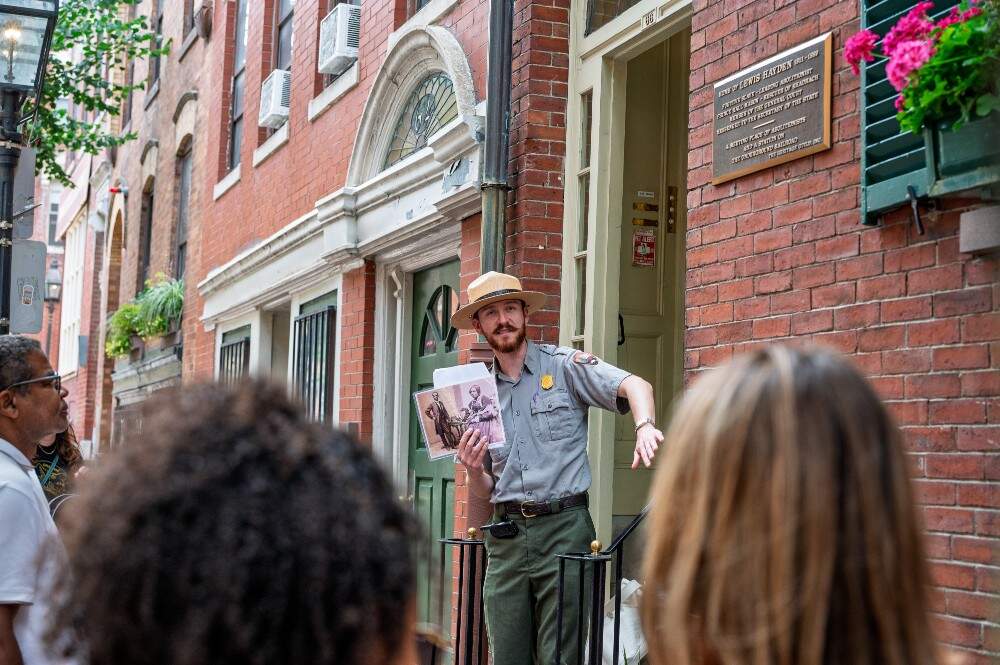
Burns was 20 years old when he escaped slavery in Virginia in February 1854. He was inspired by folks like Ellen and William Craft, Shadrach Minkins, and Thomas Sims, who had escaped slavery and settled in the free North.
He stowed away on a ship headed north and disembarked at the Port of Boston. He knew the risks. Not only did he witness and experience the atrocities of slavery firsthand, but through elaborate systems of communication and transportation like the Underground Railroad, he likely knew about fellow freedom seekers who attempted to escape slavery and were apprehended.
Less than a year after reaching freedom in Boston, Burns was arrested. He had sent a letter to his enslaved brother in Virginia and its contents revealed his location. Burns’s former enslaver, Charles Suttle, intercepted the letter and received a warrant for Burns's arrest under the Fugitive Slave Act. On May 24, 1854, a U.S. Marshal identified and arrested Burns. Abolitionist Bostonians quickly rallied to support Burns. After years of combating federal power to protect the Crafts, Minkins, Sims and other freedom seekers, abolitionists increasingly turned to militant tactics and the Anthony Burns affair became a flashpoint in the years leading up to the American Civil War.
After Burns’ arrest, the Boston Vigilance Committee attempted a violent rescue, which they had done successfully before. But, this time, the authorities were waiting for them. The Vigilance Committee battered down the door where Burns was being held. A fight broke out, a shot was fired, and a guard was killed. In response, President Franklin Pierce deployed U.S. Marines to ensure Burns would remain in custody until he was sentenced to return to slavery. “Incur any expense,” Pierce wired the U.S. Attorney in Boston, “to insure the execution of the law.”
Hundreds of marines, marshals, militiamen and police officers escorted Burns from the courthouse to the transport vessel. And tens of thousands of people lined the streets in protest. They hissed at the officers, hung black mourning crepe from storefront windows, and even suspended a coffin between two buildings upon which the words “death of liberty” were emblazoned.
The violence and financial toll (multiple millions of dollars in today’s dollars) of sending Burns, one 20-year-old man, back into slavery was enough to radicalize many centrists and conservatives. As businessman Amos A. Lawrence declared, “We went to bed one night old-fashioned, conservative, compromise Union Whigs & waked up stark mad Abolitionists.”
Episodes like this, in which the federal government used tremendous resources to protect the institution of slavery, ran afoul of public opinion and accelerated polarization and factionalization as the nation spiraled toward a civil war. Sound familiar?
It’s not an apples-to-apples comparison, but the parallels are striking. Several episodes have kindled the public resistance in Minnesota: Department of Homeland Security officers have infiltrated communities and allegedly detained U.S. citizens; the federal government has authorized agents to forcibly enter peoples’ homes without a judicial warrant; and ICE has taken young children into custody as they arrive home from school.
When ICE agents shot Renee Macklin Good, Julio Cesar Sosa-Celis, and Alex Pretti, killing Good and Pretti, I couldn’t help but think of the Fugitive Slave Law and the Anthony Burns affair. The Trump administration continues to support an agenda that is out of step with public opinion. And now, the unrest in Minnesota is intensifying: a man attacked Minnesota Congresswoman Ilhan Omar at a Minneapolis town hall; bystander videos, eyewitness testimonies and a preliminary government review have contradicted White House accounts of Pretti’s death; and President Trump, who is moving to “de-escalate” the situation in Minnesota, and distance himself from his own administration’s response, initially blamed Pretti and Good for their own deaths.
But in a move reminiscent of Boston’s support for Burns in 1854, Minnesota residents have coalesced around the murders of Good and Pretti. Volunteers patrol neighborhoods, Minnesotans crowdfund donations to help people affected by DHS pay their legal bills, and local aid groups offer food assistance to impacted communities.
When my fellow rangers and I recount to visitors the story of the Anthony Burns, on several recent occasions, visitors have said things like “This sounds exactly like ICE.” They made the connections between the past and present on their own.
The government’s show of power to enforce contentious laws and policies in the 1850s and today reminds us that the struggle over justice and civil rights continues to resound across generations. Indeed, the rhymes of history are clearly audible. They remind us that unresolved injustices have a way of reverberating through time. I hope our leaders begin to hear them, too.