Support WBUR
Essay
Bad Bunny's gift of multiplicity
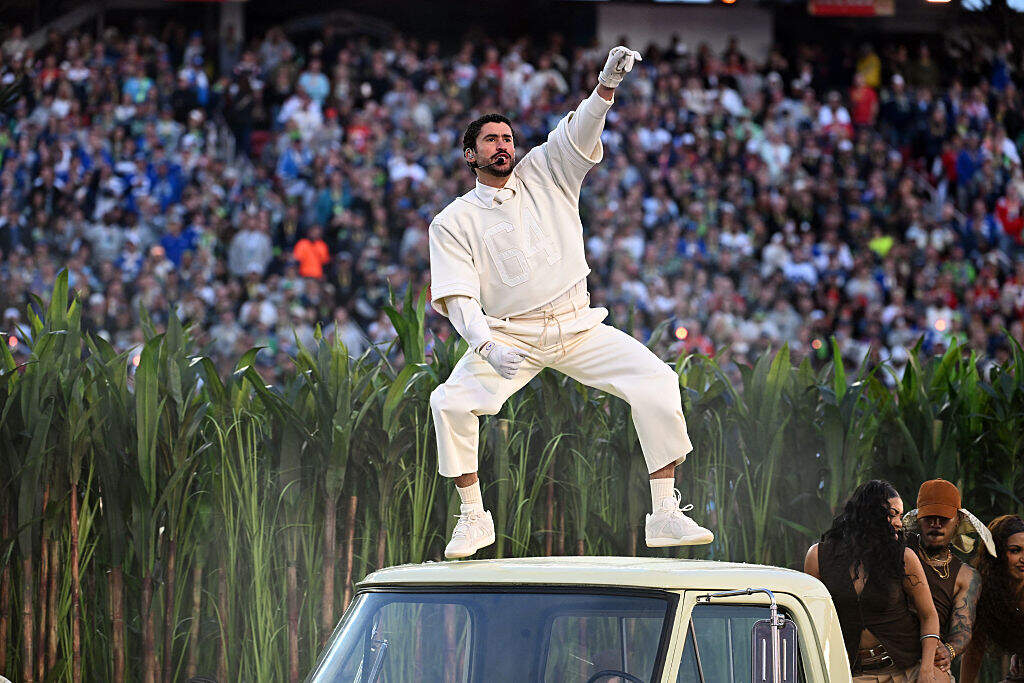
During Bad Bunny’s Super Bowl halftime show, I wasn’t only a viewer. For 13 minutes, I was a little girl running through cornfields, stumbling on hidden treasures: a taco stand lit at midnight, a child asleep in two pushed-together chairs at the end of a wedding that had stretched deep into the night.
As a Latina, it felt rare to see not just one of us, but our culture, take up space in one of the most emblematic American rituals — and rarer still in the current political climate.
Bad Bunny’s selection as the Super Bowl halftime performer ignited a firestorm over who belongs on that stage.
As the world's most-streamed artist last year, selecting Benito Antonio Martínez Ocasio was, at minimum, a savvy business decision by the NFL. His popularity could draw in a young, increasingly Latino fan base domestically and help to expand it abroad. The decision also said something about this moment, and how this country is changing.
Bad Bunny’s detractors didn’t like that he showed up as unapologetically Puerto Rican — singing in Spanish, standing up for immigrants, speaking out against ICE. His performance has been treated by some as defiance of Americanness: as if Puerto Rico were not part of the United States, as if this country were not the world’s second-largest Spanish-speaking nation (behind my native Mexico), as if expressing political views is not deeply American.
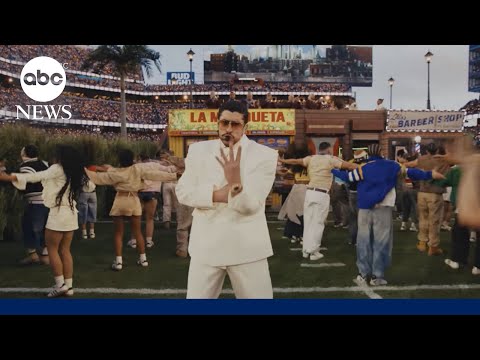
Regardless of one’s feelings about Bad Bunny, we know the backlash isn’t really about the Super Bowl halftime show. The real political battleground is the idea of belonging — who gets to claim it and on what terms.
Of course, xenophobia and racism are part of this. But what’s at stake is larger than immigration policy. As a still-new immigrant, I’ve become acutely aware that the pressure isn’t only to exclude some of us, but to narrow the range of what anyone is allowed to be. Who gets to speak and how, who we’re supposed to love, and what we’re allowed to believe.
Bad Bunny is many things. He wears painted nails and a pink dress on one red carpet, then a tailored suit on another. He moves between playfulness, tenderness and protest. He sings about longing and then wrestles in WWE. His latest album is a sophisticated meditation on colonization, but he also makes fun of himself in skits on SNL. Louder than any lyric is the fact that he seems completely uninterested in hiding the parts of himself that don’t fit neatly. And that refusal gives immigrants — and everybody else — permission to bring our full selves.
https://www.youtube.com/watch?v=jn9AFMKlGLA
Multiplicity isn’t only something that exists outside of us, through diversity or representation, nor is it limited to immigrants. It lives within all of us. All human beings are many things at once. We carry identities and feelings that can seem contradictory: anger and gratitude, grief and joy, belonging and distance.
What some are rejecting now is the permission to exist fully, even for those with the largest platforms. At the Grammys, artists are allowed to entertain, but speaking out is treated as overreach. At the Winter Olympics, athletes can carry the flag but not demand what it promises. The message is clear: our duty is to perform freedom, but we are not meant to live it.
The thing about democracy is that it depends on our ability to embrace the multitudes we contain, not to trim them.
Bad Bunny showed up with community, color, dance, music and chaos. That’s why, when he ended his performance by saying seguimos aquí (“we’re still here”), it felt like an insistence on showing up as our full selves, without leaving anything or anyone behind.
As immigrants, we are often asked to be one thing, to flatten ourselves, to tell a cleaner story. I adjust my voice now depending on who I’m speaking to, or what version of myself fits best in the room. And still, it feels like it isn’t enough — my Spanish no longer sounds quite Mexican enough for Mexico, and my English will never fully sound “American” enough in this country. Being whole shouldn’t require choosing. It’s possible to hold a contradiction without it turning into rejection or restlessness. To learn to love my ever-changing accent. To feel settled, not because everything aligns neatly, but because nothing has to be cut away.
Being many things at once isn’t always as romantic as it sounds. For me, it means tripping over my words, writing this essay in English and dreaming in Spanish. It’s being grateful to be in this country while demanding and believing it should be better. It’s missing home and choosing to stay. It’s hearing that I don’t quite fit in here or there — and wondering whether I’ll ever belong anywhere.
It can feel disorienting and sometimes heartbreaking. But there is something beautiful about refusing to allow parts of us to disappear. Bad Bunny reminded me that those feelings can coexist. And that sometimes the only way to stay here—to stay whole — is to dance.