Support WBUR
Essay
My dog Belle is at the end of her life, and I am walking her home
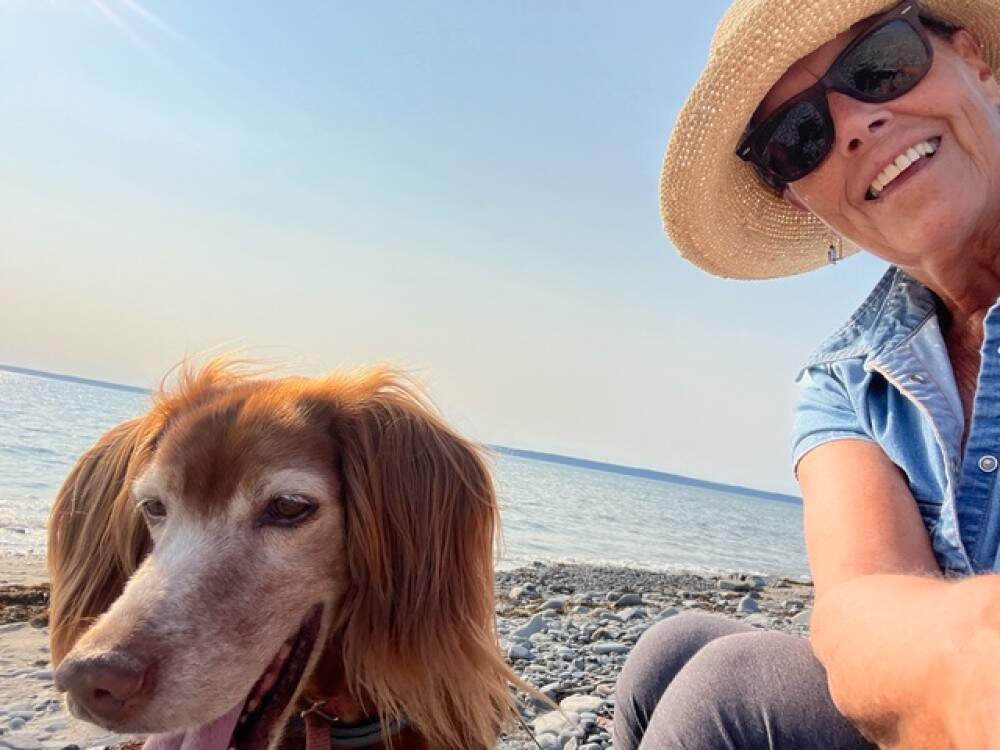
For months, my bed upstairs remained undisturbed. There was no need for changing the bed linens because my nightly ritual of slipping between the sheets had been replaced by curling up on a spot on the living room sectional under a down throw, next to my dying dog, Belle.
Belle has always been a quiet, stealthy dog. She inhabits her quietude, often undetected as she moves from the couch to the chair or the chair to the kitchen. She doesn’t even bark to go outside; she stands and stares at you until you take notice of her. But what had initially been diagnosed as allergies, marked by sniffles and occasional throat-clearing, gradually had creeped into congestive heart failure due to a congenital heart murmur. Her sputtering cough became more pronounced, as did the diagnosis from the doctor. Her murmur had worsened. The end was coming. “We’re talking months,” he said, his hand on Belle’s head.
The vet loves Belle, a Field Irish Setter — a breed he’d had as a child and one I knew nothing about until she arrived in my life as a red-coated rescue during Covid. She wasn’t my first dog; I had had three adult rescues and one puppy, bought from a Brittany Spaniel breeder, before her. But she would be my last, as I was of a sufficient age that math meant any other adopted dog would likely outlast me. At nearly 13, Belle is smaller and sleeker than the more common Irish Setter. “She really is in good health,” the vet remarked that day. “Her coat is good, her weight is good, her teeth are good. She just has a bad ticker.”

Belle’s route to my heart was circuitous. After nearly seven years of living in Ireland, I had returned to Boston with 12 hours notice in March of 2020, as Covid was closing down the world. I wasn’t thinking of adopting a dog, but through a confluence of circumstances, she needed a home, and I needed a grounding here, and also, perhaps weirdly, a connection back to Ireland.
A man from Alabama had bought Belle at age three for $2,500 and had bred her until she outlived her usefulness to him four years later. She was a favorite at the Alabama dog rescue where he left her, the one dog that was allowed to hang out in the office with the staff.
Belle has many fans that she has collected here with me, too, on our daily four-mile walks along Lynn Shore Drive. There is Grace, who always remarks that Belle’s friendly nuzzles have made her day. There is the Cambodian man who always bows to Belle, touching his head to hers and then says, “Thank you, thank you, thank you,” before we part ways. There is the group of four older men who walk together every day and wait expectantly to see which one Belle will greet first.
On one of those walks, I thought regretfully about how I had not trained Belle to be a therapy dog, but then I realized, she actually is one, for me. During those hard, weird, awful days of Covid, when I found myself otherwise alone, she was a constancy of love. She grounded my days in daily walks and morning coffees on the couch when her 32 pounds would stretch across my legs like a lapdog. As the world opened up again, Belle and I navigated it together.
Now, she seems to need me more, and my nights as well as my days are grounded next to her.
Now, she seems to need me more, and my nights as well as my days are grounded next to her. When her fluid-y, phlegmy coughing wakes her and me, a quiet hand on her head or behind her soft ears settles her. I find I slept better on the couch than in my bed, because I worry less about her. We are on our own, Belle and I, and I alone can offer her palliative care. So now, we have a new routine: I close the blinds of the living room each night, Belle takes one side of the L-shaped sectional and I take the other, and our heads meet in the corner.
When my mom began her age-related decline, she moved into an assisted living facility where an entire staff doted on her, so much so she said she felt like she was living at a resort. And when she was diagnosed with congestive heart failure, she had a medical team to devise a plan and prescribe her treatments. Later, as her decline accelerated and deepened, she had a corps of hospice nurses and caretakers, including a guitarist who played gentle, soothing music in her final days.
Belle has only me. I am the watchful eye, gauging whether her cough is worsening, if her food and water intake has changed, if she shows signs of confusion and dementia, if she sleeps longer and deeper or if her hind leg muscles are withering. And I know ultimately, at some point, it will be my decision, in consultation with her beloved vet, when it is time to make her most fateful appointment.
Before Belle grew sick, I’d tracked down her origin to a Field Irish Setter Hall of Fame breeder in a small outpost of North Carolina. The wife told me Belle’s mother, listed as Come Back Superfire on her UKC papers, was their all-time favorite dog in 50 years of breeding, but sadly she had died at 12. As strange as this may sound, my hope is that Belle gets to outlive her mom, and we get to celebrate her 13th birthday. I have decided, if she does, I will invite my kids, neighbors and friends and serve a dog-friendly birthday cake — a ricotta cake that I think she will like. It is the same cake I made for my oldest daughter on her first birthday.
It seems to me now that when death knocks, there is nothing to do but to open the door, let it in, maybe offer a cup of coffee or tea and patiently wait out the visit. I do not know how long this part of the journey will last. I only know that I will be snuggled next to my companion Belle, offering her my presence, my care, my love, until the end. I have come to see, on those daily walks, that it is as the psychologist and yogi Ram Dass used to say, “We’re all just walking each other home.”