Support WBUR
Essay
Learning to ice skate — at 67
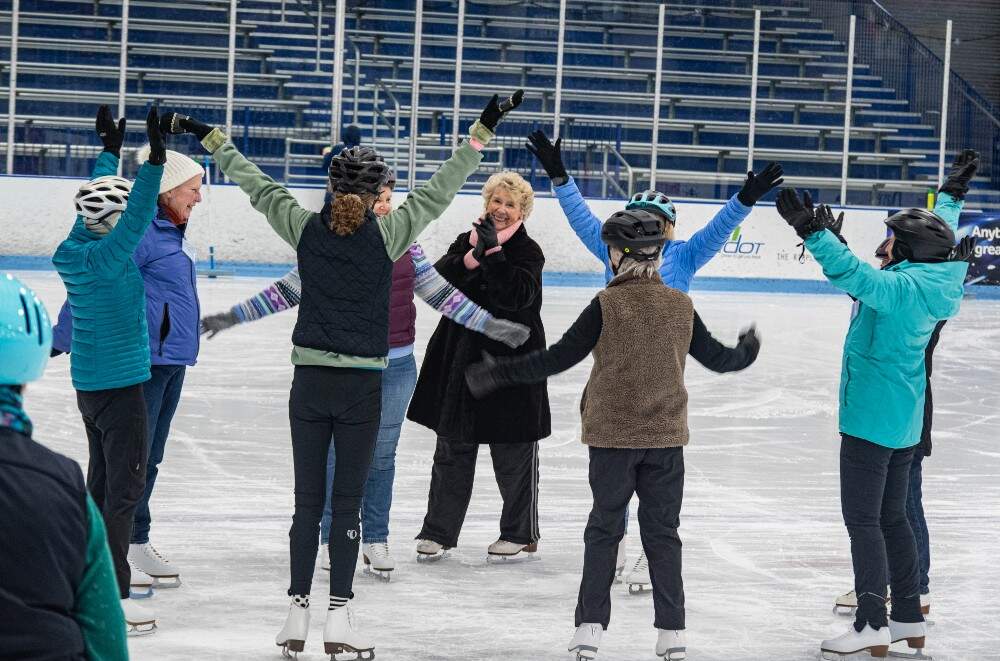
I wobbled, lurched and clung desperately to the waist-high wall that circled the ice rink. What was I thinking when I decided to start ice skating lessons at age 67?
Although I never took formal lessons as a child, I have loved to skate since I was 8 years old. Gliding around the ice, legs and arms pumping, I felt like I was flying. When I retired and saw an adult skating class advertised at the University of Rhode Island, I thought, why not? Although it had been 40 years since I’d skated, I figured “muscle memory” would kick in as soon as my blades hit the ice.
Doubled over the dasher boards, I realized I was wrong.
Suddenly, an elegant woman in her early 80s skated over to me. Short blond hair, blue eyes, black coat. An older version of Princess Diana. On skates.
“I’m Dottie Cunningham,” she said. The instructor. “Are you ready to have some fun?”
I wasn’t. I was ready to flee. Now, two years later, I’m glad I stayed. This has been a particularly tough winter, with its relentless cold, frozen snow mounds, and never-ending stream of bad news at home and abroad. I’m still not much of a skater, but Dottie has taught me some unexpected lessons about how to cultivate joy and resilience even when life seems bleak.
Before I could make for the exit on that very first day, she gave me a few tips.
“Hold onto the wall with one hand. Pick one foot up, then another.” She turned around and demonstrated. “Step, step, glide.”
Gulping hard, I mimicked her movements. Soon, I was stumbling around the perimeter of the rink. Not graceful, but upright.
“That’s it,” Dottie said, skating at my side. “Step, step, and remember to glide. Enjoy the ride.”
By the end of the class, I was smiling — and hooked. I felt like I was rediscovering a part of myself that had atrophied over the years.
When I was younger, I hurled myself through life. I quit jobs without having another lined up. I moved so often up and down the East Coast that one friend nicknamed me Anntrak. I made my life up as I went along.
With age came caution, and a focus on problems rather than possibilities. As a medical writer, I spent much of my career explaining what can go wrong as people grow older. When I retired, that focus turned inward. All too often, when meeting with friends, I caught myself participating in the type of conversation I once swore I would never have. We’d start with our “joint report” (status of wrists, hips and knees), followed by an “organ recital” (functioning of brain, bladder and heart). I didn’t want to dwell on what was falling apart. I wanted to focus on what I could build: balance, strength, and flexibility. Enter ice skating.
I invested in protective equipment: Helmet, wrist guards, elbow pads, knee pads — even a butt pad. This way if I fell, I would bounce across the rink like a beach ball.
The combination of padding and practice helped. Gradually, with Dottie’s encouragement, I weaned myself from the wall and learned some basic skating skills. But I had yet to master one of the most important — stroking.
Dottie coached me through the steps: Bend the knees with feet in a T position. Push off on the inside edge of the back skate and glide forward on the front skate. Keep the back leg elevated at the 4 or 8 o’clock position, depending on which foot is gliding forward.
It was that last part that stumped me. I would bend, push and drop my back foot too quickly.
“You know what the trick is?” Dottie asked one day. “Bend, push and glide. Then remember to enjoy the ride.” She demonstrated, smiling while keeping her back leg elevated.
You’d never guess Dottie is an octogenarian. The skating class is just one of several she teaches at URI’s Osher Lifelong Learning Institute. Founder of the Franklin Blades Skating School, she coaches skaters of all levels in Massachusetts and Rhode Island. A former grade school teacher, she continues to tutor students in math and English.
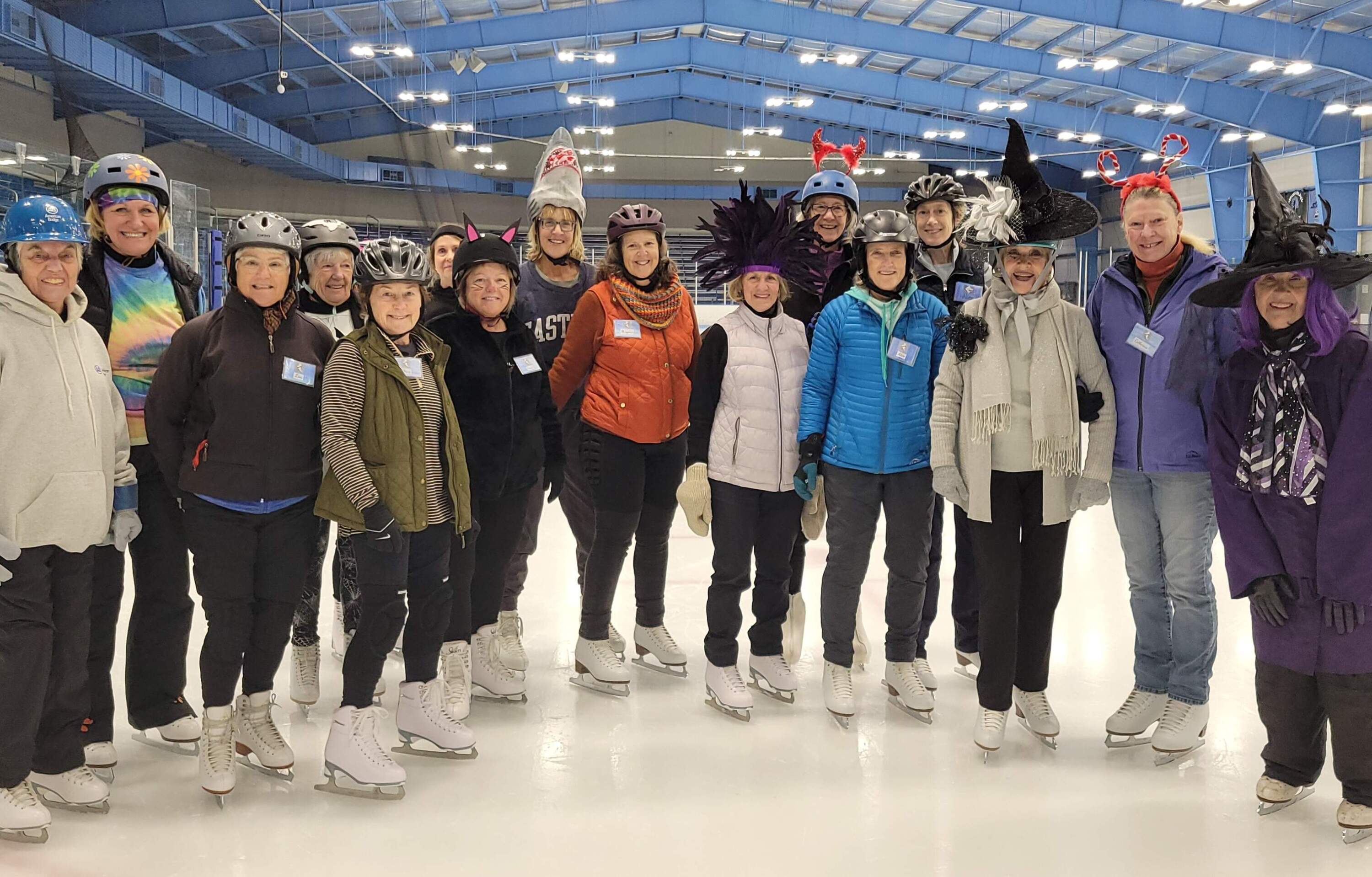
A born extrovert who enjoys spontaneity, she’s inspired me to change my introverted, overly scheduled ways. Why hurry home after class? I’d rather join Dottie and the other skaters for brunch. We’ve got class on Halloween? Let me find my red devil horns. A holiday potluck? Sign me up. If Dottie mentions an organ recital, you can be sure it involves music — and I’ll want to attend the performance.
Like all of us, Dottie has faced her share of challenges in life, yet she focuses on the positive. She epitomizes the type of resilience I hope to develop by building skills at the rink.
It’s already starting to happen. When I’m on the ice, I’m so focused on staying upright and learning how to execute new moves that I don’t ruminate over or get anxious about all that’s going wrong in my life or the world. And when I head outside after a skating session, I feel happier, even if my muscles are sore.
As a medical writer, I know that some of these effects are the result of regular physical activity. Research shows that exercise improves mood, helps reduce stress, and builds resilience. But a lot of it has to do with Dottie. Like all the best coaches, she’s taught me more than what I thought I was signing up for.
I may never be a great skater, but I’ve taken her words to heart. For as long as I’m able, I am going to enjoy the ride.